Animal feed production outlook

February 2026

Compound feed demand set to stay elevated

  • Compound feed demand is expected to stay elevated over the next 12 months, underpinned by tight forage stocks and broadly supportive livestock margins
  • Demand for cereals as animal feed is expected to remain robust throughout the 2025/26 marketing year
  • Soya cake and meal usage in animal feed is expected to remain stable; oilseed rape cake and meal is expected to rise given increased production across Europe from 2025 harvest, improving regional availability

Animal feed demand

The latest AHDB UK cereal supply and demand estimates  forecast total cereals (wheat, barley, maize and oats) used for animal feed in the 2025/26 marketing year to track sideways and remain strong.

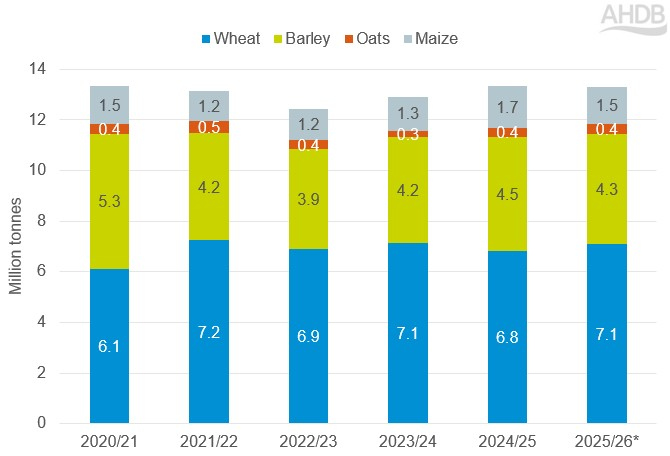
Total demand for cereals as animal feed is forecast at 13.3 million tonnes (Mt). As seen in Figure 1, the marginal year-on-year reductions in maize (-194 thousand tonnes (Kt)) and barley (-148 Kt) usage are compensated for with increases to wheat.

Wheat usage as animal feed is forecast to rise 0.3 Mt year-on-year to 7.1 Mt, based on current forecasts for 2025/26.

Figure 1. Cereals used for animal feed in the UK

Source: AHDB

* Forecast 29 January 2026

The stacked bar chart in Figure 1 shows trends in cereals used for animal feed in the UK from 2020 to 2026.

Livestock producers continue to compensate with additional cereals due to depleted forage reserves following last year’s challenging grass‑growing conditions.

Production of compound animal feed is currently firm and broadly stable, with the beef cattle and dairy sectors driving much of the volume. Only modest change is expected in the near term.

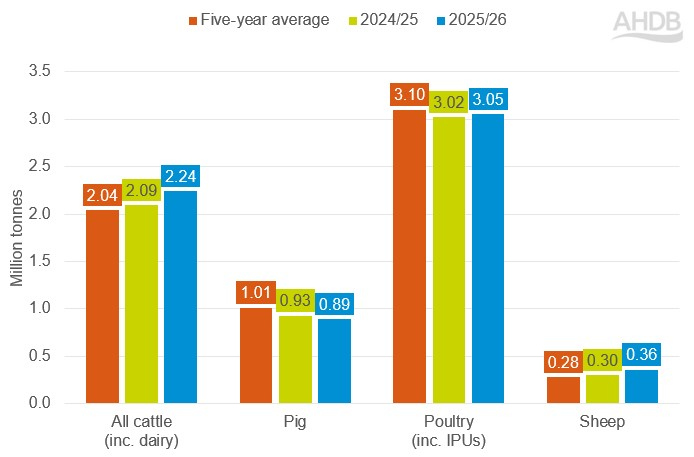
Total cattle feed demand has been growing in the first part of the current season (Jul–Dec), shown in Figure 2. The growth has been supported by cattle prices, previously good dairy margins and the need to compensate for tight forage as mentioned earlier.

However, usage is expected to ease back as cows are turned out to grass and milk prices soften. Cattle feed is projected to account for the largest share of any year‑on‑year increase, with growing and finishing compounds remaining a key growth area.

Sheep feed demand is likely to stabilise after recent growth, but at a higher baseline, though it is more seasonal and sensitive to grass growth and lambing patterns.

Fewer lambs are expected to be born this spring given the carry-over from 2025, with a longer-term gentle contraction in the UK ewe flock.

Figure 2. GB compound animal feed production (July – December)

Source: AHDB

The bar chart in Figure 2 shows 2024/25, 2025/26 and the five-year average of animal feed production for cattle (including dairy), pork, poultry and sheep.

There are tentative signs that the recent contractions in pig and poultry feed demand have reached their lowest point, with modest restocking in the poultry sector. However, for pig feed there could possibly be further pressure, given pig margins are expected to come under pressure from the EU market and African swine fever.

Further adding to uncertainties are the proposed legal phase‑out of conventional pig farrowing crates and enriched cages for laying hens, but the detail and timings are still going through the policy process.

Limited forage availability in some regions is expected to have knock‑on implications into winter at the end of 2026, particularly if spring grass growth underperforms.

This will likely keep many producers reliant on purchased feed to maintain performance, sustaining compound demand through the next 12 months.

Cereal inclusion

Cereal inclusion in rations is likely to remain firm over the outlook period, with cereals retaining a cost advantage over many protein and co‑product alternatives.

Depressed global grain prices and comfortable stock levels are expected to keep grain relatively attractive in least‑cost formulations.

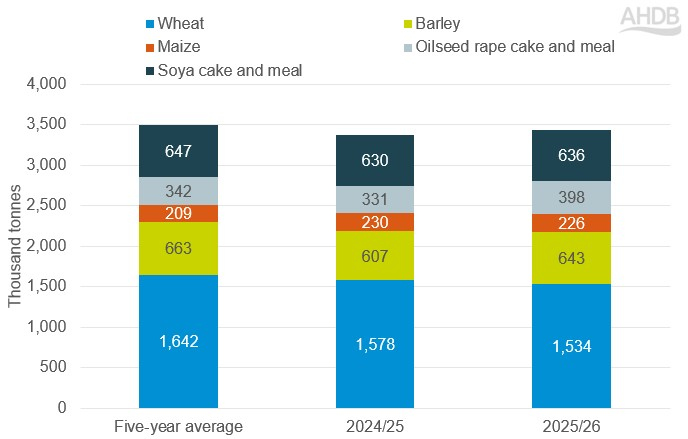
Figure 3. Key raw materials used for GB animal feed production (July – December)

Image of staff member Anthony Speight

Anthony Speight

Senior Analyst (Cereals & Oilseeds)

See full bio

Source: AHDB

The stacked bar chart in Figure 3 shows 2024/25, 2025/26 and the five-year average of raw materials for animal feed production: wheat, barley, maize, oilseed rape and soya.

Within the cereals complex, maize and barley are set to continue displacing a small part of the wheat share where logistics and availability allow (see Figure 3). Barley featured heavily in rations during the first half of the season, but usage is now reducing due to the narrower price discount to wheat.

Oat usage is anticipated to remain broadly steady, filling niche roles in specific rations rather than driving overall inclusion changes. Where quality issues arise in the malting or milling sectors, additional barley and wheat volumes may be redirected into feed channels, further underpinning cereal availability.

Assuming no major weather‑related supply shocks, overall cereal inclusion rates are expected to hold at, or be slightly above, last season’s levels.

Nutritionists are prioritising energy from grains to complement constrained forage supplies.

Oilseeds and protein meals

With the recovery of European rapeseed production in 2025, it’s expected that use of rape meal and cake will increase in compound formulations given its nutritional benefits.

There is a shortfall in UK rapeseed production, which will be compensated for by rapeseed and rape cake imports, notably from Europe and Ukraine.

Soya meal is likely to retain a central role in many rations, supported by competitive pricing in global oilseed markets and sustained import flows.

Where sustainability or assurance requirements encourage reduced soya usage, nutritionists may look to sunflower and other alternative protein sources, subject to availability and price.

Sunflower meal availability is expected to be slightly reduced as a result of Ukraine’s poorer harvest in 2025, which could trigger short‑term price volatility. In this context, compounders may favour a flexible approach, switching between protein sources as their relative values move through the year.

Overall, protein inclusion strategies are expected to balance cost, supply security and sustainability commitments. Soya is positioned as the main swing factor in compound feed protein formulations.

Price direction

Feed grain prices are expected to remain under downward pressure in the near term, reflecting comfortable global balances and strong maize output in key exporting regions.

Any sustained rallies are more likely to be driven by weather scares or geopolitical developments than by underlying tightness in the fundamentals.

One global supply risk is that 80% of Brazilian maize for 2025/26 is only just being planted now. Furthermore, when US maize plantings start for 2026 harvest, we could see a risk premium start to build, up to July 2026.

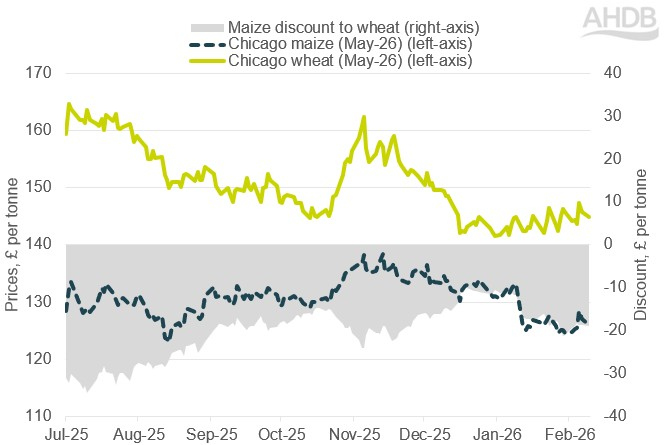
Figure 4. Chicago wheat and maize futures prices for May 2026

Source: CME Group, ECB

The line graph in Figure 4 shows changes in Chicago wheat and maize futures prices from July 2025 to February 2026. Green line = Chicago wheat, dashed line = Chicago maize, grey area = maize discount to wheat.

Maize is expected to continue trading at a price discount to feed wheat on most forward horizons, maintaining its attractiveness in feed rations where import logistics are favourable.

What is critical to note though is that wheat prices cannot have any sustained downward price shift unless maize reduces further. The notably narrowed discount for maize to wheat prices is shown in Figure 4.

Oilseed markets are forecast to remain more finely balanced, with rapeseed prices supported by constrained supply and competition from other vegetable oils.

Heavy soyabean crops in major producers, if realised, are likely to cap upside in soyameal prices, keeping them relatively competitive against rapeseed meal. The harvest of the Brazilian soyabean crop is underway, and yield estimates keep on growing.

For feed buyers, this backdrop points towards continued opportunities to take value from cereals, while exercising caution around protein cover where market sentiment can shift quickly.


Sign up to receive the latest information from AHDB

×