Beef market outlook

July 2025

Key points

  • Reductions in both prime cattle and cow slaughter have led to a forecast 4% fall in UK beef production in 2025 to total 896,000 tonnes, slightly below that of our previous production forecast in May
  • For the second half of 2025 we expect retail and foodservice beef prices to remain elevated, due in part to constrained domestic supply, leading to a 2% year-on-year decline in total beef volume sales
  • Import demand is likely to remain elevated (+6% vs 2024) for the remainder of the year, in order to support lower production levels. We expect that export volumes will be limited by the UK’s lower production and higher price point
  • Forecasted tighter supplies would point to support for farmgate prices for the remainder of the year; however, challenged consumer demand and potential for increased imports may weigh on price growth as the year progresses
Image of staff member Becky Smith

Becky Smith

Senior Analyst (Livestock)

See full bio

Overview

We have seen extraordinary beef prices in the first half of 2025, with the GB all-prime deadweight cattle price hitting a record high of 702p/kg in early May. A combination of constrained supply and sustained consumer demand contributed to this acceleration of the beef price, with production for the first half of the year back 4% versus 2024 at 445,000 tonnes.

Demand for beef appeared resilient during the first quarter of this year but eased back through the second as price increases fed through to consumers. We have seen increased imports for the year so far to fill production shortfalls, while high domestic cattle prices and limited supplies have contributed to constrained export volumes.

UK beef market balance (year to date) Jan–May

Source: AHDB, Defra, HMRC, Trade Data Monitor LLC

Trade data includes fresh, frozen and processed, in carcase weight equivalent
"Supplies" is calculated as production + imports - exports

For the full year of 2025 we forecast beef production down 4% year-on-year to total 896,000 tonnes. These drops will be felt particularly in the second half of the year as tighter cattle and cow numbers limit production volumes. Demand will be a key watchpoint for the rest of the year, as rising beef prices are likely to weigh on consumer demand across both retail and foodservice channels.

In terms of trade, we expect growth in import volumes to persist for the rest of the year, while exports are somewhat limited by our lower production. Tightness in supplies is likely to continue to underpin the beef price; however, rising imports and lower demand have the potential to put downwards pressure on price growth.

Supply

Prime cattle slaughter

In the first half (H1) of this year, 1.02 million head of prime cattle were slaughtered, 3% fewer than the same period of 2024. We have seen the greatest decline in steer slaughter, down 5% (27,000 head) in H1 of 2025 versus 2024, while both heifer and young bull kill fell by smaller magnitudes. However, the slaughter for H1 was higher than originally forecast at the start of the year, as high prices at the farmgate incentivised increased numbers. We also saw a revision to the Northern Ireland cattle population figure for December 2023, which will have increased available supply in the pipeline.

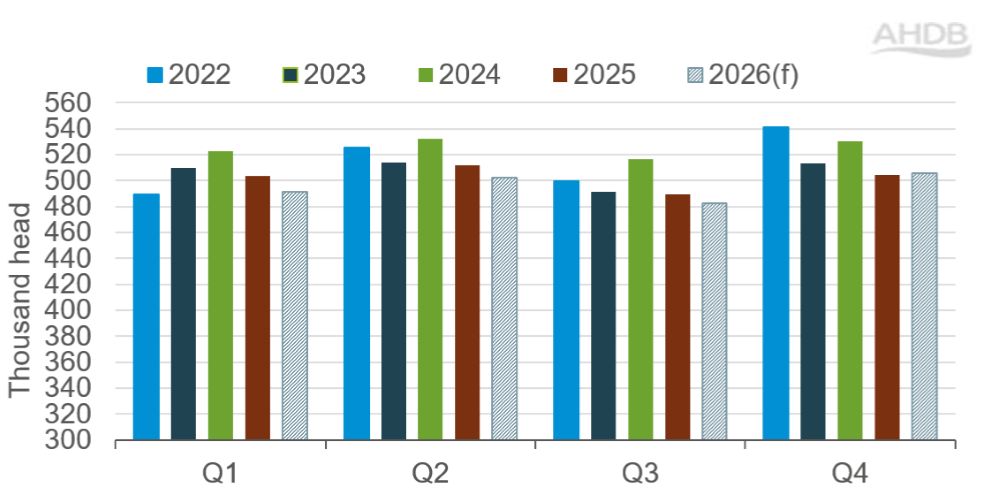
Accounting for the kill numbers for the year to date and considering cattle inventory data, we have revised our forecasts for 2025. We expect prime cattle slaughter will total 2.03 million head for the full year of 2025, a 4% reduction on 2024 levels. Compared to 2023, prime cattle slaughter is forecast to be relatively stable overall.

Actual and forecast (f) UK prime cattle slaughter

Source: Defra, AHDB. Forecasts in hashed bars

We expect that the greatest annual reductions will be seen in Q3 and Q4 of 2025, comparing to strong quarters in 2024. This considers the higher-than-forecast kill in the first part of the year, reducing cattle availability in the second half.

Several factors could influence this forecast. For example, volatility in farmgate beef prices could influence kill patterns and affect slaughter levels, as we have seen so far this year. More widely, policy drivers such as the changes to farm payments and to inheritance tax that impact farmer confidence may also elevate kill levels if producers choose to scale back or come out of production.

Alternatively, we could see greater female retention, in attempt to rebuild the herd and secure longer-term supplies, which would reduce slaughter numbers in the short term. The elevated prices of recent months may be acting as a signal to some for investment and herd expansion; however, mixed producer confidence surrounding the future of the industry is likely a key limiter. The latest calf registration figures from BCMS for the first half of 2025 shows growth in dairy-beef numbers and a slowing of the decline of suckler calf registrations. However, overall beef calf registrations remain in annual decline. Any expansion in the beef herd will take time to feedthrough into production data.

Cow slaughter

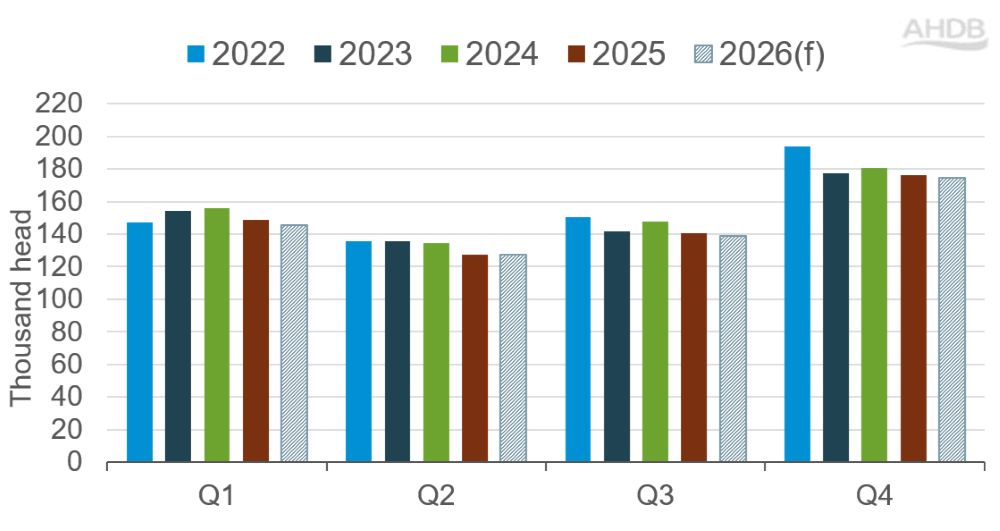
UK cow slaughter totalled 277,000 head for H1 2025, a 5% fall on the same period of the previous year.

Data from the British Cattle Movement Service has indicated that the fall in cow slaughter has been evident across both dairy and beef animals. However, lower slaughter of dairy cows has been the greater driver, with cow retention incentivised by consistent milk prices and reported challenges with sourcing replacement heifers from Europe.

The latest forecast for cow slaughter totals 595,000 head for the full year of 2025, a 5% drop on 2024. This has been adjusted down from our original estimates, based on the lower-than-expected levels of slaughter in the first half of the year and an expectation of higher retention rates.

Beef production

The above slaughter forecasts are expected to result in a 4% fall in UK beef production in 2025 to 896,000 tonnes. We expect carcase weights to remain broadly stable for the year as a whole, as an increasing proportion of native and dairy beef type animals in slaughter figures balance any incentives from lower feed costs and strong beef prices to maximise weights.

Actual and forecast (f) UK beef production, 2021–2025

Source: Defra, AHDB

Demand

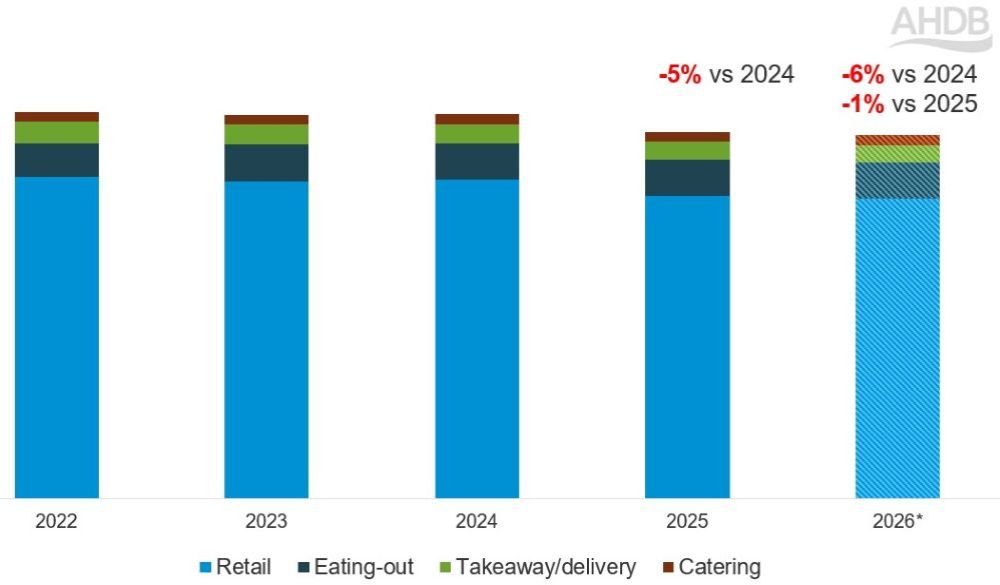
In 2024 total beef volumes were flat versus 2023. Growth for retail was balanced with a decline in both dining out and takeaway volumes (AHDB/Worldpanel by Numerator UK, 52 w/e 29 December 2024).

So far in 2025, total beef retail volumes have declined -2% year-on-year, driven by an increase of +8% in average prices (Worldpanel by Numerator UK, 24 w/e 15 June 2025). This drop in demand had been particularly evident in the past 12 weeks, where total beef retail volumes have declined -4% year-on-year as average prices increased +11% (Worldpanel by Numerator UK, 12 w/e 15 June 2025). Shoppers have responded to these higher prices by reducing the amount of beef purchased, buying beef less frequently or buying cheaper proteins such as chicken or pork instead of beef.

In the out-of-home market, demand for beef has been also been subdued, with beef volumes declining -5% year-on-year driven by declines in takeaways (AHDB estimates based on Worldpanel by Numerator UK OOH, 24 w/e 15 June 2025).

For the second half of 2025 we expect retail and food service beef prices to remain elevated as a result of constrained supply. This, together with wider economic uncertainty, is likely to impact shopper confidence in purchasing beef.

In our revised forecast for beef volumes in 2025, we expect a year of volume decline with total beef volumes for 2025 forecast to be -2% versus 2024.

For more data and latest trends for total beef and cut specifics, see our retail and foodservice dashboards.

Beef volumes by channel

Image of staff member Emma Wantling

Emma Wantling

Retail and Consumer Insight Manager

See full bio

In retail, shoppers are likely to gravitate towards more affordable and versatile beef cuts (e.g. mince) or switch out of beef to cheaper proteins such as pork and chicken. Higher levels of sunshine this year may encourage purchase of BBQ cuts such as beef burgers through the summer months, while Christmas will remain a key event for beef roasting joints. Promotional effort that is landed is likely to focus on offerings such as dine-in deals, aiming to encourage in home consumption rather than out-of-home dining, so consumers can benefit from added value and ready meal offerings.

Explore the full analysis and insights into the impact of rising beef prices within retail in our recent article.

In the out-of-home market, consumers are likely to focus on cheaper channels such as bakery, salad and sandwich outlets or cheaper dishes such as beef pasties for everyday consumption. Full-service restaurants are likely to benefit from consumers who are looking for a premium or treat-led occasion, although they may potentially move away from more expensive menu dishes such as steaks into cheaper dishes such as burgers. Higher beef prices could impact the availability of beef dishes on menus, leading to fewer beef options for consumers. Continuing to bring innovative offerings and new flavours to menus will remain important to encourage spend and build beef perception around taste and enjoyment. A lower number of sporting events in the summer of 2025 may further impact out-of-home volumes for beef, so promotions and loyalty offerings will be key to maintain engagement through the summer months.

Explore the full analysis and insights into the impact of rising beef prices within the out-of-home market in our recent article. 

How might the outlook for beef demand be improved?

The beef outlook might be boosted further if the industry:

  • Encourages tasty and versatile beef dishes which play on value for money by utilising cheaper cuts such as mince. Inspire meals that are family friendly, filling and reduce waste with batch cooking
  • Focuses on capturing up-trading to more premium offerings through inspirational dinners such as restaurant-quality dine-in deals
  • Addresses health concerns by communicating the health benefits of beef, such as B12, iron and protein
  • Encourages consumers with the right messaging in-store, online, on packs and foodservice
  • In the longer term, looks to maintain and build consumer trust, demonstrating where farming values (animal welfare, environmental stewardship and expertise) are shared with consumers. See our consumer reputation landscape hub for more information

AHDB has a range of marketing activities planned for the year, including the new Let’s Eat Balanced campaign. Please visit our marketing pages for more information. For more insight around consumer demand, visit our retail and consumer pages.

Trade

Imports

For 2025 to date (Jan–May), the UK has imported 127,500 tonnes of beef (total including fresh, frozen, processed and offal products). This is 1% higher than the same period of 2024; however, if we look more closely into the monthly splits, we have seen imports around 10% higher year-on-year for the last three months (Mar–May).

Ireland remains our major beef supplier, despite volume declines in the year to date and a smaller market share. This has been driven by a combination of lower Irish supplies and a narrowing of the price differential between GB and Irish beef.

As supplies imported from Ireland have fallen, we have seen increasing volumes from minority suppliers, filling this deficit and supporting lower UK production. Volumes have significantly increased from Brazil, Australia and New Zealand, although these markets combined still accounted for less than 10% of total import volumes. This trend of reduced volumes from Ireland but greater volumes from minority suppliers is expected to persist for the rest of the year.

We expect that imports will remain higher for the remainder of the year, supporting availability as domestic supplies are constrained. We forecast a 6% annual increase in import volumes for the full year of 2025.

Exports

UK beef exports for Jan–May of 2025 have totalled 51,300 tonnes, back 9% on the same period of 2024. The EU remains our majority market, taking 85% of all exports in the year to date, with Ireland, France and the Netherlands being key destinations. High domestic beef prices have somewhat curbed export volumes, hampering competitiveness on the global market.

Globally, beef supply remains tight, with competitively priced large producers such as Brazil and Australia being well placed to satisfy demand from key importers such as the US and China. Ongoing trade negotiations remain an important watchpoint for global trade flows of beef.

We have seen falls year-on-year in export volumes of fresh, frozen and offal products. There has been slight growth in processed beef exports; however, these make up the smallest proportion of volume.

We expect that strong UK prices, combined with lower domestic production volumes, will continue to limit exports for the remainder of the year. For the full year of 2025, we forecast export volumes down 7% versus 2024.

Cattle price outlook

We have seen prices hit record highs so far in 2025, with the combination of reduced supplies and strong demand for available cattle driving this trend. Sharp price growth, followed by significant falls, has led to unprecedented volatility in the domestic beef market.

Looking ahead to the rest of the year, cattle supplies are expected to remain tighter, which would point to underlying support for farmgate prices. However, future price inflation remains a threat to consumer confidence and subsequent purchase behaviour in the beef category.

We also expect that we will continue to see increased import volumes in 2025, in order to support lower domestic supplies. These impact of these increased imports on the domestic market will be an important dynamic to consider as the year progresses.

While AHDB seeks to ensure that the information contained on this webpage is accurate at the time of publication, no warranty is given in respect of the information and data provided. You are responsible for how you use the information. To the maximum extent permitted by law, AHDB accepts no liability for loss, damage or injury howsoever caused or suffered (including that caused by negligence) directly or indirectly in relation to the information or data provided in this publication.

All intellectual property rights in the information and data on this webpage belong to or are licensed by AHDB. You are authorised to use such information for your internal business purposes only and you must not provide this information to any other third parties, including further publication of the information, or for commercial gain in any way whatsoever without the prior written permission of AHDB for each third party disclosure, publication or commercial arrangement. For more information, please see our Terms of Use and Privacy Notice or contact the Director of Corporate Affairs at info@ahdb.org.uk  © Agriculture and Horticulture Development Board. All rights reserved. 

×