What impact have recent dry springs had on wheat? Analyst insight

Thursday, 22 May 2025

Market commentary

  • UK feed wheat futures closed (Nov-25) closed at £186.70/t yesterday, up £2.75/t from Tuesday’s close. The May-26 contract also rose by £3.05/t to close at £196.05/t on Wednesday
  • Domestic wheat prices followed the Paris wheat futures market, which was up 1.5% for the Dec-25 contract due to weather concerns for Russia, China and Northern Europe. Dec-25 Chicago wheat was up 0.9% from Tuesday’s close, driven by a weaker US dollar and short covering by speculative traders
  • Nov-25 Paris rapeseed futures ended yesterday’s session at €488.50, down €3.75/t from Tuesday
  • Meanwhile, Chicago soya beans were supported by Argentina crop concerns and the Nov-25 contract rose by 1.1%. Winnipeg canola for Nov-25 was up 0.7%
Image of staff member George Craddock

George Craddock

Analyst (Cereals & Oilseeds)

See full bio

Sign up to receive the Weekly Market Report and Grain Market Daily from AHDB.

Subscribe

What impact have recent dry springs had on wheat?

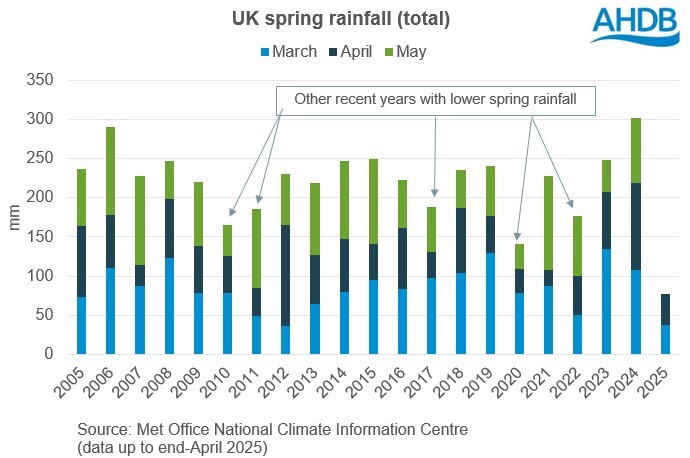
The very dry conditions this spring are a clear cause of concern for growers and industry. For the UK overall March and April 2025 had just 77.3 mm of rain, the lowest volume for those months since 1974 (Met Office), with some areas receiving far less. By 13 May, this UK total for spring had only increased to 80.6 mm. The forecast now shows some rain for the end of May, but it’s not clear where the spring total will end up.

Recent years with lower spring rainfall levels include 2022 (174 mm or 76% of the long-term average), 2017 (189 mm, 79%), 2011 (188 mm, 79%) and 2010 (72%).

Chart showing UK rainfall in March, April and June 2005 to date

While we wait to see what rain falls, is there anything can we take from recent dry springs about the potential impact on wheat yields or quality?

A drier spring in 2022 was followed by below usual rainfall in June, though with regular showers and above-average sunshine levels. Despite lower rainfall, prospects remained strong through to end-June. The proportion of winter wheat in a good/excellent condition remained over 80% from the end of March to the end of June. Hot, dry weather into July negatively impacted crop conditions, particularly in the east of the country, and reduced yields for crops on lighter land. But the strong start for winter crops helped give strong yield results overall.

Protein contents were below average as the dry conditions limited nitrogen uptake. For example, in AHDB’s Cereal Quality Survey UKFM group1 varieties averaged 12.6% compared to 13.0% on average in the preceding three years.

While 2020 was a ‘dry spring’ with 59% of long-term rainfall, this was a welcome respite after an exceptionally wet autumn and winter. The drier spring in 2020 stopped an already dire situation for winter crops from getting even worse and supported early spring crop development. Given this context, 2020 offers no insights for us in this comparison.

Winter crops had a good start and promising yield potential as spring 2017 got underway. After a prolonged dry period, timely rain in mid-May and June helped return an above average UK yield. While a relatively low proportion (24%) of UKFM Group 1 samples met a typical bread wheat specification (13% protein, 76 kg/hl and 250s), the main limiting factor was Hagberg Falling Number (HFN). 2017 saw lower HFNs due to wet weather at points during harvest.

After a dry March and April, rain returned for Scotland, Wales, northern and western parts of England in May 2011. However, large areas of southern and eastern England remained dry leading to notable concerns for crops in these areas with low tiller numbers and delayed nitrogen applications. Wetter conditions returned in June. This rain alongside cooler weather through June and into July helped to prolong the grain fill period and boost grain sizes, supporting both yields and quality.

Overall, the impacts of the dry spring in 2011 were less severe than expected. The UK average wheat yield in 2011 was 7.7 t/ha, compared to the 2006–2010 average of 7.8 t/ha, while quality improved year-on-year, including higher protein and specific weights.

Wheat yields averaged 7.7t/ha across the UK in 2010, slightly below the previous five-year average of 7.9t/ha. Low spring rainfall was accompanied by cooler temperatures, which slowed development. Rainfall was variable during the grain fill period, with wetter conditions to the north partially offsetting yield losses in the east. Protein contents were above average, with Group 1 samples at 12.9%, along with strong specific weights.

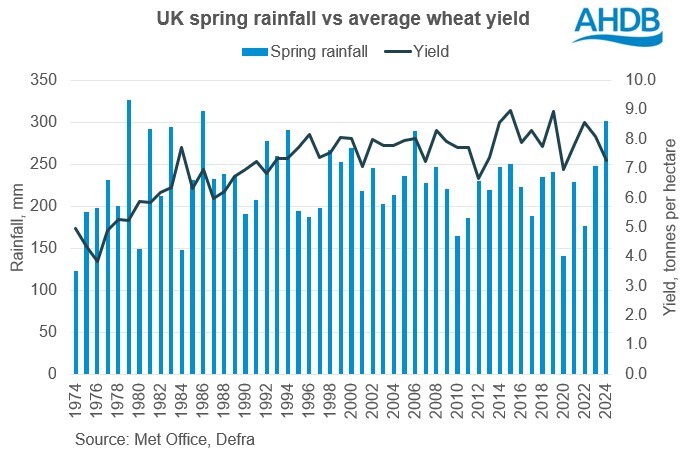
Looking further back, 1984 and 1980 also recorded low spring rainfall, with 147.8 mm and 149.4 mm falling respectively. In 1974 (mentioned earlier), spring rainfall totalled just 123.2 mm. However, when looking back to these periods, we need to remember that technology, farm practices and crop potential were quickly evolving supporting production.

A mild and moist autumn supported winter crop establishment. While spring 1984 was dry and cool and followed by a hot, dry summer, growing conditions were described as ‘particularly favourable’ for arable crops. Reported showers in May, especially for southern and eastern parts of England, and above average June sunshine hours are likely factors.

Strong yields were achieved along with above-average GB level specific weight. GB protein content on average was below-average, though overall quality was better than the previous year.  

Good autumn planting conditions were followed by a very wet winter, with above-average rainfall lasting into March 1980. Despite a dry spring, contemporary sources describe the growing and harvesting conditions that followed as ‘excellent’ in England with above-average rain through June. Sunshine levels were also above average in April and May.

While wet weather badly disrupted harvesting in Scotland, the GB average yield was a new record for the time at 5.9 t/ha, up 0.6 t/ha from the previous record (1978). GB average specific weight and protein content were both above the previous three-year average.

Despite the dry March and April in 1974 being followed by a drier than average May, there were regular showers. June rainfall was also closer to average, with above average sunshine levels. This was also in the midst of the second Agricultural Revolution, so farm practices and crop potential were quickly evolving. Great Britian saw a record wheat yield of 5.0 t/ha in 1974, beating the previous record of 4.7 t/ha from 1962.

Chart showing UK spring rainfall and final wheat yields 1974 - 2024

So what does this suggest?

There’s not a direct comparison we can point to and say this tells us the likely impact of the dry weather we’ve had this spring. Past years show how dry springs can reduce yield, and quality such as grain protein levels due to reduced nitrogen uptake

So, given that spring 2025 has been much drier than other recent dry springs, I can’t imagine that the weather will be without impact. We also started from a poorer position as winter crops didn’t have the best of starts last autumn.

But it’s not the end of the story, June rainfall and temperatures, as well as sunshine levels will be important. Spring 2025 so far (1 Mar–13 May) has been particularly sunny. April 2025 was the sunniest since UK records began in 1910.

With the crucial ‘grain fill’ period still ahead, rain in the coming weeks could still have big benefits. Though yellow rust is more prevalent, the dryness has also reduced disease pressure overall, which is a positive for crop potential.

At a total UK level, recent years suggest that 2025 prospects hinge on what happens now, i.e. how much rain we might get as crops go through grain fill and how well they can access that moisture. But a dry or overly wet and dull June could be very negative for crops.

Our next crop development report is planned for 30 May, which will give more information on what impact the dry conditions have had on crops.

Useful AHDB links

Image of staff member Helen Plant

Helen Plant

Senior Analyst (Cereals & Oilseeds)

See full bio


Sign up to receive the latest information from AHDB.

While AHDB seeks to ensure that the information contained on this webpage is accurate at the time of publication, no warranty is given in respect of the information and data provided. You are responsible for how you use the information. To the maximum extent permitted by law, AHDB accepts no liability for loss, damage or injury howsoever caused or suffered (including that caused by negligence) directly or indirectly in relation to the information or data provided in this publication.

All intellectual property rights in the information and data on this webpage belong to or are licensed by AHDB. You are authorised to use such information for your internal business purposes only and you must not provide this information to any other third parties, including further publication of the information, or for commercial gain in any way whatsoever without the prior written permission of AHDB for each third party disclosure, publication or commercial arrangement. For more information, please see our Terms of Use and Privacy Notice or contact the Director of Corporate Affairs at info@ahdb.org.uk  © Agriculture and Horticulture Development Board. All rights reserved. 

×