March dairy forecast: GB milk production to stabilise

Thursday, 26 March 2026

GB milk production for the 2026/27 season is forecast to record a new high of 13.04 bn litres, 0.1% more than the current milk year according to the March forecast update.

GB milk volumes have registered record highs in 2025/26, an increase of nearly 5.2% (April to 14 March) compared with the previous milk year due to strong dairy economics.

After a record-breaking year, 2026/27 should see things slow down and we predict it will be a more stable year. However, we have to keep in mind that we are annualising against a year of record highs, meaning there will still be a lot of milk available.

The growth momentum is likely to continue in the first half of the milk year but will likely slowdown in the second half as we annualise against high levels to end the year mostly stable.

We have built the forecast based on normal market conditions. However, if the current war scenario continues to put pressure on input costs for an extended period, the situation could be different.

Despite price cuts since late autumn, milk volumes were higher as the milk-to-feed-price-ratio (MFPR) remained in the expansion zone, particularly once seasonality and milk composition were factored in.

There is too much milk, not only in the domestic market, but also globally. And in such a situation, controlling volumes is necessary to support the market.

Changes in milk prices and feeding practices

Even though some milk prices have been cut substantially, there have been recent announcements of stability and increases for April and May.

Moreover, those on retail-aligned liquid and organic contracts have mostly not felt the declines.

Also, for others, high constituent levels in the milk and bonus payments have compensated for some of the headline decline in milk prices.

Dry weather and lack of grass growth in 2025, meant farmers had to feed more concentrates, thereby boosting yields. A wet winter has helped reservoirs and ground to recover, and we have assumed more normal grass growth and forage availability this year.

Herd size

Cow numbers are declining, with the size of the GB milking herd in January 2025 1.3% lower than a year earlier. This is the lowest figure recorded in a decade.

The GB female herd total stood at 2.47 million head, a 1.6% decline year-on-year.

A fall was seen across all age groups with the exception of 4–6-year-olds. Youngstock levels continue the year-on-year decline.

However, herd size was a less important factor on last year’s strong milk volumes so yields will be the key factor to look at.

Costs and yields

High yield growth of 6% to 7% was seen in 2025/26 milk year, which compensated for falling cow numbers, a trend which is likely to continue into the next milk year. However, some slowdown in the yield growth is expected in the second half of the year.

In the 12 months to November 2025, the overall Agriculture Price Index for all agricultural inputs increased 2.4% year-on-year.

Though fertiliser inflation price was easing previously, in 2025 prices began to rise – caused by tight global supply and increased production costs.

The largest downward correction to the inflation rate was compound feedstuffs. In January 2025, compound feedstuffs moved below the average rate of inflation of all agricultural inputs and remained so for the rest of the year

War scenario

A key factor for 2026/27 will be the outbreak of war in the Middle East and to what extent and for how long this impacts input costs.

We have already seen fertiliser and fuel costs spiking, and this looks set to continue until global conditions improve. This has the potential to impact feed prices longer term, which we will monitor going forwards. 

War between Iran, the USA and Israel will be a caveat to our production forecast.

With the ongoing Iran war, trade has been disrupted across the Strait of Hormuz, which is leading to an increase in costs of fertiliser, energy, oil, plastics.

This will increase the cost of production and squeeze dairy farmer’s margins.

Global demand for dairy in the Middle East and neighbouring regions is also affected.

In the event of war lasting longer, milk prices could increase to support rising costs, and this could heighten milk supplies further moving into another record territory.

The forecast

There are uncertain times ahead for dairy markets with input costs rising quickly and spring flush approaching.

The recent upward momentum in commodity markets will decide farmgate price direction but is uncertain, and trade flows are being impacted by the outbreak of war.

For the forecast, we are assuming prices will remain under pressure due to the fundamentals of oversupply until well into the year, although we will see some easing from where we have been.

Our forecast is based on current market conditions and normal weather. However, further declines in milk prices, upwards pressure on input costs and extreme weather conditions could result in a lowering of output in the next milk season.

The momentum of higher production is likely to continue until at least the second half of the milk year.

Breeding decisions

Long-term breeding decisions would have been made when prices remained high. Beef prices are currently strong with deadweight cow prices sitting at 527p/kg this week (21-Mar), up 5% from a year ago and nearly 50% higher compared to five-year average.

With margins being squeezed amid increasing input costs, and depending on forage availability, there could be reassessment of herd size with more culling coming forward in the coming months.

During the last three months, dairy culls were up 8% year-on-year (7,300 head). Though throughputs are lower than expected, going forward it could accelerate based on market situation. On the other hand, heifer replacements are expensive and scarce, which may hold back culling decisions.

Weather will be crucial in influencing yield levels in the upcoming flush period. Any deviation from normal weather condition will affect grazing and forage availability later in the season.

Impact of disease

Animal diseases also remain a risk to our forecast.

Bluetongue virus (BTV) has spread across the country and with the midge season approaching, there could be further outbreaks.

It is continuing to circulate in Europe and might have a lasting impact on calving patterns.

Last year we saw record volumes of milk in Europe in the second half of the year following late spring calving due to BTV.

Oversupply and market volatility

After the first half of the milk year, we are likely to see lower production numbers following slow down in yield levels and there will be decline year-on-year.

However, we are annualising against a year of record volumes, which means too much milk in the supply chain. How demand copes with this oversupply in the domestic and global markets will influence price direction.

Dairy farmers should be prepared for a more uncertainty and highly volatile markets.

The Milk prices support hub has been launched, which provides practical tools, market insight and support to stay in control and plan for the future.

Reviewing costs, testing decisions around herd size, improving efficiency, planning cash flow and making the most of the milk contract will help farmers to navigate through turbulent times.

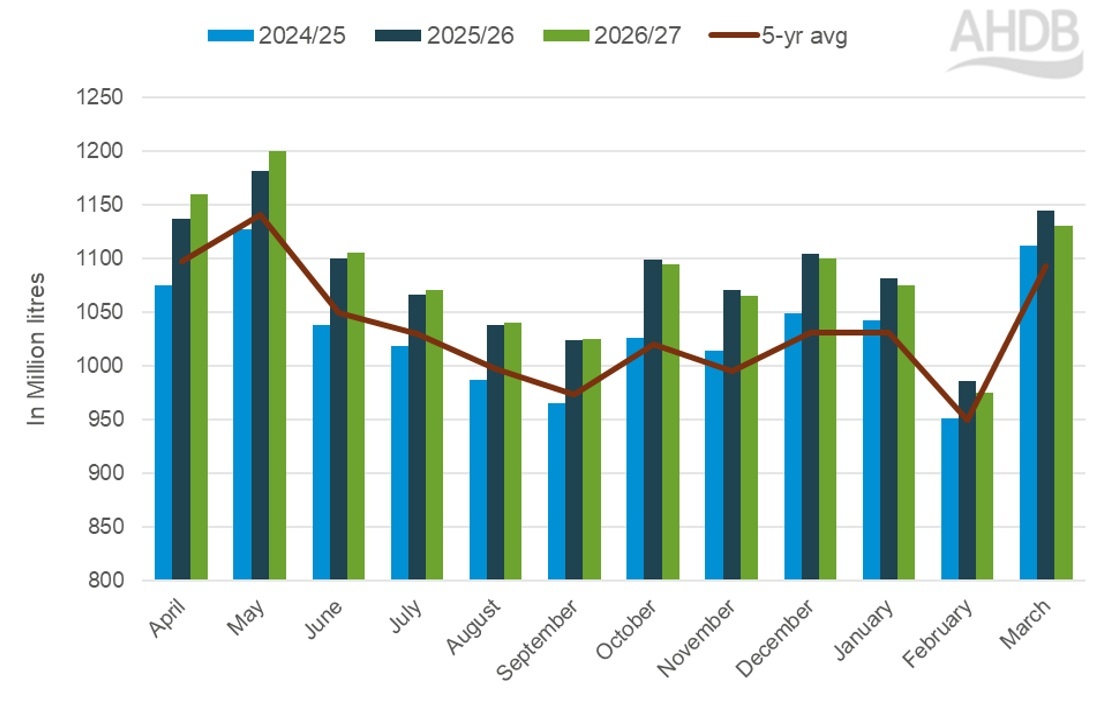
Figure 1. GB milk production, Mar-26 forecast (million litres)

Dairy production forecast_Mar26

Source: AHDB

Figure 1 shows monthly milk production for 2024/25, 2025/26 and 2026/27, with a five‑year average line. Production peaks in May, then decreases through to September. Production then fluctuates before a further dip in February, it then rises in March through to May.

Table 1. GB milk production forecast – March 2026 (million litres)

Month 2024/25 2025/26 2025/26 2025/26 2026/27 2026/27
Actuals Actuals Forecast Yr-on-yr Forecast Yr-on-yr
Apr 1,075 1,137  n/a 5.7% 1,160 2.0%
May 1,127 1,182 n/a  4.8% 1,200 1.5%
Jun 1,038 1,100 n/a  6.0% 1,105 0.5%
Jul 1,019 1,066 n/a  4.6% 1,070 0.4%
Aug 987 1,038 n/a  5.2% 1,040 0.2%
Sep 965 1,024 n/a  6.1% 1,025 0.1%
Oct 1,026 1,099 n/a  7.2% 1,095 -0.4%
Nov 1,014 1,071 n/a  5.6% 1,065 -0.6%
Dec 1,049 1,104 n/a  5.2% 1,100 -0.4%
Jan 1,042 1,081 n/a  3.7% 1,075 -0.6%
Feb 950 986 n/a  3.7% 975 -1.1%
Mar 1,112  n/a 1,145 3.0% 1,130 -1.3%
Year 12,405 n/a  13,033 5.1% 13,040 0.1%

Source: AHDB

Note: 28-day equivalent used for leap year Februarys

Image of staff member Soumya Behera

Soumya Behera

Senior Analyst (Dairy)

See full bio


Sign up to receive the latest information from AHDB.

While AHDB seeks to ensure that the information contained on this webpage is accurate at the time of publication, no warranty is given in respect of the information and data provided. You are responsible for how you use the information. To the maximum extent permitted by law, AHDB accepts no liability for loss, damage or injury howsoever caused or suffered (including that caused by negligence) directly or indirectly in relation to the information or data provided in this publication.

All intellectual property rights in the information and data on this webpage belong to or are licensed by AHDB. You are authorised to use such information for your internal business purposes only and you must not provide this information to any other third parties, including further publication of the information, or for commercial gain in any way whatsoever without the prior written permission of AHDB for each third party disclosure, publication or commercial arrangement. For more information, please see our Terms of Use and Privacy Notice or contact the Director of Corporate Affairs at info@ahdb.org.uk  © Agriculture and Horticulture Development Board. All rights reserved. 

×