Dairy October 2026 forecast update: GB milk production under pressure

Wednesday, 14 October 2026

Key points:

  • GB milk production is estimated to fall by 2.2% in the 2026/27 milk season, slowing to -1.1% in the first half of the 2027/28 milk season
  • Low forage stocks, falling cow numbers, increased costs of production and disease risk are key factors expected to drive the decline
  • Increases in milk price are currently not well supported by commodity markets but are necessary to support milk production
  • Milk production is likely to be highly variable depending on contract type, impact of drought and exposure to disease/vaccination status

What has happened so far in 2026?

GB milk supplies have been easing since May 2026,

Milk prices, began to fall sharply in October 2025, amidst a backdrop of global oversupply and depressed commodity markets, and remained low through most of spring/summer 2026. Despite this, milk supplies only began to fall after the flush, dropping more sharply through the summer, to a low-point of a 4.4% reduction year-on-year in August.

Several key factors explain the reduction in milk volumes seen this year, the most influential being:

  • Milk volume management schemes operated by several key processors aimed to reduce milk volumes and stay within processing capacity. This brought volumes down in spring
  • Heat stress induced by a run of five heatwaves through May into August
  • Lack of forage due to drought conditions
  • Lower milk prices and rising input costs squeezed margins

As we come into autumn, additional factors have emerged including a growing threat from bluetongue virus and falling cow numbers.

What are the expectations for the year ahead?

The overall expectation is for a continuation of the pressures seen in the summer, although heat stress itself will not be a factor over the winter, forage quantity could be a problem for some, increasing costs of production where supplies need to be bought in. Cow numbers are falling and high beef prices along with a lack of available forage will incentivise further herd reductions. Rising input costs will squeeze margins to a greater or lesser extent depending on the scale of milk price increases.

Finally, bluetongue virus has spread across most of the western parts of the UK and up into southern Scotland. This has previously had a significant impact on milk volumes in Europe in the 2023/24 season. Anecdotal reports from industry stakeholders suggest that most dairy farms have vaccinated but this is not universal and there may have been an impact earlier on in the summer.

AHDB’s forecast for the 2026/27 milk year is for supplies to reach 12.74m litres, a drop of 284m litres compared to the previous year or 2.2%. We expect that the rate of decline will decelerate closer to a 1% decline going into the first half of the 2027/28 milk year.

Margin pressures        

These will be felt on many farms but the degree to which they apply will vary considerably depending on contract type and region. A farmer on a retail-aligned (cost-based) contract in Southern Scotland where grass growth has been good and bluetongue virus is less widespread will be in a very different position to someone on a cheese contract in the South West of England where they have already had to dip into forage stocks and milk prices have been constrained by the current cheese commodity price.

However, all farms face a rising cost base. Feed costs are expected to rise due to dry conditions in key crop growing areas as well as conflict in Russia/Ukraine preventing some stocks from travelling. War in the Middle East is continuing to drive up the costs of fuel, energy, and fertiliser with the economic outlook increasingly less positive for a swift conclusion. Weather related costs on forage and straw have also risen, as have labour costs.

Some farmers under pressure may decide to cut back numbers of  cows and reduce their cost base where possible. Others may attempt to do the opposite and milk their way out of trouble. However, it is increasingly likely that the cost of producing milk will continue to rise.

How sustainable are milk price rises?

At the peak of supply concerns in August, we saw most milk prices rising with further positive announcements made for September and October. These prices were primarily aimed at stabilising milk supplies, particularly those in the worst heat affected regions in the south and were not underpinned by rises in commodity values. As supply fears have now eased in many quarters and commodity prices have remained relatively weak, most processors announced holds for November.

This presents a key question? Will milk prices move further forwards or fall back? And what is the outlook for commodity markets?

Currently, the market direction is uncertain. The protein market seems set to remain strong with rising global consumer demand for protein products, but fats remain with high stock volumes and continuing strong production in most key milk producing regions. This would point towards a relatively stable outlook for prices over the next six months. After that, much will depend on the global supply outlook.

Rabobank are expecting continued growth from the US (although slowing in response to lower margins) but a decline in EU milk production in Q4 into Q1 2027 due to margins and regulatory constraints as well as comparisons versus a very strong 2025. New Zealand is currently producing strongly but the ‘super-El Nino’ could produce dry conditions that could slow grass growth and milk production. This points towards a stabilising outlook for global milk production, rather than much decline. Under this scenario prices would stay fairly steady or even decline slightly depending on if global demand tightens in response to economic challenges.

Farmers under pressure from rising costs are in need of some certainty that milk prices stay high enough to support production to inspire growth. Many will opt to keep production in a more conservative range this year.

Winter forage stores and spring grass

Spring growing conditions were good this year with good quality and quantity of silage reported for the first cuts, which were necessary after a poor growing year in 2025. However, record-breaking heat and incredibly dry conditions in many parts in the summer of 2026 meant that many farmers needed to start feeding these stocks in the summer, compromising winter forage availability.

This pressure will particularly affect herds in the South West, Wales, and the Midlands. Scotland and parts of the North experienced more rain and a much better growing season so forage availability will not be a concern.

Fortunately, rain in September and October means that many farmers will get another cut and an opportunity to top up dwindling forage stocks. Some will have opted to buy in forage to make up for shortfalls, other may have elected to manage cow numbers and we did see an increase in culling in the worse affected region in last summer. An exceptionally cold winter, or a very dry (or very wet) Spring that delays grazing forage availability could still be factors but if we see more seasonally “normal” conditions there should be less challenges.

Herd size and composition challenges

Cow numbers continue the declining trend, with the size of the GB milking herd in July 2026 2.2% lower than a year earlier. The GB milking herd totalled 1.57 million head as of July 2026, the lowest number recorded with a fall of 34,500 head. A fall was seen across all age groups with the exception of the 4-6 years age group. Youngstock levels continue to decline, which remains a watchpoint for the sector, particularly since sales of beef semen have continued to increase and are now more than half of semen used.

Bluetongue virus

Bluetongue has been a growing threat for livestock sectors through 2026, emerging strongly in the South West of England in the spring and moving across the country. At the time of writing, on 14 October, there were 3,370 farms with confirmed cases of bluetongue (BTV-3) in the UK in the 2026-27 season (across all sectors). The latest information on the outbreak can be found here: Bluetongue: latest situation - GOV.UK.

Assessing how the bluetongue outbreak will shape our forecast is challenging as much remains unknown about the impact of the disease and levels of vaccination. To address this challenge AHDB has developed a likely bluetongue scenario, using the best available information at time of writing.

This is based on the geographic spread of Bluetongue being concentrated in the South West, West Midlands, East Midlands, North West, Yorkshire (South and West), and Wales.

Whilst far less lethal in cattle than in sheep bluetongue has implications for milk production. Within our scenario analysis we have assumed that a cow within an infected herd will see a production decline of 4 litres per day for two months (or a 248 litres loss per infected cow per year). There may also be fertility losses in term of aborted or deformed calves or failure to get in calf for around 1 in 4 affected animals.

Given the seriousness of potential impacts, it was important to consider the impact that bluetongue infection could play within the forecast. Through discussions with stakeholders and experts at AHDB we have assumed that most dairy cattle are now vaccinated, which should limit the overall impact of bluetongue in the milk forecast. It is likely that we have already seen the worst impacts of BTV when it first emerged in the South West when fewer herds were vaccinated.

Unfortunately, these effects happened at the same time as the heat stress effects (in fact the heat itself will have enabled bluetongue to spread faster and weakened immunity in cattle) so the two events are not independent of one another which make it very difficult to quantify at a national level.

Future impacts on milk production are expected to be modest. However, there is no empirical data on vaccination rates which introduce some uncertainty on impacts. AHDB would still urge farmers to discuss vaccination protocols with their vet as the midge season will be active into December so there is time to protect any stock that are not yet vaccinated.

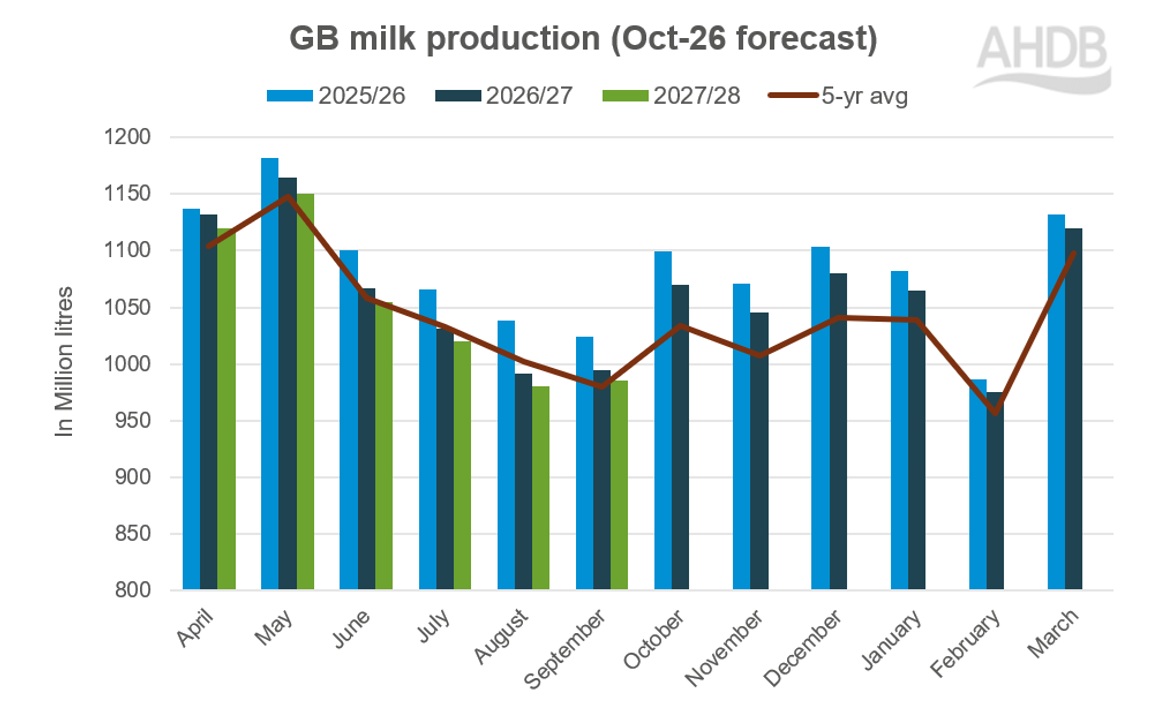
Figure 1 shows GB milk production during the last two years and forecast for the milk year 2026/27. This is compared with the 5-year average milk production.

Figure 1. GB milk production (Oct-26 forecast)

(million litres)  GB milk production is under pressure in 2026/27 milk year compared to previous year.

Source: AHDB

2025/26 milk production (light blue line)
2026/27 milk production (dark blue line)

2027/28 milk production (green line)

5-yr average milk production (dark red line)

Table: 1 GB milk production forecast - October 2026 (million litres)

m litres 2025/26 2026/27 2026/27 2025/26 2027/28 2026/27
Actuals Actuals Forecast Yr-on-yr Forecast Yr-on-yr
Apr 1,137 1,132   -0.4% 1,120 -1.1%
May 1,182 1,165   -1.4% 1,150 -1.3%
Jun 1,100 1,067   -3.0% 1,055 -1.1%
Jul 1,066 1,031   -3.3% 1,020 -1.1%
Aug 1,038 992   -4.4% 980 -1.2%
Sep 1,024   995 -2.8% 985 -1.0%
Oct 1,099   1,070 -2.6%    
Nov 1,071   1,045 -2.4%    
Dec 1,104   1,080 -2.2%    
Jan 1,082   1,065 -1.6%    
Feb 986   975 -1.1%    
Mar 1,132   1,120 -1.1%    
Year 13,021   12,737 -2.2% 6,310 -1.1%

Source: AHDB

Note: 28-day equivalent used for leap year Februarys

Image of staff member Susie Stannard

Susie Stannard

Lead Analyst (Dairy)

See full bio


Sign up to receive the latest information from AHDB.

While AHDB seeks to ensure that the information contained on this webpage is accurate at the time of publication, no warranty is given in respect of the information and data provided. You are responsible for how you use the information. To the maximum extent permitted by law, AHDB accepts no liability for loss, damage or injury howsoever caused or suffered (including that caused by negligence) directly or indirectly in relation to the information or data provided in this publication.

All intellectual property rights in the information and data on this webpage belong to or are licensed by AHDB. You are authorised to use such information for your internal business purposes only and you must not provide this information to any other third parties, including further publication of the information, or for commercial gain in any way whatsoever without the prior written permission of AHDB for each third party disclosure, publication or commercial arrangement. For more information, please see our Terms of Use and Privacy Notice or contact the Director of Corporate Affairs at info@ahdb.org.uk  © Agriculture and Horticulture Development Board. All rights reserved. 

×