Global Supply Growth Eases: Rabobank Q3 dairy outlook

Thursday, 8 October 2026

Global milk production continues to expand, but with weather challenges, high production costs, and environmental pressures increasingly influencing milk supply, how much longer could this last?

Key points

  • Global milk production is continuing to grow but is expected to slow in the second half of 2026 before stabilisation in 2027
  • El Niño is creating uncertainty around supply, with excessive rains, heat stress and lower feed availability predicted
  • EU and UK milk supply growth is losing momentum due to drought, higher feed costs, and lower milk yields
Image of staff member Hannah McLoughlin

Hannah McLoughlin

Trainee Analyst

See full bio

Global market overview

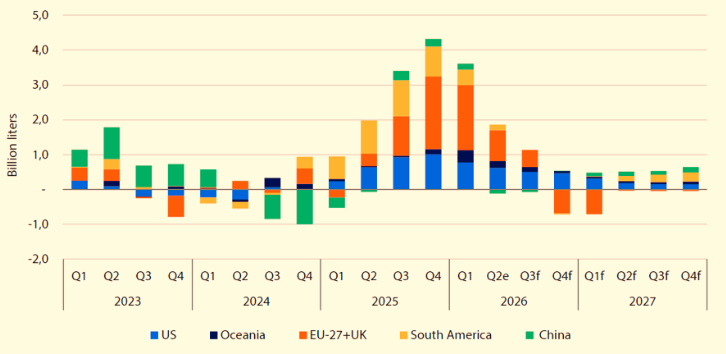
Global milk production continues to increase across the major exporting regions, although growth is losing momentum. Rabobank are forecasting growth to slow further to 0.5% in H2 2026, including a slight contraction in Q4 before stabilising in 2027.

Figure 1: Milk production growth, Big-7* exporters and China (actual and RaboResearch forecast), 2023–2027f

Quarterly changes in global milk production growth by region

Source: Big 7 and Chinese government and industry agencies, RaboResearch 2026

Figure 1 shows a stacked bar chart showing quarterly changes in global milk production growth by region from 2023 to 2027.

EU including the UK

Milk production continues to increase across the EU and UK, but at a slower rate. Combined supplies were up 2% year-on-year in June, this was the weakest growth since July 2025. Drought has caused reduced milk yields, lower feed quality, increased feed costs and encouraged herd reductions.

The European milk supply is shifting from expansion towards gradual constraint with margin pressure, regulatory measures targeting emissions and a demanding 2025 comparison base expected to curb further growth.

Cheese has become the preferred outlet for surplus milk supported by prices. EU cheese exports increased 4%.

Demand is providing a cushion with retail volumes responding positively to lower prices.

US

US output continues to expand faster than average.

This is supported by a growing dairy herd, improving milk components and additional processing capacity. Growth is expected to continue into 2027, although at a slower pace.

Total dairy demand rose 3% year-on-year in Q2, driven by both domestic consumption and exports, it is expected that this growth will persist through 2026 and into 2027.

US dairy exports remain on track for record annual volumes, led by cheese and butter.

Cheese and butter commodity prices are expected to remain stable, while non-fat dry milk prices are likely to remain volatile. Dry whey and whey protein markets continue to be supported by strong global demand and tight supplies.

New Zealand

The first few months of the 2026/27 season has continued the strong momentum from the previous season. June and July both set new monthly production records.

Growth has been supported by greater adoption of autumn calving, extended winter milking, and favourable weather conditions, helping smooth seasonal production patterns.

Milk production is forecast to increase by around 1% in 2026/27, this remains dependent on the developing El Niño pattern.

The additional milk produced has been exported, with exports up 11% from May-July 2026. Demand from Southeast Asian markets has helped absorb additional production and provide support to farmgate milk prices.

Australia

Milk production in Australia recorded slight growth in 2025/26, reaching an estimated 8.35 billion litres as favourable seasonal conditions and a stronger second half supported output. Further growth is expected this season, although at a slower pace, with the potential development of El Niño posing risks.

Farmgate milk prices remain well supported by the domestic market, helping shield producers from some of the volatility seen in global dairy commodity markets. However, future price increases are likely to depend on stronger global returns, particularly for cheese.

Commodity dairy exports weakened, with butter, whole milk powder, skim milk powder, and whey powder all decreasing.

Contrastingly imports increased across most major dairy categories, reflecting solid domestic demand for dairy fats and protein products.

Brazil

Production in Brazil is expected to slow further after a strong 2025. Production is forecast to decline 1% for Q3 and Q4.

Tighter milk supplies have supported farmgate prices, helping improve producer margins after a difficult start to 2026. Despite stronger milk prices, domestic dairy demand remains under pressure due to high household debt levels and persistent inflation.

Weather conditions associated with El Niño present a key risk. Excess rainfall in southern regions and drier conditions elsewhere could affect milk and crop production, while heat stress may reduce productivity in Q4 2026.

Argentina

Excessive rainfall in April caused the growth of milk production to slow, output recovered in July. Production is projected to increase between 1.5% and 3% in 2026 depending on the severity of El Niño.

Farmer profitability remains under pressure. Although the milk price index has moved closely in line with inflation, this has not produced a recovery in profitability.

Domestic dairy demand is being constrained by limited population growth and negative net migration. High costs have also reduced disposable income.

China

In the first half of 2026, milk production in China rose 2.4% year-on-year, primarily driven by large scale farms.

The exit of small and medium sized farms continues to weigh on supply. The dairy cow population is expected to continue declining in the second half of 2026.

Recovering farmgate milk prices, shrinking herd size and seasonal peaks in consumption have created favourable market conditions for moderate milk price growth in Q3.

What does this mean for the UK market?

For the UK dairy market, slower milk production growth across the EU and other major exporters is needed to help support dairy prices. Strong demand for cheese and protein-rich products may also provide export opportunities, although weather risks and higher production costs remain key challenges.

* The Big 7 includes the EU, the US, New Zealand, Australia, Brazil, Argentina, and Uruguay


Sign up for regular updates

You can subscribe to receive Beef and Lamb market news straight to your inbox. Simply fill in your contact details on our online form.

Visit the Keep in touch page

While AHDB seeks to ensure that the information contained on this webpage is accurate at the time of publication, no warranty is given in respect of the information and data provided. You are responsible for how you use the information. To the maximum extent permitted by law, AHDB accepts no liability for loss, damage or injury howsoever caused or suffered (including that caused by negligence) directly or indirectly in relation to the information or data provided in this publication.

All intellectual property rights in the information and data on this webpage belong to or are licensed by AHDB. You are authorised to use such information for your internal business purposes only and you must not provide this information to any other third parties, including further publication of the information, or for commercial gain in any way whatsoever without the prior written permission of AHDB for each third party disclosure, publication or commercial arrangement. For more information, please see our Terms of Use and Privacy Notice or contact the Director of Corporate Affairs at info@ahdb.org.uk  © Agriculture and Horticulture Development Board. All rights reserved. 

Topics:

Sectors:

Tags:

×