Milk utilisation trends: Cheese, milk powders, butter and yogurt production on the rise

Wednesday, 12 August 2026

Total UK milk availability for processing touched a new peak following record milk volumes in 2025/26. Is there any change in milk utilisation trends?

Milk production touched record highs in 2025/26 following favourable dairy economics. UK milk deliveries for the calendar year 2025 recorded a new high at 15.75 billion litres, an increase of 5% compared to the previous year.

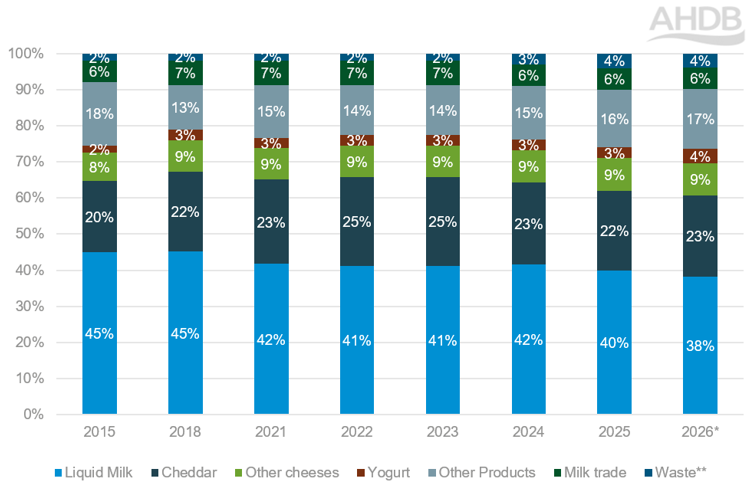
However, liquid milk production and consumption continued the long-term trend of decline – 40% was processed into liquid milk in 2025 compared to 45% in 2015.

In 2026 so far, liquid milk has continued to lose share of total milk utilisation.

Figure 1. Annual milk utilisation as percentage of production during 2015–2026

Stacked bar chart showing milk utilisation trends.

Source: Defra

*Data from Jan-Jun

**Includes Sub-sales and stocks change

Figure 1 is a stacked bar chart showing milk utilisation into liquid milk, Cheddar, other cheeses, yoghurt, other products and milk trade between 2015 and 2026. There has been decline in milk utilisation towards liquid milk and an increase towards Cheddar and yogurt. Light blue bar represents liquid milk, dark blue bar = Cheddar, green bar = other cheeses, dark red bar = yogurt, grey bar = other products, dark green bar = milk trade and blue = waste.

Cheddar is the largest variety produced of all types of cheeses accounting for 22% of total milk utilisation in 2025 and over 70% of total cheese production. Other cheeses like blue vein cheese, long life territorial cheese and short life territorial cheese accounted for 9% of milk utilisation.

While yogurt production volumes increased, its share of total milk utilisation remained relatively stable due to overall growth in milk availability. Milk trade also remained steady in terms of share, while ‘other products’ increased by one percentage point to 16% during the period.

Within the other products category, butter is the major contributor followed by milk powders and condensed milk.

Production of milk powders and butter increased significantly by 18% and 6%, respectively, in 2025 compared to the previous year.

What has happened so far in 2026?

In the first half of 2026 (Jan–Jun), milk utilisation towards cheese and other products (powders, butter, condensed milk and yogurt) continued to grow while that of liquid milk declined.

In the first half of the current year (JanJune), there was an increase in share of milk going to Cheddar by 0.6% to 23% compared to 2025.

Similarly, the share of milk going to other products increased by 0.7% to 17% during the same period. Liquid milk continued the declining trend with milk utilisation at 38%, a decline of 2% compared to 2025.

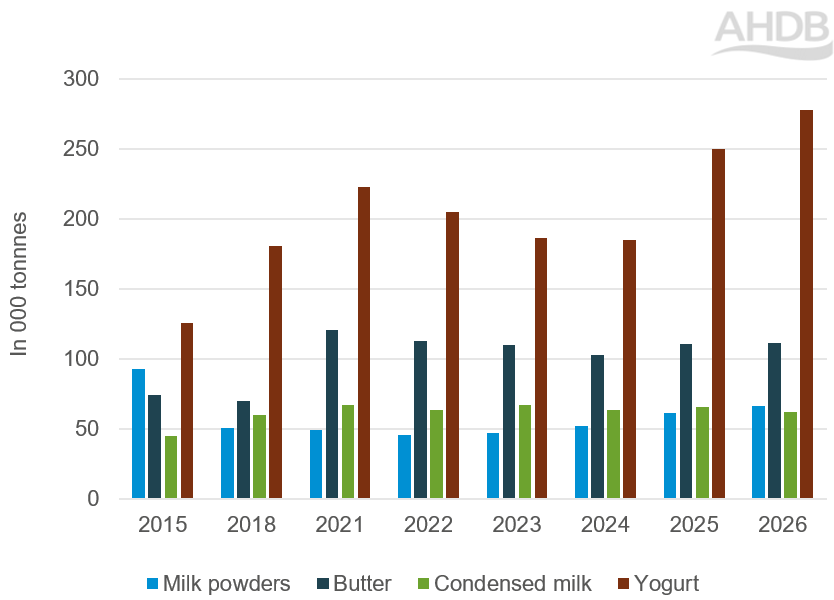
Production of yogurt witnessed the biggest increase of 11.3% to 278,000 tonnes in the first half of 2026 (JanJun) compared to the same period in 2025.

This was followed by the increase of milk powders to 66,000 tonnes (+7.6%) and marginal increase of butter by 0.3% at 111,000 tonnes.

With supplies at record levels, more milk was diverted towards milk powders which has higher shelf-life.

Figure 2. Dairy products production 2015–2026 (Jan–Jun)

  Bar chart showing dairy products production during 2015 till 2026.

Figure 2 is a bar chart showing production of dairy products between 2015 and 2026 in the first half of the year. Production of yogurt, milk powders and butter has increased during last three years while that of condensed milk has declined. Light blue bar represents milk powders, dark blue bar = butter, green bar = condensed milk and dark red bar = yogurt.

What have been the drivers of changes in milk utilisation?

Retail demand for liquid milk is continuing to decline while that of yogurt and cheese have continued to increase as seen in the latest retail data available. Yogurt saw a significant increase due to consumers growing preference for protein rich foods and healthier snacking. C

ottage cheese demand has also been growing following boost in demand for proteins.

In the ‘other products’ category, milk powders and butter saw increases as record milk deliveries in 2025/26 resulted in more production of powders and butter to help store and balance milk supplies.

According to the estimates of the latest Defra Family Food Survey, per capita consumption of liquid milk per person per week in the UK declined by 27% from 2015 to 2024, while per capita consumption of cheese increased 11% over the same period. This reinforces the long-term shift in milk utilisation towards higher value-added products like cheese.

Changes in the milk utilisation ratio is a function of variety of factors like shifts in consumer demand, returns from products, export demand, processing capacity investments and evolving market conditions.

Growing demand for protein-rich products like cheese, yogurt coupled with favourable returns, export opportunities and investments in processing capacity have boosted utilisation of milk into manufacturing routes.

The record deliveries of milk in 2025/26 boosted dairy products with higher shelf-life, thereby helping to balance the excess supply in the market.

With milk flows poised to decline amid heat waves, outbreak of diseases and the long-term structural and environmental policies, it will be interesting to see how processing decisions evolve in the coming years.


Sign up to receive the latest information from AHDB.

While AHDB seeks to ensure that the information contained on this webpage is accurate at the time of publication, no warranty is given in respect of the information and data provided. You are responsible for how you use the information. To the maximum extent permitted by law, AHDB accepts no liability for loss, damage or injury howsoever caused or suffered (including that caused by negligence) directly or indirectly in relation to the information or data provided in this publication.

All intellectual property rights in the information and data on this webpage belong to or are licensed by AHDB. You are authorised to use such information for your internal business purposes only and you must not provide this information to any other third parties, including further publication of the information, or for commercial gain in any way whatsoever without the prior written permission of AHDB for each third party disclosure, publication or commercial arrangement. For more information, please see our Terms of Use and Privacy Notice or contact the Director of Corporate Affairs at info@ahdb.org.uk  © Agriculture and Horticulture Development Board. All rights reserved. 

×