Organic dairy update: Strong demand but do we have the resources to meet it?

Monday, 15 June 2026

Key points

  • Organic GB milk deliveries have been behind year-ago volumes since May 2026
  • Defra’s figures show a further decline in organic dairy cow numbers
  • Strong demand for organic milk, though processing capacity is limited, constraining the market

Organic deliveries show a weak flush


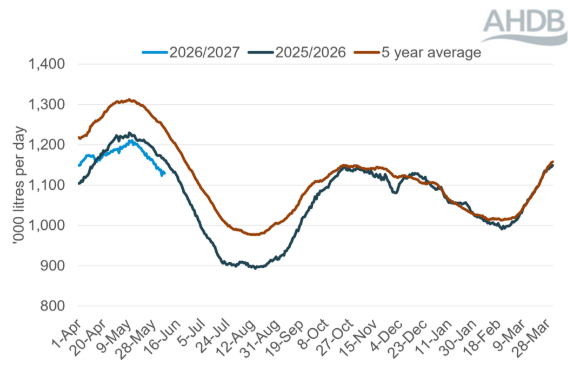
Figure 1. GB daily organic milk deliveries (7 day rolling average)

GB daily organic milk deliveries (7 day rolling average)

Source: AHDB

Figure 1 is a line chart showing GB daily milk deliveries, using a 7 day rolling average, from 1 April to 31 March. It compares 2026/27, 2025/26 and the five year average (million litres per day). The vertical axis shows thousand litres per day, ranging from 800 to 1,400 thousand litres. Three lines are shown:
2026/2027 (light blue line)
2025/2026 (dark blue line)
Five year average (orange top line)

Last year, GB organic milk deliveries showed year-on-year growth from March 2025. Similarly to overall deliveries, good dairy economics supported growth, despite low forage stocks and quality. Anecdotal reports indicate that some organic farmers used derogations to supplement their organic supply during the drought.

Deliveries dipped into year-on-year decline from May 2026 and have remained well below the 5-year average. Milk year to date (April to 6 June) volumes are now 1.1% lower, year-on-year, whilst calendar year to date (January to May) is 4.7% ahead.

The recent dip has shown a similar trend to total milk volumes, albeit with a weaker spring flush.

Although farmgate prices have not dropped to the same extent of conventional averages, rising input costs are pressuring margins. In addition, grass growth (to which organic production is generally more closely linked to) has not been as strong as average. Forage stocks are also in tight supply due to the poor season last year.

Organic cull cow numbers are in short supply, creating incentives for sales and pressuring cow numbers.

Defra organic farming statistics show a drop in dairy cows but increase in organic land

According to Defra’s UK organic farming statistics for 2025, total organic farmland (including in-conversion) hectarage increased by 7% year-on-year, in the UK to 540,000 hectares. Area in-conversion increased significantly, by 63%.

However, organic livestock numbers mostly declined. Dairy cows registered as organic (not including in-conversion) saw a decline to 46,000 head, from 48,000 head in 2024 (-4%), which is a steeper decline than total dairy cow numbers. Organic dairy livestock numbers were not the only category to decrease and total livestock producers reduced by 5% in 2025 compared to the previous year.

An increase in permanent pasture indicates a move toward more extensive land uses, likely in conjunction with environmental schemes. However, transitioning to organic farming is a significant long-term shift in production system. Farmers highlight that the suspension of the Sustainable Farming Scheme (in March 2025) and changing requirements for farmers reduced confidence in long term planning.

Organic farmgate prices have held better than conventional

Recent organic farmgate prices have held better than the average conventional prices. For March, the average UK farmgate price was announced by Defra as being 35.05ppl, down 9.81 pence year-on-year, whereas organic contract movements have been less drastic.

Despite the pressures for downward pricing, organic farmgate milk price stability is likely a strategy used to hold onto long-term producers. In terms of margins, the premium will need to remain high enough to retain producers to keep pace with rising production costs.

The current economic climate does raise challenges but demand for premium is ‘resilient’.

According to the Soil Association Market Report, volume sales for the organic major retail category rose by 7% in 2025, year-on-year. Dairy was listed as one of the main drivers (accounting for 27.3% of the share of organic sales in 2025).

Nielsen data also showed a 7% volume increase year-on-year for total organic dairy sales in retail (NIQ Homescan POD, 52 w/e 16 May 2026). Entry point staples, milk (+10%) and butter (3%) drove this performance, segments which appeal to the whole, natural and non-ultra-processed food (UPF) market.

Meanwhile, yoghurt and drinks (-2%), cheese (-6%) and cream (-16%) declined. The decline in organic yogurt is disappointing considering the overall category growth seen. It may be worth reviewing which specific SKU’s would benefit from organic replication.

Existing organic shoppers drove the overall growth of organic dairy (NIQ Homescan POD, 52 w/e 16 May 2026), buying larger volumes per shopper as opposed to recruiting newer buyers.

The Grocer report showed that two-thirds of consumers are intentionally buying organic and this group is growing. Consumers are looking for simpler, more natural choices. Interests around animal welfare standards and pesticide use were named drivers of growth.

Despite the ongoing cost of living crisis, and widening price differential between conventional and organic products, the spotlight on UPF’s is likely to have benefitted the category. Additionally, demand may have been boosted by the attention to glyphosate use in agriculture (anti-glyphosate campaign) particularly across social media and potentially consumer attention around the use of the Bovaer feed additive.

While value is top of mind, the credentials of organic dairy must be communicated to retain existing shoppers and attract new ones, as well as bring in new customers to the category, such as natural, pasture access/welfare and sustainability call-outs.

Organic demand is growing in other markets too

Opportunities exist in the larger, European market, which is now starting to recover after a tough recent period. Organic dairy products in French retail saw strong recovery at the end of last year, according to CNIEL, supported by a relatively small price gap between organic and conventional dairy products. However, production was lower and forecasted to fall again in 2026. This may present as an opportunity for the UK if organic was to command higher prices on the continent.

Additionally, further away markets including the Middle East, Asia, America and beyond have demand for high-quality organic food and drink.

The future arrangement of dynamic alignment between the EU and GB on SPS regulations will span organic standards. This is a positive move for epotential to the EU, reducing the burden and costs to exporters and opening up further opportunities.

The UK-Japan recent organic trade agreement came into effect on 1 April. It is also expected to cut costs and bureaucracy, enabling British organic exporters better access to the £1.4 billion Japanese organic market. This could be a potentially lucrative market for premium organic dairy products, such as cheese.

Processing capacity does remain a worry, despite strong demand

The NFU warns that the increased appetite for organic should be met here in the UK. The breaking point is processing capacity and ability to produce shelf-stable products. Due to the greater seasonality aspect of organic milk production, the flush period is particularly challenging, particularly when competing with overloaded conventional dairy supplies for limited processing space. Equally, the autumn lull can be challenging to maintain production and therefore demand momentum.


Sign up to receive the latest information from AHDB.

While AHDB seeks to ensure that the information contained on this webpage is accurate at the time of publication, no warranty is given in respect of the information and data provided. You are responsible for how you use the information. To the maximum extent permitted by law, AHDB accepts no liability for loss, damage or injury howsoever caused or suffered (including that caused by negligence) directly or indirectly in relation to the information or data provided in this publication.

All intellectual property rights in the information and data on this webpage belong to or are licensed by AHDB. You are authorised to use such information for your internal business purposes only and you must not provide this information to any other third parties, including further publication of the information, or for commercial gain in any way whatsoever without the prior written permission of AHDB for each third party disclosure, publication or commercial arrangement. For more information, please see our Terms of Use and Privacy Notice or contact the Director of Corporate Affairs at info@ahdb.org.uk  © Agriculture and Horticulture Development Board. All rights reserved. 

×