Q1 2026 dairy market review

Thursday, 16 April 2026

Key points

  • Milk supplies remain too far ahead of processing capacity
  • Markets saw some recovery through the quarter due to growing demand and outbreak of war, but milk supplies are now pressuring prices again
  • Milk prices have stabilised at low levels, but margins are now pressured at the other end with rising input costs due to war in Iran
  • Retail demand is steady with growing consumer demand for protein supporting the category
  • Competitiveness in global markets is supporting trade, with export growth in Q4

Milk production

GB milk deliveries through Q1 remained elevated, reaching 3.1% up on the same quarter in 2025.

January and February increased by 3.7% respectively and March by 1.8%. We are still annualising against strong growth versus the previous year, generating a compound effect. 

We are up 4.2% for Q1 against the 5-year average, which represents a slowdown from the previous quarter’s 7% premium. 

The milk year has ended at a high of 13.02 billion litres. 

The milk to feed price ratio is now edging down into the ‘stabilisation zone’, indicating that milk supply growth should normalise although will remain at high levels. 

Our forecast for the milk year ahead predicts stabilisation of milk supplies at 13.04 billion litres which is a scant 0.1% higher than this year.  However, we have to keep in mind that we are annualising against a year of record highs, meaning there will still be a lot of milk available. 

  • Smaller herds but bigger yields to continue
  • War in the Middle East presents a significant risk to the forecast
  • The growth momentum is likely to continue in the first half of the milk year but will likely slowdown in the second half as we annualise against high levels to end the year mostly stable

Milk composition has been well above average all year as well with the latest butterfat at 4.43% and protein at 3.49% in February, well above the 5-year average.   

The GB milking herd totalled 1.60 million head as of January 2026, the lowest in a decade and a 1.3% decline from the same month the previous year with a decline across all age groups with the exception of 4–6-year-olds.

Dairy cow kill is up by 4% when comparing the latest 6-month period (Sep-Feb) to the same period of the year prior. This equates to a further 8,000 head of dairy cattle culled. Cows being culled are likely weaker producers or barren. Dairy farmers should consider heifer replacement costs and availability when making culling decisions for the year ahead.

While dairy cull cow numbers have grown in recent months, we have seen the market absorb this supply without weighing on overall cow prices, in part due to reduced numbers from the suckler herd holding total supply below year-ago levels.

GB organic milk deliveries have continued to recover since the nadir in production seen last year and production was up by 9.3% for Q1.

Global milk production averaged 850.5 million litres per day in January, an increase of 40.9 million litres per day (+5.1%) across the selected regions, compared to the same period in the previous year. All regions recorded growth with the EU and US the biggest contributors. 

US rose by 3.3% driven by herd size, disease recovery and a boost to cheese production facilities, and NZ by 2%. Australia grew by 1.5%. Latin America continued to see strong growth through 2025. 

The EU maintained its strong growth (+5.2%). Germany was up most: 186 million litres (+7%) for the month of January, followed by France, up 118 million litres (+5.8%), and Italy, up 83 million litres (+7.6%).

According to Rabobank, milk production growth among the 'Big 7' exporters is forecast to slow to 0.2% in 2026, down from 2.6% in 2025, with a slight contraction expected in early 2027.

Wholesale markets

In spite of soaring milk volumes here and abroad Q1 surprised everyone with recovery in wholesale prices. 

This began with the GDT auction which started the year with an improvement of 6.3% baffling observers.  It then proceeded to rise a further five periods in Q1, increasing the overall index by 28.7% over the quarter.  However, that run came to an end in the first auction in April which fell by 3.4%. 

Reasons for this rise shifted through the quarter, beginning with an expectation that prices had bottomed out, an investor-led ‘short squeeze’, and a need to secure volumes with war brewing. 

SMP supplies, in particular, have been short due to growing consumer demand for protein, low US production and increasing reformulation from higher priced whey proteins. The removal of Iran as the world’s fourth largest SMP exporters also contributed, as did our competitive pricing. 

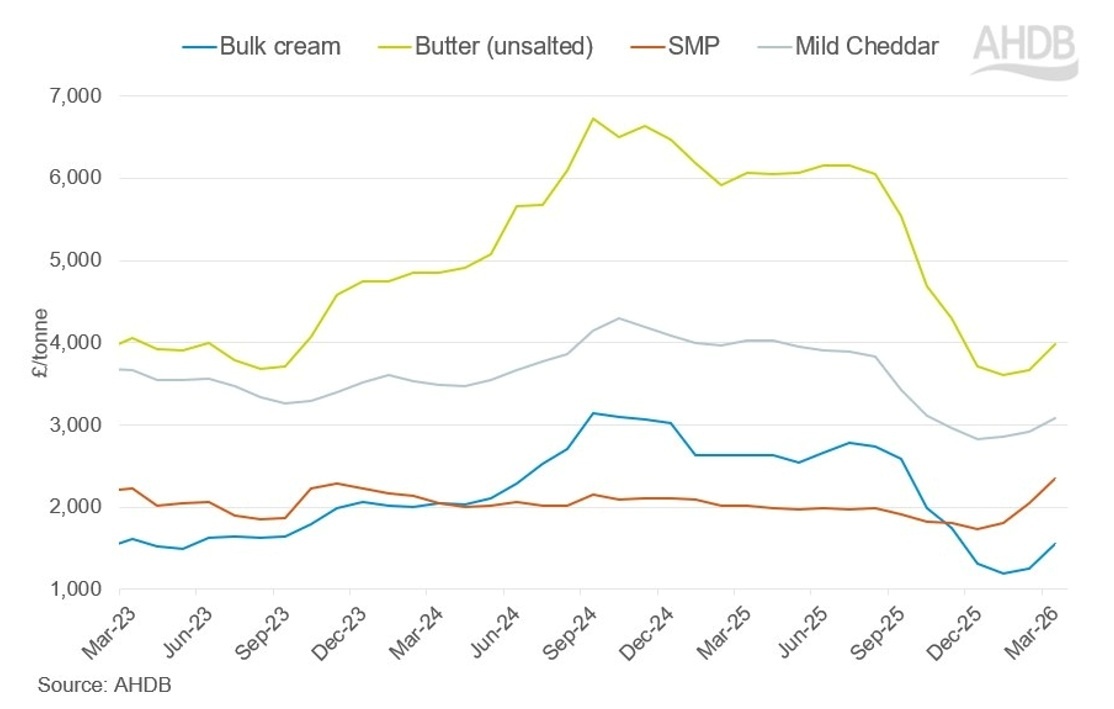
  • SMP (second up red line in figure 1) ended at an average of £2,340 in March, a growth of £300/tor 15% since last month. It is the only commodity that is more valuable than a year ago
  • Cheddar stocks are reportedly tight after much curd was sold last year to drive cashflow. Both mild and mature are said to be limited. The average price for mild Cheddar (grey line, second down in figure 1) was £3,080/t, which is 5% higher than the previous period
  • Bulk cream (bottom blue line in figure 1) saw strong growth through March, averaging £1,556 per tonne for the period, an increase of 24% compared with February. Reports indicate a big loss of value in April, however
  • The average butter price was £3,980 per tonne (top green line in figure 1), an increase of 8% compared with the previous period. There was high volatility through the period, and again reports indicate the market has now softened once more

Towards the end of the period, fats markets in particular have plunged, reflecting continuing high milk volumes, although this is not yet reflected in our wholesale prices.  Volatility remains king. 

Figure 1. Average UK wholesale prices from early 2023 to March 2026, measured in pounds per tonne

UK wholesaleprices_Mar26

Source: AHDB

Butter prices remain consistently higher than the other products throughout the period. All four products show a steep decline from late summer 2025 into early 2026, followed by modest recovery in February and March 2026.

SMP shows the strongest improvement in early 2026 compared with the other products. Bulk cream remains the lowest‑priced product across the period.

As of March, milk market values (which is a general estimate on market returns and the current market value of milk based on UK wholesale price movements and typical milk utilisation) rose sharply to 35.4ppl. AMPE grew by 14% to 37.4ppl, MCVE grew by 7% to 34.9ppl.  A rise in the MMV is generally predictive of a rise in farmgate milk prices three months later.

Farmgate milk prices

The latest published farmgate price was for February, with a UK average of 36.1ppl, a loss of 10ppl in three months since October 2025. Latest announced farmgate prices have now broadly stabilised with some processors moving upwards slightly, some further declines and many holds.

Retail aligned liquid contracts announcements were a mixed bag. M&S made a positive announcement of 0.81 ppl after holding steady for two months.

Sainsbury’s reduced their price for another consecutive month with prices dropping by 0.41ppl. Co-op dairy and Tesco have held on to their price for another consecutive month.

On non-aligned liquid contracts, all buyers on the AHDB League table held their price. Crediton Dairy and Muller held on to their price after five consecutive months of price decline.

Freshways also made no change to their price for a second consecutive month. Payne’s Dairy held on to their price after a month of decline and Pembrokeshire made no change to their price after six months of continuous decline.

Cheese contracts held steady to firm except Saputo and Wensleydale. First Milk made a positive announcement of 0.5 ppl after few months of decline and steady last month while Lactalis added 0.52 ppl in this month’s announcement.

Saputo reduced their price by 1.00 ppl, adding on to the fifth consecutive month of decline. Wensleydale continued the trend of decline in price and made a reduction of 0.2 ppl. Barbers and Belton Cheese held on to their price after five months of consecutive decline.

Leprino Food remained steady after having made a positive announcement in the previous month. Parkham Farms, Wyke Farms and South Caernarfon Creameries held on to their price.

Manufacturing contracts also held. UK Arla Farmers Manufacturing made no change in price. However, the quarterly currency exchange rate adjustment led to an increase in price by 0.09 ppl.

Meadow and Pattemores Dairy announced no change in price for another consecutive month.

Input costs 

Emerging conflict in the Middle East is having a far-reaching effect on input costs on farm, as well as trade disruption.  While there remains limited evidence of physical disruption to agricultural input supply in the UK, gas, oil and freight markets continue to be impacted with implications for agricultural input costs.

AHDB have moved to weekly reporting of fertiliser prices through this period.  The cost of AN has already increased by approximately 30% compared to before the conflict. Fuel and energy costs are also heavily affected. 

Farm input costs were rising in certain areas even before the conflict.  In the 12 months to November 2025 the overall Agricultural Price Index (API) for agricultural inputs rose 2.4%.  Despite falling costs of feed, costs including forage, straw and labour all increased. 

Demand

During the 12 weeks ending 21 March 2026, volumes of cows’ dairy fell into decline, down 0.2% year-on-year¹. Spend on cows’ dairy increased by 5.0% year-on-year, driven by a 5.2% increase in average retail prices despite farmgate prices decreasing.

Cows’ milk

Cows’ milk saw a 1.6% decline in litres purchased year-on-year¹, while increasing average prices saw spend up by 6.0%.

Declines were seen for semi-skimmed, skimmed and other cows’ milk. Whole milk continued to see volume growth, with a 2.7% increase year-on-year, due to more buyers. Plant-based milk also saw volume growth.

Cows’ cheese

Cows’ cheese remained in volume growth, seeing a 1.9% increase year-on-year¹. Spend grew by 3.1% during this period, driven by volume gains and a 1.1% increase in average prices.

Cheddar

Cheddar fell into volume decline this period, down 0.5%. However, it continues to be the most purchased cheese in Britain, accounting for 45% of cows' cheese volumes. British regionals and processed cheese also saw declines.

Growth in cheese was driven by snacking and other cow cheeses. The top three growing subcategories within cows' cheese were cottage cheese (+1,351 tonnes), soft white cheese (+688 tonnes) and kids snacking (+589 tonnes). These categories have seen growth due to consumers wanting convenient, healthier options.

Cows’ butter

Cows’ butter saw a 0.9% decrease in volumes purchased year-on-year¹. Spend on butter fell in to decline this period, down 0.1% but average prices were still up 0.9%.

Block butter continues to see volume growth (+7.1%), due to falling average prices and consumers wanting less ultra-processed and more natural foods. However, this growth was not enough to offset the decline in cow butter spread volumes (-4.4%).

Cows’ yogurt, yogurt drinks and fromage frais

Volumes continue to see growth (+6.6%), with spend increasing 8.6% year-on-year¹. This growth is driven by both new and repeat shoppers.

Cows’ standard plain yogurt saw the fastest growth, up 27.1% year-on-year, while cows’ fat-free yogurt saw the greatest actual growth, with an additional 4.4m kg purchased year-on-year (+10.9%).

Cows’ cream

Cows’ cream volumes remained in growth, up 2% year-on-year, with an 7.8% increase in average prices paid leading to an 9.9% increase in spend¹.

The majority of growth is through double cream (+3.8%) with an additional 410K litres due to existing shoppers buying more often – potentially due to Mother’s Day demand. Aerosol cream, which had been in strong growth, lost shoppers this period, so fell into decline.

¹ NIQ Homescan POD, Total GB, 12 w/e 21 March 2026

See the full data and these insights visualised on our GB household dairy purchases retail dashboard.

Trade

UK dairy export volumes in Q4 2025 grew by 28% in Q4 2025 to 367,000 tonnes with value increasing by 13% to £551 million. UK dairy exports continued to rise for the third quarter in a row. Shipments to EU countries increased by 68,600 tonnes, and exports to non‑EU countries rose by 11,800 tonnes.

Most categories grew in both volume and value, except whey and whey products

Imports fell by 1.5%, mainly due to reduced imports of butter and of milk and cream

Growth was driven mainly by:

  • Milk and cream (up 56,800 tonnes)
  • Milk powders (up 14,000 tonnes)
  • Cheese (up 7,900 tonnes)
  • Butter (up 3,200 tonnes)

We have undertaken a detailed analysis of our export prospects into the MENA and other markets as part of this study: Prospects for UK agri-food exports


Sign up to receive the latest information from AHDB.

While AHDB seeks to ensure that the information contained on this webpage is accurate at the time of publication, no warranty is given in respect of the information and data provided. You are responsible for how you use the information. To the maximum extent permitted by law, AHDB accepts no liability for loss, damage or injury howsoever caused or suffered (including that caused by negligence) directly or indirectly in relation to the information or data provided in this publication.

All intellectual property rights in the information and data on this webpage belong to or are licensed by AHDB. You are authorised to use such information for your internal business purposes only and you must not provide this information to any other third parties, including further publication of the information, or for commercial gain in any way whatsoever without the prior written permission of AHDB for each third party disclosure, publication or commercial arrangement. For more information, please see our Terms of Use and Privacy Notice or contact the Director of Corporate Affairs at info@ahdb.org.uk  © Agriculture and Horticulture Development Board. All rights reserved. 

×