Will there be enough milking cows to meet future demand? Weighing up beef vs milk

Thursday, 9 July 2026

  • Dairy female births have been declining since 2022
  • Market economics have led to shift towards producing calves for the beef market
  • Improvements in efficiency and targeted breeding are influencing some of the decline

The latest data from the British Cattle Movement Service (BCMS) recorded a 0.4% increase in 2025 birth to dairy dams in GB year-on-year, whilst the latest data for Q1 (January to March) 2026 shows stability. But dairy-beef calves largely drove the increase last year.

In 2025, 60% of registrations to dairy dams had a beef sire while 32% were dairy heifer calves (potential replacements). Annual registrations of dairy females to a dairy sire have been reducing since 2021. The 2025 total was 463,373 head, a 3.1% decline year-on-year and the lowest total on record. When we factor in the numbers born, but that won’t make it to their first lactation will we have enough to safeguard future production?

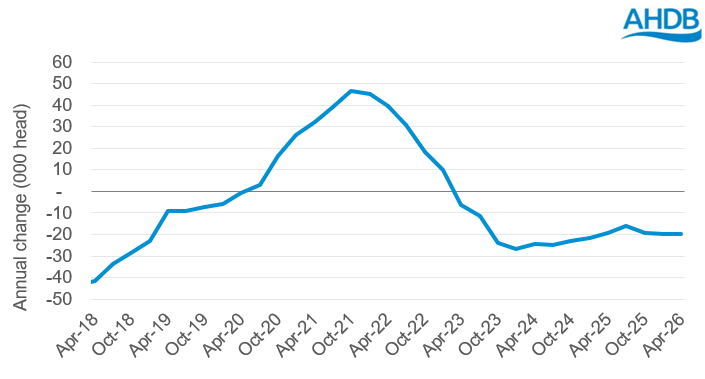
Figure 1. Annual change in GB dairy youngstock (0-2yrs) population (thousand head)

Annual change in youngstock

Source: BCMS

Figure 1 is a line chart showing annual change in GB dairy youngstock (0-2 yrs) from April 2018 till April 2026 (thousand head).

The past year’s record volume of GB milk came from higher yields per cow, while the GB dairy cow herd has continued its long-term trend of decline, falling by 2% in the latest data set.

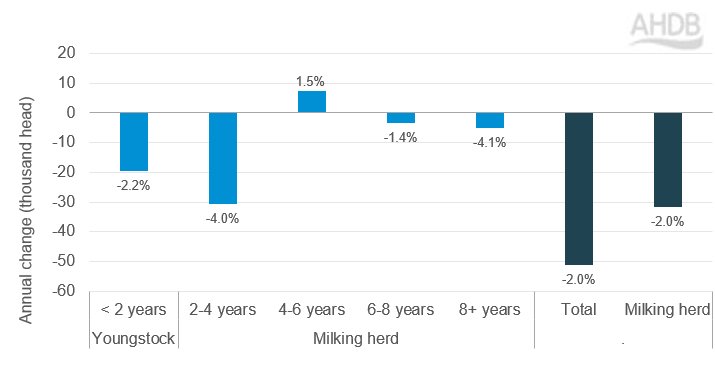
The bulge in youngstock numbers seen through the early 2020’s was driven by some mistrust in sexed semen and subsequent “over-serving”.  This cohort are now progressing through the milking herd and many will now be on their fourth lactation, a point at which herd exits grow. As of April 2026, BCMS data showed the 4-6 year old category of dairy females to be the only group showing year-on-year growth. As these groups age out, the national herd is projected to have fewer cows in milk which could mean too few cows going forwards.


Figure 2. Annual change in GB dairy herd by age as on 1 April 2026

Annual change by age group

Source: BCMS

Figure 2 is a bar chart showing change in GB dairy herd by different age categories. The change is shown on the left vertical axis (thousand head). There are two colour bars shown:

<2 years, 2-4 years, 4-6 years, 6-8 years, 8+ years (light blue bars)

Total and milking herd (dark blue bars)


Will greater longevity play a role?

As of April 2026, the average age of a cow in the GB milking herd now stands at 4.6 years, very slightly older than last year’s figures. Previously attractive milk prices may have influenced greater retention, though the recent increase in dairy cull throughputs (dairy cull throughputs +17% in March, year-on-year but only +3% in April) suggests there has been some “clearing out”. On the other hand, there are anecdotal reports suggesting that some farmers may be holding onto cows to gain another calf destined for the beef market, thus staying for another lactation.

There are positives with this strategy – more lactations drive better carbon footprints and less heifer replacement costs but requires balancing against slowing of potential genetic gain and the risk of miscalculation should disease or other issues strike the herd.

Shifting focus to beef genetics

Stronger beef prices have incentivised use of beef semen, potentially over heifer replacements. Significant factors favour the rearing of calves for beef, including better genetics, integrated schemes and the growing consumer awareness for popular cross breeds, such as Angus.

Most influentially, the currently low average milk price versus elevated beef prices also incentivises these breeding decisions. With beef supplies short, beef prices were strong throughout most of last year, albeit they have fallen back in 2026.

With more dairy business models now set up specifically to rear beef, changing systems is not only markets led, but a structural change.

The latest beef deadweight prices have weakened in the latest months due to reduced demand, but with production set to remain at low levels, price direction will depend on whether consumer confidence improves and how production adjusts through the year.

Additionally, while finished cattle prices fall, the rate of decline is not equal across the store market, and indeed average calf values have remained in annual growth which could continue to incentive use of beef semen.

Increasing efficiency in the dairy herd

More positively, we have seen a significant increase in genotypes submitted by dairy farmers for the AHDB genotype evaluation service. While the increase does not necessarily mean more heifers, it does indicate more interest in the longer-term success of the herd, and a continuation of greater yield (both volume and solids) per cow. Improved efficiency also supports the success story for reducing the environmental footprint of dairy farming.

Advancements in genetic testing and sexed semen is enabling more targeted breeding of best performing females. This reduces the need to overproduce due to improvements in the reliability of inseminations. There appears to be an increasing trend of breeding only the necessary replacement heifer numbers and putting the rest to dairy beef. However, there is risk of under availability, particularly those flying herds that are dependent on buying in replacements. Disease risk from the continent is another factor that could limit supplies.


Future: Short supplies expected

There are indications of a shortness in supply of dairy heifers to come, likely linked to lack of confidence from dairy farmers and focus on short term beef revenues. This is not just the milk price but wider agricultural challenges, such as the ending of BPS and availability of funding for the SFI schemes in England.

However, the longer-term view of the dairy industry does indicate increasing global demand and projected farmgate milk prices to pick up later this year and into next. As a result, dairy heifers will be increasingly needed and more expensive.

Heifer supply shortage is not just a domestic problem. In the US, investment in new cheese plants requires the increased dairy to supply to fill it, whilst strong beef prices have provided incentives for beef calves. The US is currently experiencing record high prices for replacement dairy cows, a pattern that we could also see here. In the EU, environmental regulations and incentives are reducing herd size meaning the cows that do exist need to be ever more efficient and productive.

Producers may have to slow culling of cows if markets incentivise more milk production, given the time required to breed more replacements, or more farms may turn to flying herd systems to increase numbers quickly – but in the absence of ready supply – industry growth could be constrained in the medium term.


Sign up to receive the latest information from AHDB.

While AHDB seeks to ensure that the information contained on this webpage is accurate at the time of publication, no warranty is given in respect of the information and data provided. You are responsible for how you use the information. To the maximum extent permitted by law, AHDB accepts no liability for loss, damage or injury howsoever caused or suffered (including that caused by negligence) directly or indirectly in relation to the information or data provided in this publication.

All intellectual property rights in the information and data on this webpage belong to or are licensed by AHDB. You are authorised to use such information for your internal business purposes only and you must not provide this information to any other third parties, including further publication of the information, or for commercial gain in any way whatsoever without the prior written permission of AHDB for each third party disclosure, publication or commercial arrangement. For more information, please see our Terms of Use and Privacy Notice or contact the Director of Corporate Affairs at info@ahdb.org.uk  © Agriculture and Horticulture Development Board. All rights reserved. 

×