Stacking options for SFI 2026: Beef and lamb

Updated 20 July 2026

What is the economic impact of the Sustainable Farming Incentive (SFI) on farm businesses? We calculate the likely effect on beef and lamb farm profit levels of stacking SFI actions over a three-year period. 

We have also examined the impact of stacking on two other sectors:

Main findings

  • The SFI alone is not going to be enough to mitigate the loss of direct payments – this is an intentional feature of the scheme. But the right combination of actions could make up a considerable amount of the shortfall
  • Taking part in the SFI can provide extra income for beef and sheep farm businesses
  • If farmers select SFI actions that are right for their farm, they can considerably boost the net profit level
  • The farm’s net profit will benefit more if SFI actions requiring land are carried out on less productive or unproductive areas of grassland
  • It is likely that actions carried out on unproductive grassland will regenerate the land and make it more productive in the long term
  • Farmers have the opportunity to maximise the potential of every hectare of land on their farm
  • Looking ahead, the SFI can play a role in stabilising farm business incomes

AHDB virtual farms used for beef and lamb analysis

We used two AHDB virtual beef and sheep farms in this analysis:

  • 150 ha beef and sheep farm, South West 
  • 220 ha mixed farm, Yorkshire and the Humber 

In this analysis, it has been assumed that the 150 ha beef and sheep farm and 220 ha mixed farm had no other active agri-environment agreements in place when they applied for SFI26. The farms previously had Countryside Stewardship agreements but these had expired. Farms which have existing agri-environment agreements cannot select equivalent SFI actions on the same area of land as this is considered as double-funding.

Methodology

The AHDB virtual farms are theoretical farms that exist on a spreadsheet and are designed to be representative of ‘typical farms’. They have been created as middle 50%-performing businesses: this means that their performance is comparable to actual national or regional averages. Costs associated with middle-performing farms tend to be higher than farms in the top 25%, and these costs have been cross-referenced to Farm Business Survey average results. 

Detailed descriptions of the AHDB virtual 150 ha beef and sheep farm and virtual 220 ha mixed farm are available here.

The main analysis used 2025 as the baseline year, as this is the most recent with a full set of annual data.

We allocated different areas of the farm to actions included in this analysis and calculated:

  • The cost of carrying out the SFI actions on that area
  • The net payment, by subtracting the cost from the payment rate published by Defra

Net payments were calculated for each of the selected actions over the three years of the SFI agreement, taking into account that there are one-off costs and annual costs incurred, depending on the action.

To examine the effect on the farm of taking part in the SFI, all other variables – such as input and output prices – were assumed to be constant over the three-year time frame (2026–2028). The net payments were incorporated into the virtual farm’s balance sheets to calculate the net profit (total revenue minus total costs) for a given year. The change in the farm’s net profit as a result of taking part in the SFI compared with not taking part in the SFI was then calculated.

What are the key differences between SFI26 and SFI24?

  • There are fewer actions to choose from – SFI26 has 71 actions available, compared with 102 for SFI24. Actions which had low uptake, or were considered to be low value for money, were removed for SFI26
  • Actions such as soil assessment plans, integrated pest management plans and nutrient management plans are no longer available for SFI26
  • The SFI management payment, which paid farmers £2,000 in year 1 of an SFI agreement and £1,000 in years 2 and 3, has also been removed for SFI26
  • Our analysis of the SFI24 offer showed that:
    • the 150 ha beef and sheep virtual farm received around £4,400 from the management payment and management plans in year 1 of the SFI agreement and around £3,400 in years 2 and year 3 (a total of £11,200 over the 3-year agreement)
    • the 220 ha mixed virtual farm received around £4,800 from the management payment and management plans in year 1 of the SFI agreement and around £3,800 in years 2 and year 3 (a total of £12,400 over the 3-year agreement)
  • SFI26 agreements are capped at £100,000 per year. There was no cap on agreements for previous iterations of the SFI
  • Each farm business can only have one SFI26 agreement (in previous iterations multiple agreements were possible)
  • In SFI26, the maximum area of land that can be added to rotational action cannot exceed the area of land entered in the first year of the agreement. Under SFI24, it was possible to increase the area on an annual basis or to decrease it by no more than 50% of the area entered in the first year
  • There are still 10 limited area actions, but AHW1 bumble bird mix is replaced with AHW7 enhanced overwinter stubble

Analysis of the 150 ha beef and sheep farm

Table 1 shows which SFI actions were included along with payment rate and the area of the farm selected for each action.

Table 1. SFI actions with payment rates and area of land in 150 ha beef and sheep farm

CodeActionPaymentArea or length
CSAM3 Herbal ley £224/ha 10 ha
CHRW2 Manage hedgerows £13 per 100m – one side 8,000 m
CNUM2 Legumes on improved grassland £102/ha 10 ha
CIGL1 Take improved grassland field corners or blocks out of management £333/ha 10 ha
CIGL2 Winter bird food on improved grassland £515/ha 10 ha
CIGL3 4m to 12m grass buffer strip on improved grassland £235/ha 0.75 ha
CLIG3 Manage grassland with very low nutrient inputs £151/ha  10 ha
GRH10 Lenient grazing supplement £28/ha  10 ha
WBD1 Manage ponds  £257 per pond  2 ponds
WBD6 Remove livestock from intensive grassland during the autumn and winter (outside SDAs) £115/ha 50 ha

SDA: Severely disadvantaged area

Source: Defra, AHDB

What’s the overall impact of SFI26 on the 150 ha beef and sheep farm’s net profit?

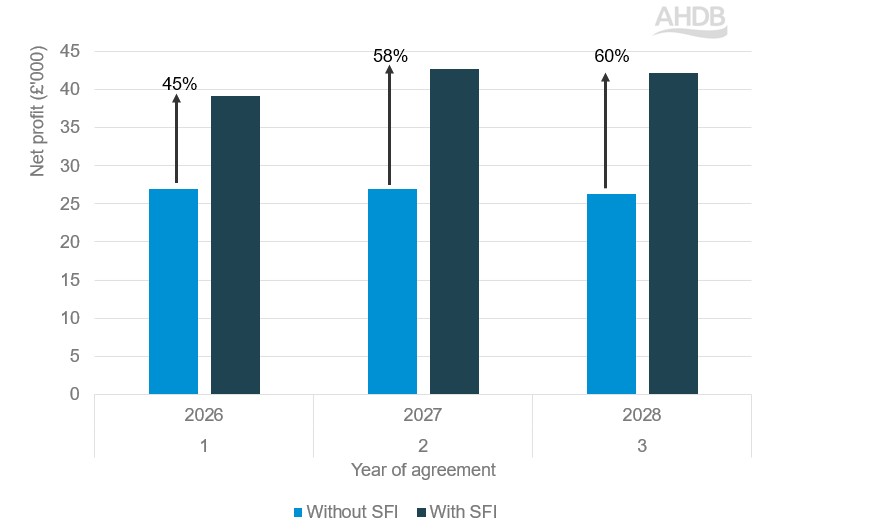
Figure 1 shows that the net profit (total revenue minus total costs) of the 150 ha beef and sheep farm increases by 45% in year 1, 59% in year 2 and 60% in year 3.

Figure 1. Effect on 150 ha beef and sheep farm’s net profit level 

Source: AHDB

The percentage changes shown in Figure 1 are based on the farm having a gross profit level of £126,584 (£844/ha). If the 150 ha beef and sheep farm had a gross profit level of £112,284 (£749/ha), the percentage changes in years 1, 2 and 3 would be 97%, 125% and 131% respectively.

How much money can the 150 ha beef and sheep farm make from SFI26?

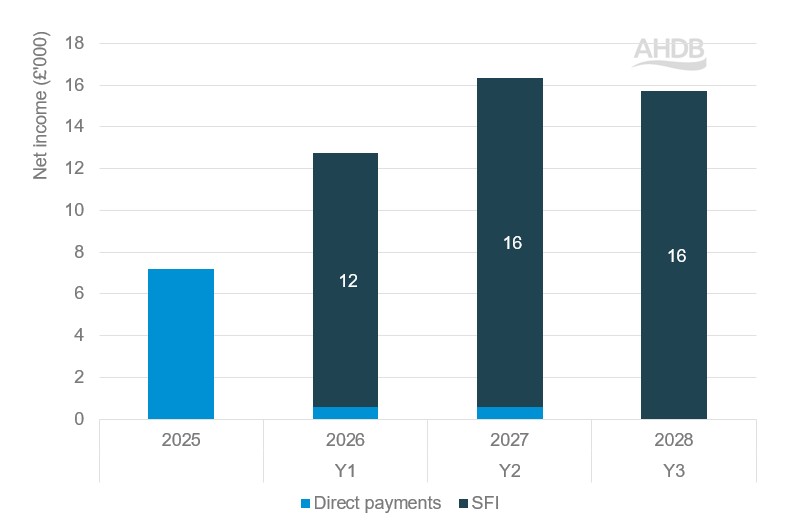
Figure 2 shows the income that would be received by AHDB’s 150 ha beef and sheep virtual farm from taking part in SFI26.

Figure 2. Three-year projection of income received by a 150 ha beef and sheep farm from direct payments and SFI actions

Source: AHDB

Breakdown of SFI payments for 150 ha beef and sheep farm

As a result of taking part in SFI26, the farm receives an extra £14,600 on average per year over the three-year duration of the SFI agreement. The total income received over the duration of the agreement is £43,900.

Analysis of the 220 ha mixed farm

Table 2 shows the SFI actions selected for the mixed farm along with payment rates and areas.

Table 2. SFI actions with payment rates and area of land in 220 ha mixed farm

CodeActionPayment per yearArea of length

CHRW2

Manage hedgerows

£13 per 100 m – one side

10,000 m

CIPM3

Companion crop on arable and horticultural land

£55/ha

14 ha

CIPM4

No use of insecticide on arable crops and permanent crops

£45/ha

17 ha

CNUM2

Legumes on improved grassland

£102/ha

10 ha

PRF1

Variable application of nutrients

£27/ha

90 ha

HEF1

Maintain weatherproof traditional farm or forestry buildings

£5/m2

540 m2

CSAM3

Herbal leys

£224/ha

10 ha

CIGL1

Take improved grassland field corners or blocks out of management

£333/ha

5 ha

CIGL2

Winter bird food on improved grassland

£515/ha

5 ha

CLIG3

Manage grassland with very low nutrient inputs (outside SDAs)

£151/ha

5 ha

GRH10

Lenient grazing supplement

£28/ha

5 ha

WBD6

Remove livestock from intensive grassland during the autumn and winter (outside SDAs)

£115/ha

90 ha

SDA: Severely disadvantaged area

Source: Defra, AHDB

What’s the overall impact of SFI26 on the 220 ha mixed farm’s net profit?

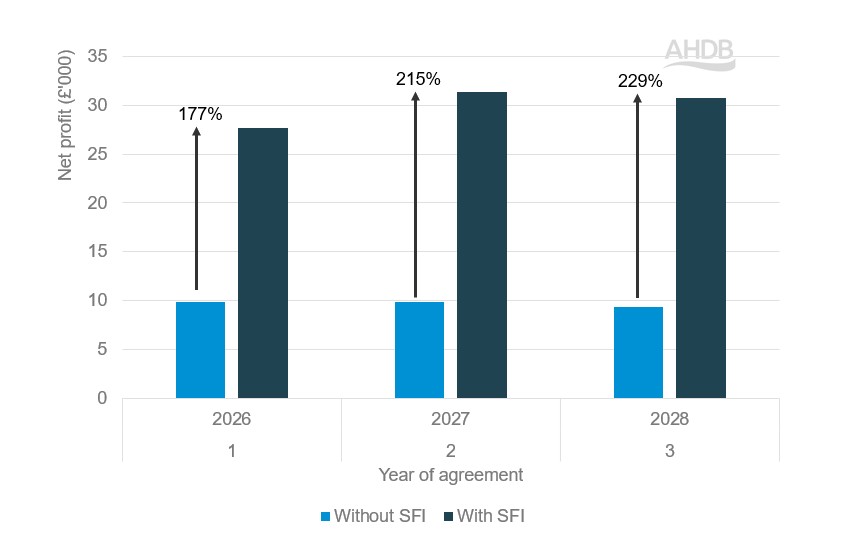
Figure 3 shows that the net profit of the 220 ha mixed farm increased by 178% in year 1, 216% in year 2 and 230% in year 3.

Figure 3. Effect on 220 ha mixed farm’s net profit level

How much money can the 220 ha mixed farm make from SFI26?

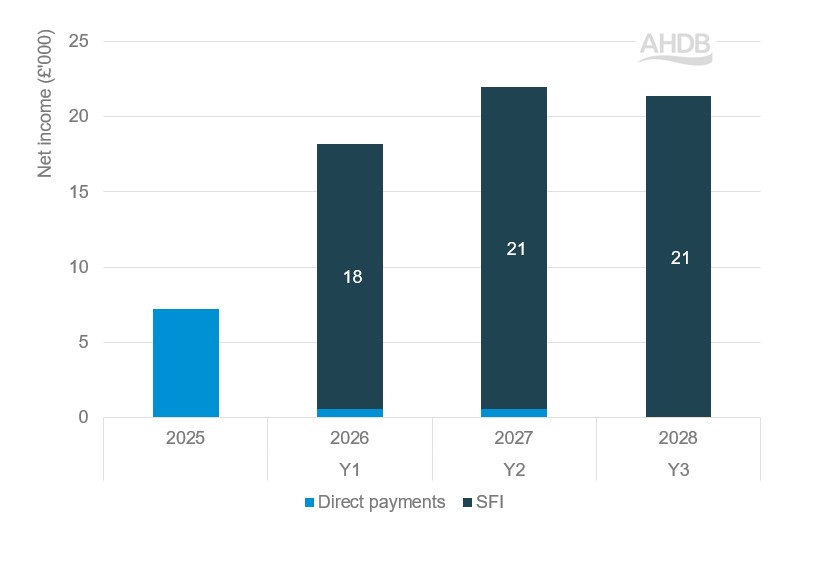
Figure 4 shows the income that would be received by AHDB’s 220 ha mixed virtual farm after participating in SFI26.

Figure 4. Three-year projection of income received by 220 ha mixed farm from direct payments and SFI actions

Breakdown of SFI payments for 220 ha mixed farm

As a result of taking part in SFI26, the farm receives £20,200 on average per year over the three-year duration of the SFI agreement. The total income received over the duration of the agreement is £60,600.

Conclusions

In this analysis, the 150 ha beef and sheep virtual farm benefited from taking part in SFI26 to the tune of £14,600 per year in additional income for three years. In total, the farm received £43,900 from SFI26. The 220 ha mixed farm was £20,200 better off on average per year (£60,600 in total).

The 150 ha beef and sheep farm and the 220 ha mixed farm received £33,800 and £51,300 respectively from direct payments before phased reduction began in 2021. Net income from SFI26 does not replace the income both farms received from direct payments but makes an important contribution to make up the shortfall. Farmers will need to explore a variety of options to make up this loss of income.

Land requiring actions on grassland are best done on the less productive areas as this minimises the opportunity cost (income foregone) associated with the loss of grazing potential.    

It is also worth considering what motivates you as a farmer. Some actions may not give a good financial return straightaway but may provide benefits in future if it increases the productivity of your grassland.

Each farm is different – careful planning and selection will help businesses to maximise their economic and environmental potential from the SFI. From the economic perspective, our SFI cost benefit tool allows farmers to examine the net benefit of actions for their own farms, including assessing the opportunity cost involved.

The SFI is not designed to mitigate the loss of direct payments, but it is a source of stabilisation for farm business incomes and will have a greater impact for farms with relatively lower profitability and in years when there are unfavourable market and/or weather conditions

It is in farmers’ interest to investigate which options work for their farm to make the best-informed decision about their business.

Explore related SFI tools and guidance

SFI cost benefit tool

Access more information about the SFI cost/benefit tool

Sustainable Farming Incentive

Environmental Land Management Schemes

Climate resilience on-farm action planner

Carbon markets

Preparing for change: the characteristics of top performing farms

Explore the main SFI stacking options page

×