Grass allocation and feed budgeting for wintering at grass

Knowing your target grass covers can help you plan ahead and maximise grass utilisation. See our tips and advice on how to achieve this.

Why is accurate grass allocation important?

Assessing the available feed in the fields in kg dry matter (DM) per ha allows grass to be rationed according to stock requirements.

Without rationing, there is risk of over or under-estimating what grazing provides. Underestimation represents an inefficient use of a cheap feed, and overestimating will result in loss of body condition, compromising animal health and performance.

As with other crops, deferred grazing requires a flexible approach.

Aim for a dense sward with a high proportion of leaf to live material to maximise quality.

Permanent pasture or long-term leys are suited due to their dense swards, which can minimise soil damage. Grass growth and quality can vary greatly from November onwards, with an average of 11 MJ/kg DM ME expected.

Target grass covers

Turn animals out onto covers of around 3,250 kg DM/ha and graze down to 1,500 kg DM/ha. Farm grass cover should average at 2,000–2,500 kg DM/ha before the winter system commences. 

The residual is the amount of grass (or cover) that is left following grazing. If this is too high, it represents a wasted feed opportunity and may compromise tiller density and feed quality in the spring.

If managed appropriately, outwintering on strip grazed grass fields can be achieved without substantially damaging pasture or reducing the subsequent years of grass production.

Estimate grass supply by using a calibrated sward stick that converts sward height to kg DM/ha, or use a plate meter.

Take care when using a plate meter on very high swards (above 3,500 kg DM) or where there are a lot of stems, as the accuracy of the readings will be reduced.

For more information, see Grass measuring methods for rotational grazing.

Table 1. Converting compressed grass height to dry matter (DM) quantity per ha

Season

Feed available (kg DM/ha) estimations according to compressed grass height

1 cm

2 cm

3 cm

4 cm

5 cm

Winter

830

990

1,140

1,300

1,460

Spring

680

1,050

1,340

1,580

1,780

Late spring

800

1,120

1,400

1,650

1,880

Summer

930

1,190

1,450

1,710

1,980

Autumn

810

1,050

1,290

1,540

1,780

Note: These figures provide reference values, but will vary according to weather, location, grass variety and age of pasture

High rainfall in spring generally leads to low DM content, while low rainfall in summer creates higher DM content. It also accounts for seasonal variation in the amount of seed heads, green material, dead material and clover content.

Example allocation for ewes

Demand in mid pregnancy is: 65 x 0.015 (1.5%) = about 1 kg DM/ewe/day. This allows for 15% wastage, as DM intake will be 0.85 kg/day.

On 2–3 days shifts, waste will be 15–30% and therefore allocate more. Demand in late pregnancy is: 65 x 0.02 (2%) = 1.3 kg DM feed/ewe/day.

Table 2. General intake requirements for different classes of sheep

Stock Intake requirements (% of body weight)
Dry ewes 1.5
Mid-pregnancy ewes 1.5
Late pregnancy ewes 2.0
Mid to late lactation ewes 2.5
Early lactation ewes 3.0+
Growing lambs 4.0+

Note: Allows for some feed rejection and is based on high feed quality for a flock scanning at approximately 150%.

Table 3. Daily feed requirements from scanning to lambing adjusted for pasture quality and scanning results (kg DM/ewe/day for a 65 kg ewe (% of body weight))

Feed quality Single lamb Twins Triplets
Low 1.2 (1.8%) 1.5 (2.2%) 1.6 (2.5%)
High 1.1 (1.6%) 1.3 (2.0%) 1.5 (2.2%)

Note: Calculated using SRUC Feedbyte rationing software

Use these figures as a guide and increase allowances to 3% of liveweight per day in wet and windy weather to allow for extra demands and feed wastage.

If grass growth has been poor and ewes are losing too much condition, feed up to 0.45 kg of concentrates/day gradually and house if necessary.

Preparing a feed budget for deferred grazing

Once the livestock nutrition demand and grass DM supply have been estimated, a feed budget can be prepared and paddocks set up.

A feed budget will help you to gain a better understanding of how grass supply will meet demand.

An example feed budget is shown in Table 4, or use the our grass and supplementation budget planner or Feed budget and rotation plan for cattle

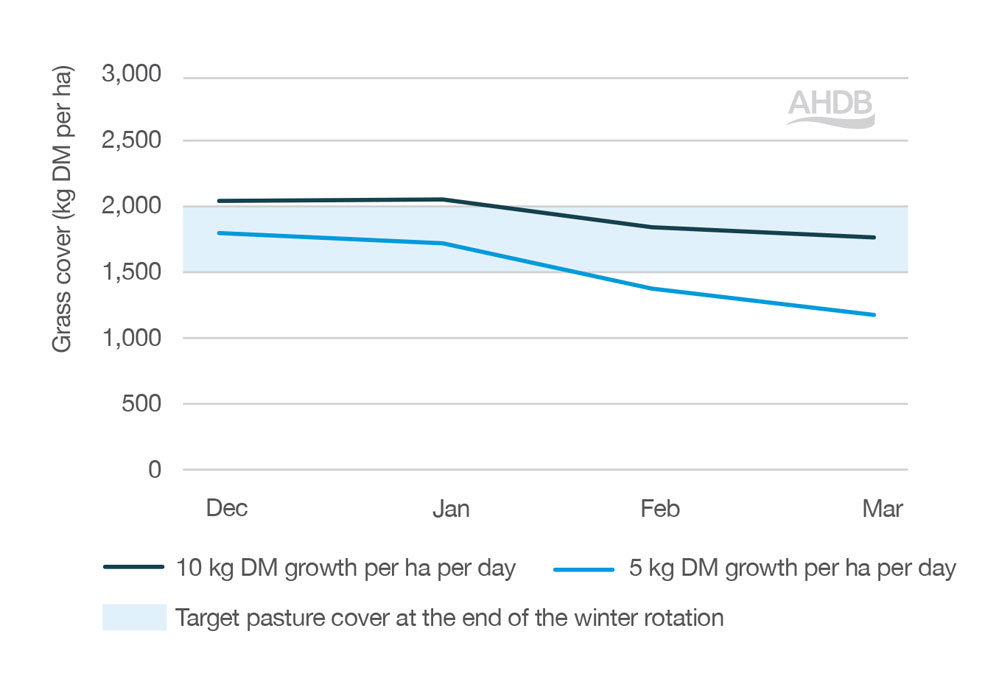
Table 4. Feed budget for 950 mature ewes assuming 10 kg DM/ha/day grass growth, high feed quality and 200% scanning (initial cover 2,000 kg DM/ha)

Measurement December January February
Grazing area (ha) 110 110 110
Grazing days 31 31 28
Net growth rate (kg DM/ha/day) 10 10 10
Animal intakes December January February
Number of ewes 950 950 950
Weight (kg) 65 67 69
Intake (% of body weight) 1.5 1.5 2.7
Daily intake (kg DM) 1.0 1.0 1.9
Total daily requirement (kg DM) 950 950 1,770
Total monthly animal intake (kg DM) 29,450 29,450 49,556
Animal intake per ha (kg DM/ha/day) 8.6 8.6 16
Difference between growth and intake (kg DM/ha/day) 1.4 1.4 -6.0
Average farm cover (kg DM/ha) 2,043 2,086 1,919

Note: The feed budget accounts for weight increase as pregnancy progresses.

Animal intake per ha per day (daily intake/area) is calculated to determine the difference between intake and growth per ha, which will affect cover (difference x grazing days plus starting cover).

Figure 2. Comparing two winter grass growth scenarios with the spring cover target of between 1,500 and 2,000 kg DM per ha

Graph comparing two winter grass growth scenarios with the spring cover target of between 1,500 and 2,000kg DM per ha.

Adverse weather

An important part of budgeting is making provision for adverse weather events.

Silage or hay can be useful for snow or frost, and allowance should be calculated based on animal demand, assuming 10–30% wastage.

Silage should be analysed for precise figures on DM percentage and energy content. An average of 10.5 MJ/kg DM ME is required.

Snow cover for five days in mid–January would result in the following:

6.3 kg fresh weight/head/day silage allowance (40% DM) x 950 ewes = 6 tonnes silage FW requirement per day

Over the five-day period, this could use up to 30 tonnes FW of silage or 50 bales (at 600 kg each).

Moving stock from good grazing pastures onto a ‘sacrifice field’ in wet weather that is planned for a reseed will reduce poaching damage in the most productive fields.

High stocking rates in wet weather increases the likelihood of compaction.

Some farmers have found moving livestock every 12 hours on well-established reseeds in wet weather limits pasture damage.

Useful links

Grass and forage management

Order a copy of our guide to using brassicas

×