A widening price gap between GB and Irish cattle prices: Beef market update

Friday, 4 September 2026

Irish cattle prices have seen downward pressure in recent weeks, increasing the price differential to GB. In this article, we explore the factors behind this trend.

Key points

  • Irish prime beef production is set to fall 4% in 2026, with exports to the UK already down by 10.5% in H1
  • The GB–Irish steer price differential widened to 66p/kg in the last week of August
  • Short-term supply recovery has pressured prices in recent weeks, but Irish cattle numbers remain on a longer-term downward trend

Production

The recent successive heatwaves and a record-dry summer have left Irish pastures scorched, and second silage cuts abandoned on many farms, tightening winter fodder supplies for the season ahead. Ireland has fared only marginally better than England, recording its driest July on record at 17% of average rainfall, compared with just 10% across England.

These difficult grazing conditions are adding to the longer-term contraction in Irish cattle supplies, which continues to be reflected in slaughter volumes.

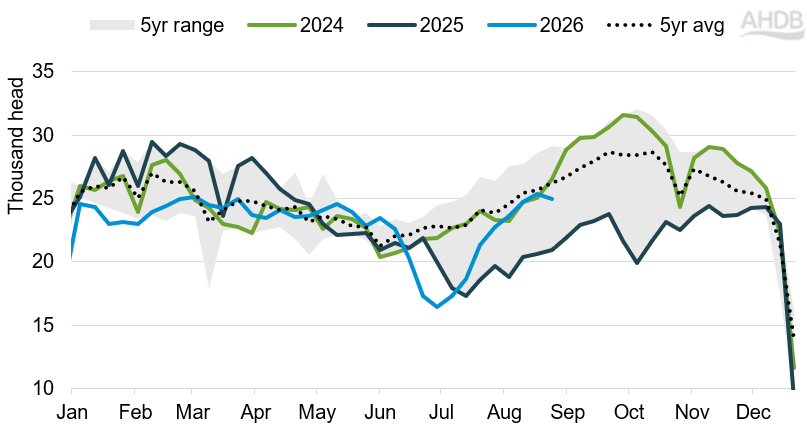
For 2026 to date, up to the end of w/c 24 August, prime cattle slaughter in Ireland totalled 802,000 head, a fall of 4% year-on-year.

Figure 1: Irish prime cattle kill, weekly in thousand head

Irish weekly prime cattle kill 2024,2025,2026, and 5 year average and range.

Source: DAFM

Figure 1 shows the number of weekly Irish prime cattle kill for 2024,2025, 2026, the 5 year average and the 5 year range. The data is from DAFM. This shows 2026 (light blue) in line with the 5 year average (black dotted line) until June where it falls below the 5 year range (grey area), and recovers back by last week of August.

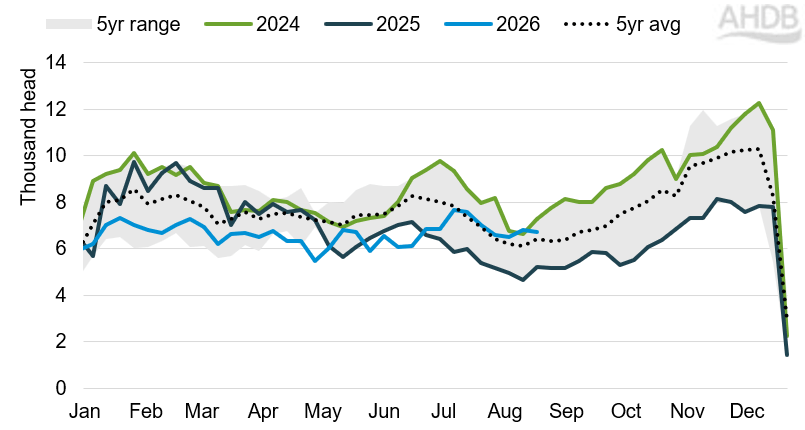
Greater declines have been seen in cow slaughter, back by 6% on the year to total 226,000 head for the same period.

Figure 2: Irish cow kill, weekly in thousand head

Irish weekly cow kill 2024,2025,2026, and 5 year average and range.

Source: DAFM

Figure 2 shows the number of weekly Irish cow kill for 2024,2025, 2026, the 5-year average and the 5-year range. The data is from DAFM. The 2026 (light blue) line sits below the 5 year average from January 2026 until July, where it has stayed in line until the last week of August.

Prime cattle carcase weights have grown across all categories for the first half of 2026, with steers and heifers up by 21kg and 15kg on average, versus last year. This has been driven by a combination of factors, such as a heightened focus on genetics, a push on value per head, and lower feed costs.

These increased weights are somewhat negating the impact on production of reduced throughputs, similarly to the situation in the UK.

Prices

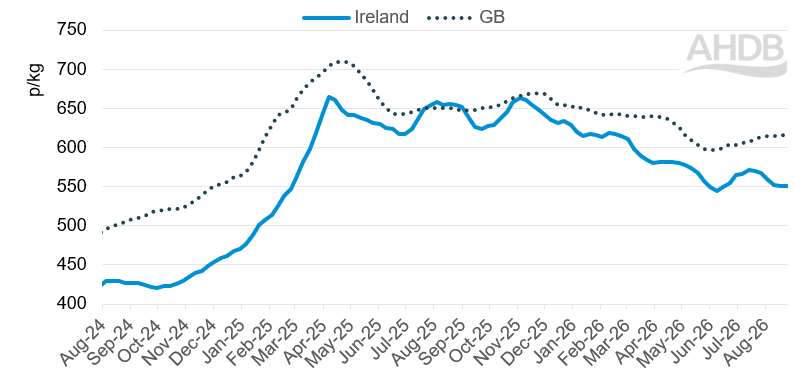
The Irish steer price sat at 551p/kg for the w/c 24 August 2026, down 103p/kg year-on-year from 654p/kg.

Following the price surge from 2024 to mid-2025, which peaked at 664p/kg in March 2025, Irish beef prices have tracked at comparable levels with the GB price, which has historically sat above Irish pricing.

Since December 2025, the two have begun to diverge, with Irish prices declining faster than GB. This comes as Irish beef exports into the UK and EU have faced competition from southern hemisphere producers and weaker consumer demand for beef, likely putting downward pressure on prices.

For the w/c 24 August, the Irish and GB steer price differential was 66p, widening the gap from the 52-week average of 34p.

Figure 3: Irish and GB steer price, p/kg

Irish and GB steer price over a 104 week period ending w/c 24 August.

Source: AHDB

Figure 3 shows the Irish and GB steer price in pence per kilogram over a 2 year period from 1 August 2024 to 24 August 2026. The Irish (light blue line) and GB (dark blue line) steer prices climbs steeply in 2024 until April 2025, where both sit flat until December 2025, with Irish steer price declining faster than GB steer price.

Trade

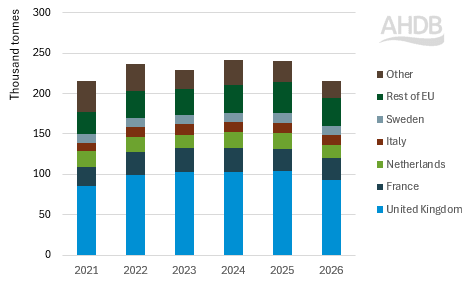
Irish total beef (fresh, frozen, processed and offal) exports fell by 10.4% in the first half of 2026, compared to last year. The proportion exported to each destination country remained near constant, with UK exports falling by 10.5% in the same period.

Exports declined across all product categories, with frozen and processed beef falling away the most, 18.7% and 14.2% respectively. Fresh and offal beef fell away the least, falling 6.3% and 8.6% respectively.

Figure 4: Ireland H1 beef exports, by destination country

Irish beef exports H1 over the period 2021 to 2026.

Source: HMRC via TDM LLC

Figure 4 shows Irish beef export volume for the first half of the year in the period 2021 to 2026, for processed (inc corned), offal, frozen and fresh beef, by country. This shows volumes remaining relatively constant year-on-year until 2026, where volumes reduced.

Irish beef imports increased by 20.2% in the first half of 2026. This comes as a combination of lower domestic supply and closer price parity with the UK.

UK beef exports to Ireland rose 24.1% in H1 2026. Growth was found in fresh and offal, growing 42.1% and 35.2% on last year’s volumes, respectively, with frozen remaining unchanged and processed beef falling 19.2%.

What’s the outlook for the remainder of 2026?

Ireland's recent price easing has been driven by softer demand and a modest recovery in cattle availability, with forecasts indicating a more normal seasonal supply pattern in the second half of 2026 relative to the exceptionally low levels of autumn 2025. While this may continue to weigh on prices in the near term, the longer-term outlook remains shaped by a structurally declining cattle supply base.

Teagasc have highlighted the difficult start to the 2026 Irish grazing season, due to poor weather, which is likely to delay the supply of cattle off grass and reinforces its forecast of a further 4% fall in Irish prime beef production this year.

On the demand side, like in the UK, summer typically lifts demand for manufacturing beef and barbecuing products, and recent promotions have delivered strong results, underlining beef's continued resonance with consumers. However, volumes in retail have been impacted by price-conscious shoppers switching to cheaper protein sources.

Implications for UK

In terms of UK imports, there is likely to be less Irish beef to draw on over time, so the pull towards southern hemisphere suppliers looks structural rather than short-term. This could leave UK imports more exposed to global shocks than to Irish conditions alone.

For UK exports into Ireland, the price competitiveness seen in the first half of the year seems to have been lost as the GB–Irish spread widens back out. The export outlook stays tied to that spread, as a sustained gap keeps British beef on the back foot into the EU market, while any renewed convergence, potentially as tightening Irish supply firms prices, could reopen the window.

Image of staff member Sebastian Abbott

Sebastian Abbott

Trainee Analyst

See full bio


Sign up for regular updates

You can subscribe to receive Beef and Lamb market news straight to your inbox. Simply fill in your contact details on our online form.

Visit the Keep in touch page

While AHDB seeks to ensure that the information contained on this webpage is accurate at the time of publication, no warranty is given in respect of the information and data provided. You are responsible for how you use the information. To the maximum extent permitted by law, AHDB accepts no liability for loss, damage or injury howsoever caused or suffered (including that caused by negligence) directly or indirectly in relation to the information or data provided in this publication.

All intellectual property rights in the information and data on this webpage belong to or are licensed by AHDB. You are authorised to use such information for your internal business purposes only and you must not provide this information to any other third parties, including further publication of the information, or for commercial gain in any way whatsoever without the prior written permission of AHDB for each third party disclosure, publication or commercial arrangement. For more information, please see our Terms of Use and Privacy Notice or contact the Director of Corporate Affairs at info@ahdb.org.uk  © Agriculture and Horticulture Development Board. All rights reserved. 

Topics:

Sectors:

Tags:

×