China pork market update: oversupply and weak demand weigh on prices

Monday, 6 July 2026

Key points

  • Pork production continues to increase in 2026 driven by productivity gains and increased slaughtering
  • Liveweight and wholesale prices ease, below year ago levels
  • Pig meat and offal imports decline amid oversupply in the domestic market and weakening demand
  • Global geopolitical factors will influence trade flows

Supply

China is the largest pork producing country globally and produces nearly half of the global pork output. The increasing pork production in 2025 has rolled into the beginning of 2026. According to the National Bureau of Statistics, China’s pork production in the first quarter of 2026 increased 4.2% year-on-year to 16.7 million metric tonnes. Chinese producers slaughtered 200.3 million pigs, an increase of 2.8% compared to the same period previous year. Productivity gain is the main driver behind increasing production.

The Chinese government has been taking steps to reduce sow herds and maintain slaughter weights around 120kg to rebalance supply and demand in the market. Grant of credit and subsidies is also restricted to curb supply. According to USDA, China is likely to produce around 59.5 million metric tonnes pork in 2026, almost stable compared to 2025. The increase in slaughter volumes will be balanced by government’s policies to limit carcass weights, thereby stabilising pork output. A new government directive in March aims at sow herd reduction to 36.5 million head, which stood at 39.6 million head at the end of 2025.

Prices

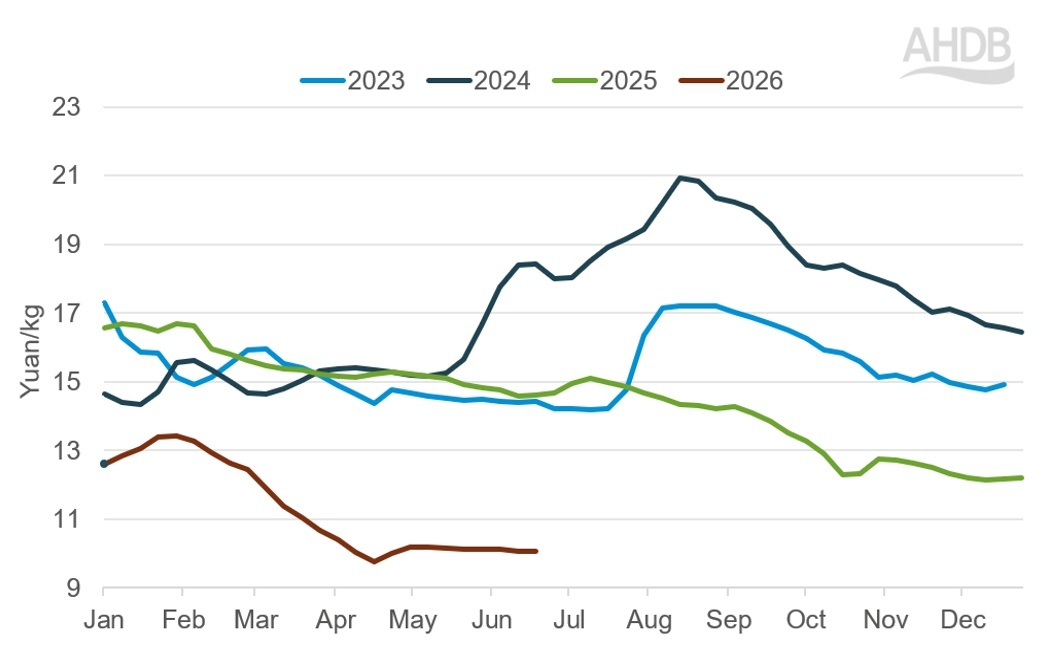
Chinese average pig prices have continued the decline in 2026. So far this year (Jan to 17-Jun), average price stood at 11.3 yuan/kg, a decline of 4.2 yuan/kg (27%) compared to the same period previous year. There was slight uplift in prices at the start of the year but declines thereafter. Ample supply in the domestic market amid weak demand is pressurising prices. Government’s drive to reduce national herd size increased slaughtering, thereby adding to production. However, with prices below break even, state and local governments initiated purchases for pork reserves to support prices. From April onwards, prices have been stable.

Seasonally demand remains weak after the Lunar New Year in February. However, some recovery is expected in 2H 2026 as production will decline amid herd reduction measures.

Figure 1. Chinese pig prices, liveweight (Yuan/kg)

Chinese pig prices liveweight.

Source: pig333

Figure 1 is a line chart showing Chinese pig prices on the right vertical axis (Yuan/kg) during last four years. The horizontal axis displays the months of the year. In 2026, prices are stabilising from April onwards.

2023 (light blue line)
2024 (dark blue line)

2025 (green line)
2026 (dark red line)

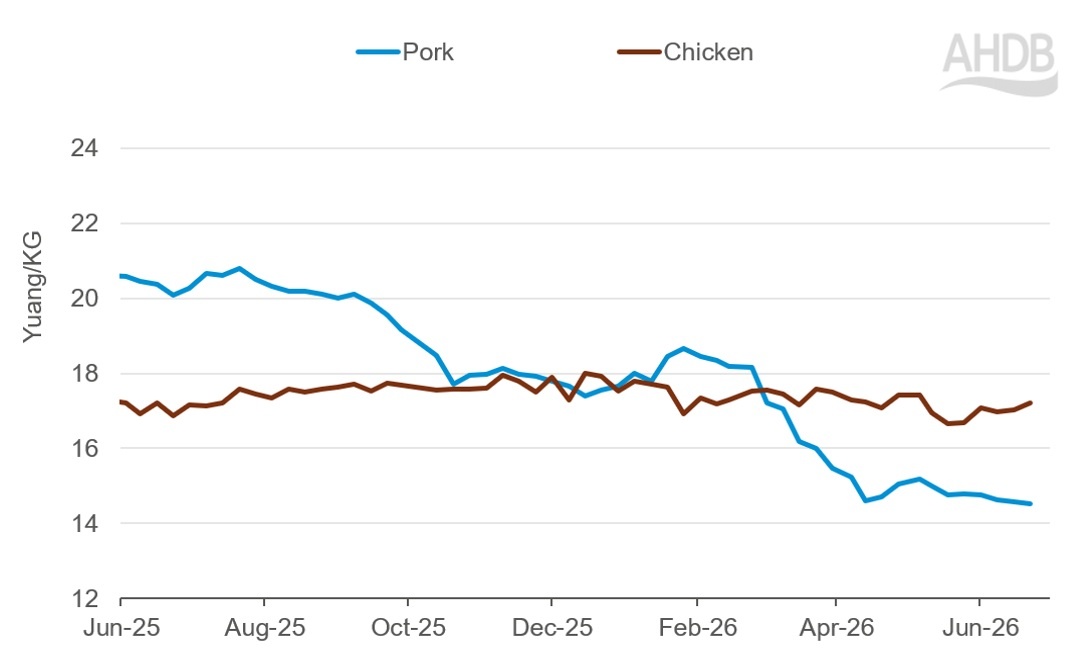
Wholesale pork prices have also declined in line with liveweight prices from the start of the year. However, recently prices look to be stabilising. According to MARA (Ministry of Agriculture and Rural Affairs) data, the national wholesale average stood at 14.5 yuan/kg for the week ending 22 June, around 28% lower compared to the same period last year.

In the later part of 2026, prices are expected to be stable to slightly higher following decline in production amid herd reduction measures initiated by the government. However, any upside will be limited on the back of lacklustre demand in foodservice and retail. Consumption has been declining in 2026 as consumers shift towards cheaper options like eggs, tofu and soy-based proteins.

Figure 2. Chinese pork wholesale prices (Yuan/kg)

Chinese pork wholesale prices.

Source: Chinese Ministry of Agriculture and Rural Affairs

Figure 2 is a line chart showing national Chinese wholesale pork and chicken prices on the right vertical axis (Yuan/kg) during last one year. The horizontal axis displays the months of the year. In 2026, prices are stabilising from April onwards.

wholesale pork price (light blue line)
wholesale chicken price (dark blue line)

Imports

In 2026 till date (Jan -May), China’s imports of both pig meat and offal declined. This is in contrast with the last few years trend of declining volumes of pig meat imports and increasing volumes of offal imports. The overall decline in imports denotes ample supply in the domestic market amid subdued demand. Total pig meat imports declined by 30% to 314,000 tonnes in 2026 (Jan -May) compared to the same period in the previous year.

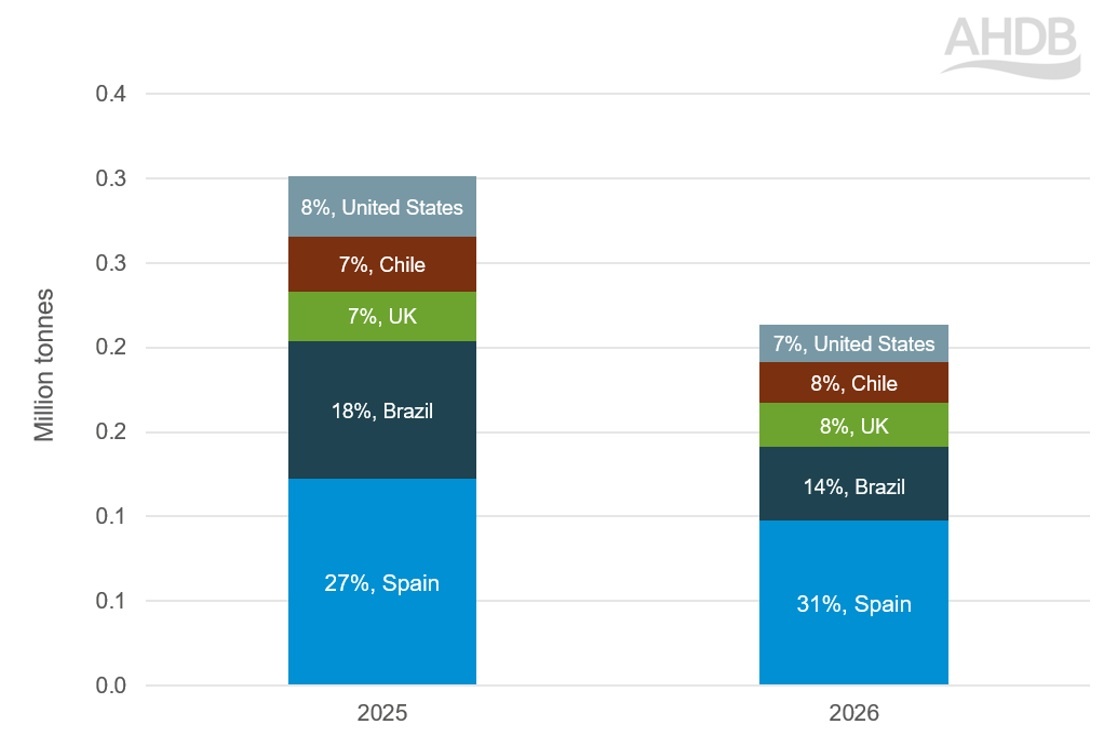
The EU27 continues to be the largest exporter of pig meat (excluding offal) to China, despite the anti-dumping duties (4.9% to 19.8%) imposed by China. Spain has retained its position as the largest supplier. Brazil and United Kingdom hold the second and third position respectively. The United States continued to lose share following retaliatory tariffs on imports and Brazilian imports were costlier.

Figure 3. China pig meat imports (excl offal), top 5 countries (Million tonnes)

China pigmeat imports Q1 2026.

Source: Compiled by Trade Data Monitor LLC

Figure 3 is a bar chart showing percentage share of major pig meat exporting countries to China in 2025 and 2026. In 2026 percentage share of Spain, United Kingdom and Chile increased while that of Brazil and United States declined.

Spain (light blue)
Brazil (dark blue)

UK (green)
Chile (dark red)

United States (grey)

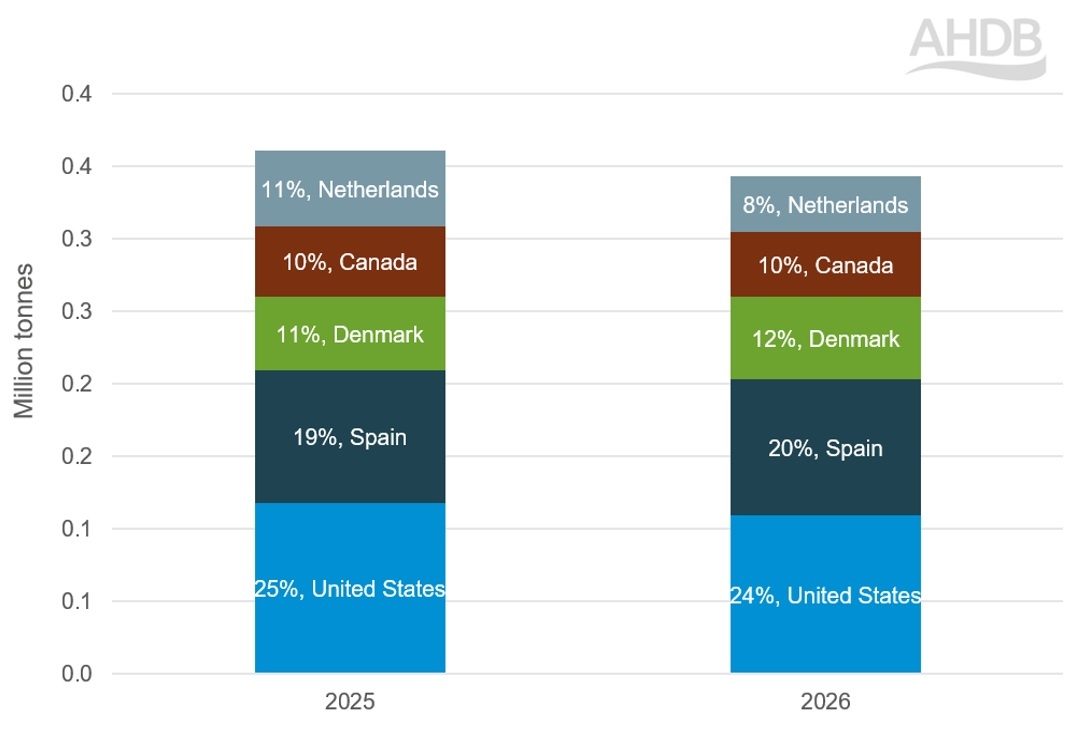
Focusing specifically on the offal category, the EU27 continues to dominate the Chinese import basket with a 52% market share followed by the United States. Year-on-year, shipment volumes of offal have increased from the UK to China driven by increased production. In 2026 (Jan-May), the UK accounted for 8% of China’s total pig meat imports, marking an increase of 1% compared to the same period previous year. At the same time, the share of UK in China’s total offal imports also grew by 1% to 6% during the period.

Figure 4. China offal imports, top 5 countries (Million tonnes)

China pigmeat imports Q1 2026.

Source: Compiled by Trade Data Monitor LLC

Figure 4 is a bar chart showing percentage share of major offal exporting countries to China in 2025 and 2026. In 2026 percentage share of Spain and Denmark increased, Canada remained same while that of United States and Netherlands declined.

United States (light blue)
Spain (dark blue)

Denmark (green)
Canada (dark red)

Netherlands (grey)

What does it mean for British producers?

According to Rabobank, Chinese imports will decline in the first half of 2026 amid ample domestic supply and then increase gradually in the second half as domestic supply tightens amid herd reduction measures. Despite decline in total pigmeat and offal imports from China, the share of the UK has gone up in 2026. This denotes some positive sentiment for the British pork sector.

However, given the overall macro-economic scenario, consumer spending is likely to remain subdued.  In addition to China, the industry should focus on opportunities developing in emerging markets in South East and East Asia and improve value from the entire carcass.


Image of staff member Soumya Behera

Soumya Behera

Senior Analyst (Dairy)

See full bio

Sign up for regular updates

Subscribe to receive pork market news straight to your inbox. Simply complete our online form.

Visit the Keep in touch page

While AHDB seeks to ensure that the information contained on this webpage is accurate at the time of publication, no warranty is given in respect of the information and data provided. You are responsible for how you use the information. To the maximum extent permitted by law, AHDB accepts no liability for loss, damage or injury howsoever caused or suffered (including that caused by negligence) directly or indirectly in relation to the information or data provided in this publication.

All intellectual property rights in the information and data on this webpage belong to or are licensed by AHDB. You are authorised to use such information for your internal business purposes only and you must not provide this information to any other third parties, including further publication of the information, or for commercial gain in any way whatsoever without the prior written permission of AHDB for each third party disclosure, publication or commercial arrangement. For more information, please see our Terms of Use and Privacy Notice or contact the Director of Corporate Affairs at info@ahdb.org.uk  © Agriculture and Horticulture Development Board. All rights reserved. 

×