Impact of Middle East war on dairy sector

Wednesday, 6 May 2026

Key trends

  • War in the Middle East is affecting the global dairy sector
  • Iran is regionally important and also the fourth largest exporter of SMP globally
  • Gulf Cooperation Council (GCC) countries are mainly import dependent to meet dairy requirements and a key growth area for British dairy exporters
  • Strait of Hormuz closure has impacted trade flows and agricultural input costs

Overview

The recent escalation of the war involving Iran, Israel and the US has sparked volatility in the entire agricultural sector including dairy. This has resulted in supply disruptions and trade flows through the Strait of Hormuz and slowdowns via other routes. Due to this there has been an increase in fuel and fertiliser prices, thereby increasing input costs and pressurising farm margins.

This will have ripple effects across the dairy sector with long-lasting impacts. The situation differs from the outbreak of war in Ukraine when production was already tight.  Globally, there has been excess production of dairy products following spectacular growth in milk production in 2025 which  continued into 2026. Markets could be under further pressure with softening demand being unable to absorb the excess stocks.

Middle East dairy imports

Dairy forms a staple part of the diet in the Middle East and North African (MENA) region. Iran is largely self-sufficient, however other Middle East countries such as the United Arab Emirates, Kuwait, Oman and Bahrain are dependent on imports for their requirements. According to OECD-FAO trade data, the region accounts for around 15-18% of global dairy imports. Imports mostly consist of milk powders, butter and cheese.

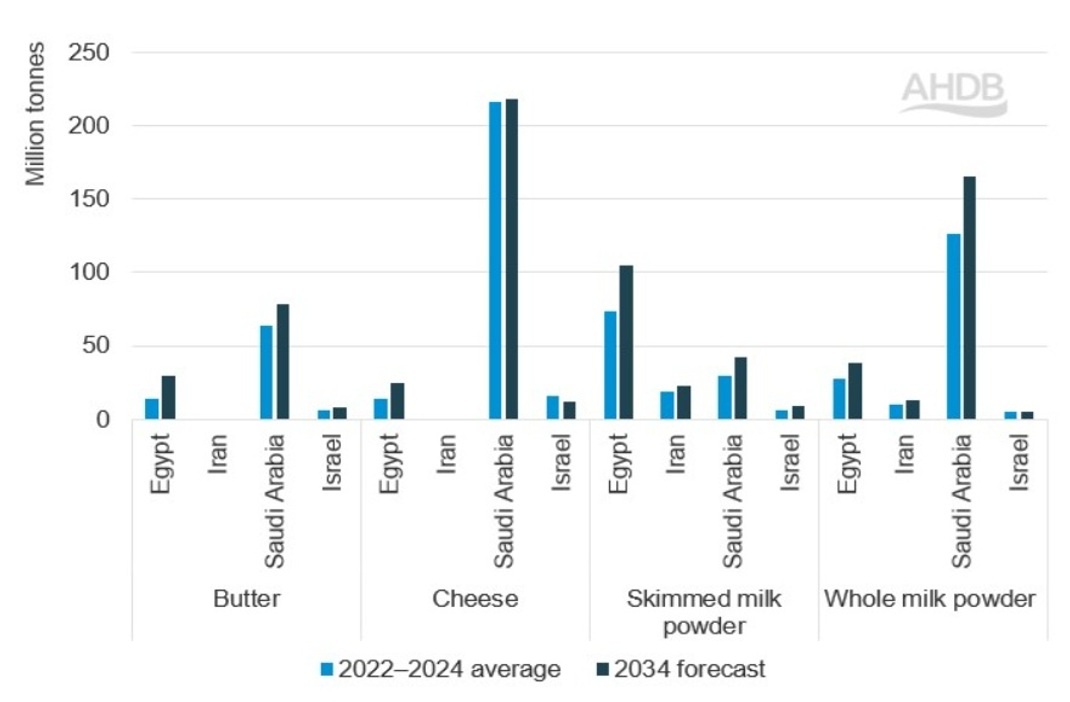
Figure 1. MENA dairy product imports in selected MENA countries (for which data is available)

Middle East dairy imports_May26

Source: OECD-FAO Agricultural Outlook 2025-2034

Figure 1 is a bar chart showing volume (in million tons) comparison of dairy products imports to select MENA countries during 2022-2024 (light blue) and forecast for 2034 (dark blue)

In the MENA region, Saudi Arabia is among the top dairy importers. According to OECD/FAO forecasts, Egypt is expected to show the largest percentage of growth in dairy imports between now and 2034 compared with the other countries.

UK cheese exports to Saudi Arabia averaged 2,400 tonnes between 2023 and 2025. Over the same period, UK cheese exports to the UAE reached a similar level (2,500 tonnes).

UK cheese exports to Egypt averaged 1,000 tonnes between 2023 and 2025.

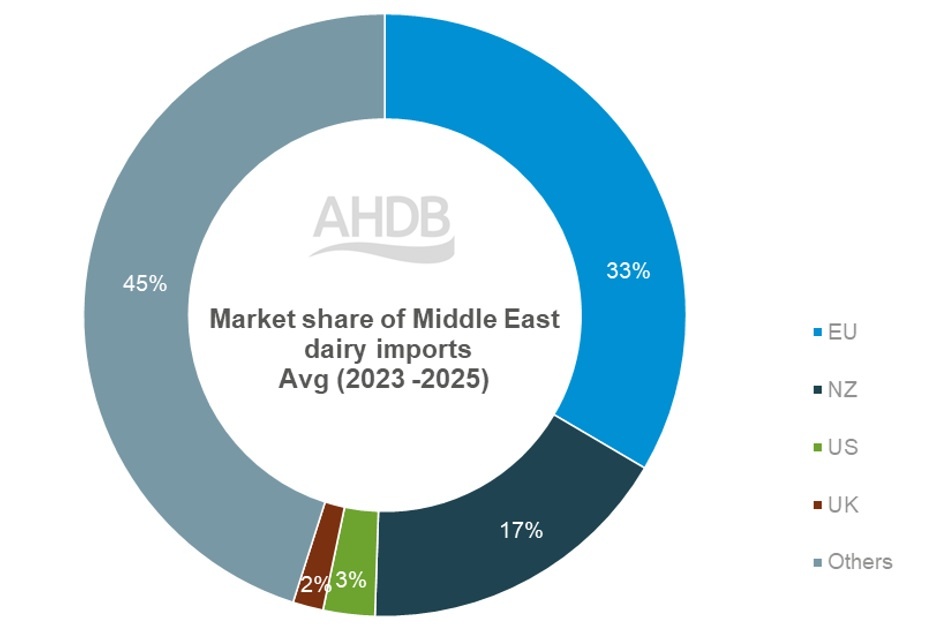
33% of total dairy imports of the region comes from the EU (based on average of 2023 to 2025), 17% from New Zealand and 3% from the US. Only 2% of the imports comes from the United Kingdom. The rest (45%) comes from the other countries, includingIran, Egypt, Turkey, India and Malaysia.

Figure 2. Import of Middle East dairy products, major sources (in percentage)

Market share of Middle East dairy imports_May26

Source: Trade Data Monitor LLC

Figure 2 is a pie chart showing Middle East imports of dairy products from major sources on an average during the last three years (2023 -2025) in percentage.

European Union (light blue), New Zealand (dark blue), United States (green), United Kingdom (dark red), Others (light grey)

Strait of Hormuz disruption

The Strait of Hormuz, located between Iran and Oman, is the primary shipping passage to the Persian Gulf linking major import markets like Iraq, Kuwait, Qatar, the United Arab Emirates (UAE), Bahrain and eastern Saudia Arabia with the major suppliers. In 2025, the Middle East dairy market size was estimated at $19.5 billion and imports comprising mainly of milk powders and functional dairy ingredients.

Trade flows between the countries will be affected by the conflict and the cost of imports will increase due to an increase in transportation and input costs. The war has removed the Red Sea, Suez and intermittently the Strait of Hormuz from normal dairy trade, sidelining ports like Jeddah, King Abdullah, Aqaba and Jebel Ali, and forcing dairy flows onto much longer Cape‑routed services or smaller alternative ports in Oman—raising costs, transit times and risk for Middle East dairy imports.

Along with dairy trade, the Strait of Hormuz is also critical for oil, gas and fertiliser exports from the Gulf. Around one-third of global fertiliser trade pass through the Strait and it handles around 20%-25% of global oil and gas shipments. Disruption in shipping is resulting in higher fertiliser and energy costs. This increases the input costs thereby squeezing dairy farmers margins further.

Middle East demand

Tourism in the region will also be affected, thereby weighing on demand for dairy products in the region. Oxford Economics estimate a decline of 11%, or 23 million international visitors to the region which could equate to $34 billion in lost revenue in total.

The other factor will be domestic demand, although dairy is a staple product in the Middle East the economic impacts of an ongoing war are likely to curtail demand overall, particularly for food service and encourage consumers to downtrade for cheaper alternatives (and less expensive imported products).

Iran dairy trade

Iran itself has emerged as an important regional dairy player, expanding its presence in nearby markets like Afghanistan and Pakistan. It was the fourth largest exporter of SMP in the world before the conflict began. As such, the country plays a crucial role in the Middle East dairy trade whilst exposure to the broader global market looks limited.

In 2025, total dairy exports amounted to 730,000 tonnes, an increase of 26.6% compared to previous year and around 35% higher compared to the 5-year average. In terms of value, exports of dairy products increased by 26% to £882Mn in 2025 compared to previous year.

Milk powders dominate the export basket and have witnessed a significant increase of 55% in 2025 year-on-year. This is followed by yoghurt, milk and cream, cheese, whey and butter. The share of milk powders in the export basket has increased from 23% in 2023 to 28% in 2025.

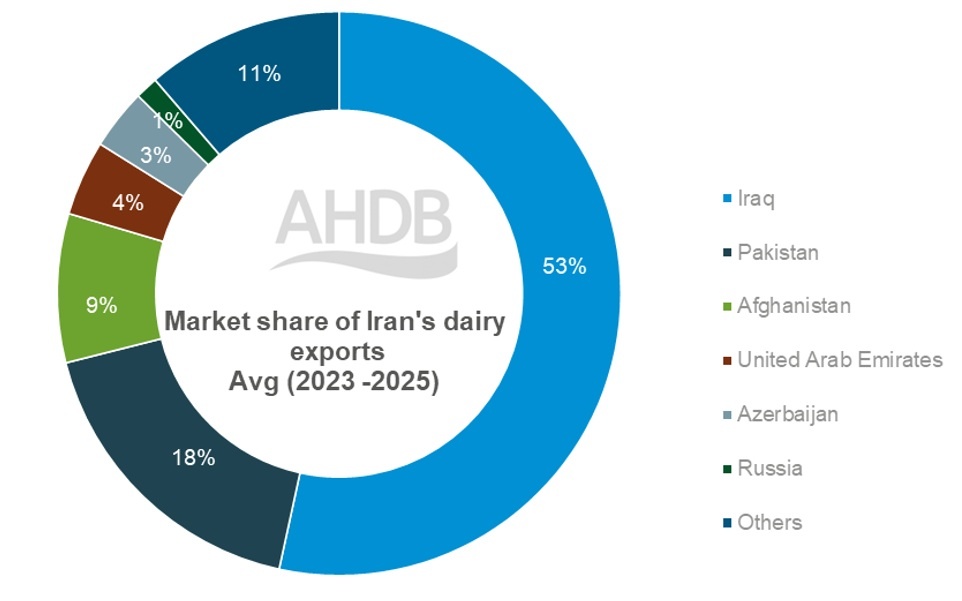
53% of total Iran’s dairy exports (based on average of 2023 to 2025) goes to Iraq, followed by Pakistan, Afghanistan and the United Arab Emirates at 18%, 9% and 4%, respectively. Lower freight costs and quicker transportation time has resulted in exports mainly to the neighbouring countries. A very meagre share of 0.01% was exported to the United Kingdom.

Figure 3. Export of Iran’s dairy products, major destinations (in percentage)

  Market share of Iran dairy exports_May26

 Source: Trade Data Monitor LLC

Figure 3 is a pie chart showing Iran’s export of dairy products to major destinations on an average during the last three years (2023 -2025) in percentage.

Iraq (light blue), Pakistan (dark blue), Afghanistan (green), United Arab Emirates (dark red), Azerbaijan (light grey), Cheese and curd (dark green), Others (blue)

Implications for the British dairy sector

The closure of Strait of Hormuz will make dairy exports to Iraq, Kuwait, Bahrain, Qatar, the UAE and Saudi Arabia east more difficult.

The GCC remains a high potential market for UK dairy products worth £99 million in 2025. The GCC (a trading bloc made up of UAE, Saudi Arabia, Bahrain, Oman, Qatar and Kuwait) is the second-largest export market outside Europe for dairy products from the UK and any disruption could put this revenue at risk.

In addition, due to the conflict, displaced products from major exporters would pressurize markets elsewhere.

Quality, traceability and food safety remain the strong selling points in the GCC which the British dairy industry can assert upon.

Exporters have to look into building flexibility in logistics, strengthen relationships and review payment and pricing strategies. These measures will help the sector to navigate turbulent and volatile market conditions.

Unfortunately, global demand is expected to remain subdued given the current geopolitical scenario with consumers reeling under inflationary pressure. If the war lasts longer, it could have wide-reaching impacts outside of the Middle East in terms of global consumer demand.


Sign up to receive the latest information from AHDB.

While AHDB seeks to ensure that the information contained on this webpage is accurate at the time of publication, no warranty is given in respect of the information and data provided. You are responsible for how you use the information. To the maximum extent permitted by law, AHDB accepts no liability for loss, damage or injury howsoever caused or suffered (including that caused by negligence) directly or indirectly in relation to the information or data provided in this publication.

All intellectual property rights in the information and data on this webpage belong to or are licensed by AHDB. You are authorised to use such information for your internal business purposes only and you must not provide this information to any other third parties, including further publication of the information, or for commercial gain in any way whatsoever without the prior written permission of AHDB for each third party disclosure, publication or commercial arrangement. For more information, please see our Terms of Use and Privacy Notice or contact the Director of Corporate Affairs at info@ahdb.org.uk  © Agriculture and Horticulture Development Board. All rights reserved. 

×