Resilient exports continue in Q2: Pork market update

Thursday, 3 September 2026

UK pig meat trade remained resilient in the first half of 2026, with stronger exports and lower imports boosting self-sufficiency, despite softer trade flows in Q2 and ongoing global market uncertainty. We explore the latest data.

Key points

  • Despite a softer Q2, UK pig meat exports remained 11% ahead year-on-year in the first half of 2026, supported by increased domestic supply and continued demand from key overseas markets.
  • Disease disruption and shifting global demand continue to reshape trade flows, creating opportunities in markets such as South Africa and the Philippines while Chinese demand remains subdued.
  • Strong domestic production and lower imports lifted UK pig meat self-sufficiency to 66% in the first half of 2026, up from 61% a year earlier.

Import volumes increase marginally on Q1 levels

Imports of pig meat (including offal) into the UK increased by 1% in the second quarter (Q2) compared to the first quarter (Q1) of 2026. However, when compared to the same period in 2025, volumes were back by 8%.

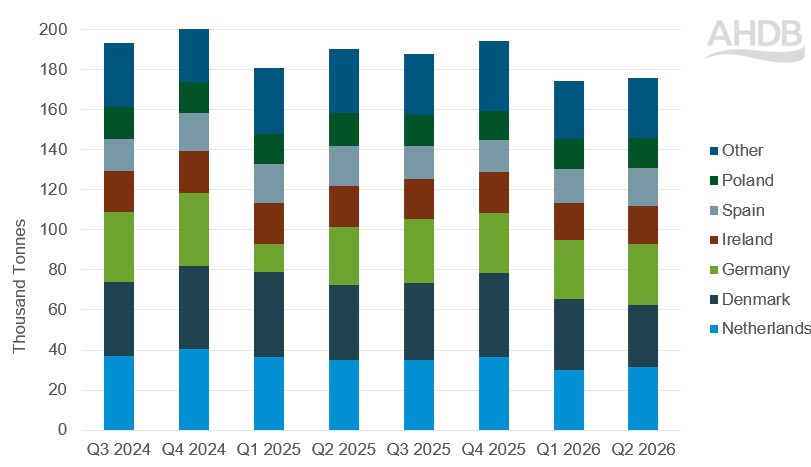
Figure 1: Quarterly UK pig meat (incl. offal) import volumes by origin in thousand tonnes from Q3 2024 – Q2 2026

Source: HMRC via Trade Data Monitor LLC

Figure 1 shows the volume of pig meat imported by the UK from country of origin, over each quarter from Jul 2024 – Jun 2026. Volumes from Denmark continue to be replaced with product from other European markets, including Spain, the Netherlands and Germany.

Import volumes from Denmark were down 12% quarter-on-quarter to 31,000 tonnes in Q2. The volume imported from Germany continued to grow, up by 3% in Q2 compared to Q1 as trade recovers following earlier restrictions.

Volumes from the Netherlands, Ireland, Spain and Poland rose in Q2 compared to Q1 but remained lower year-on-year.

Looking at cuts, the volume of bacon imported dropped by a further 3% quarter-on-quarter.

Volumes of bacon in UK retail dropped by 4.7% year-on-year in the 12 weeks ending 12 July. These declines could be influenced by consumers shifting away from more heavily processed / ultra-processed foods.

Overall, despite growth in Q2, UK pig meat import volumes were 5.6% lower year-on-year for the first half of 2026, at just over 350,000 tonnes. 

This comes as while the UK-EU reference pig price differential has narrowed, it remains on the wider end of historical ranges, averaging 40p in Q2.

Greater supply in the UK has likely contributed to smaller import volumes. When considering domestic production, import and export volumes, the UK’s self-sufficiency (domestic production as a percentage of available supply) has increased to 66% in the first half of 2026, up from 61% in the first half of 2025.

Export volumes drop after a bumper Q1 but stay strong historically

Exports of pig meat from the UK dropped by 4% in Q2 2026 compared to the high levels of Q1. Despite the quarterly fall, volumes remain elevated year-on-year.

The 84,700 tonnes exported over Q2 brought UK export volumes for the first half of the year to 173,200 tonnes, up 11% year-on-year. This was valued at £267.2 million, up 5% from the year before.

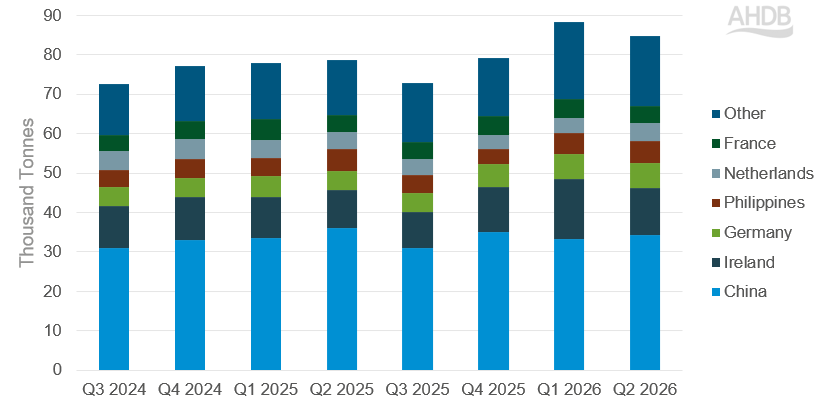
Figure 2: Quarterly UK pig meat (incl. offal) export volumes by destination in thousand tonnes from Q3 2024 – Q2 2026

Source: HMRC via Trade Data Monitor LLC

Figure 2 shows the volume of pig meat exported from the UK by destination, quarterly from Jul 2024 - Jun 2026. While volumes dipped in Q2, they remained above year-ago levels.

Export to China rose by 3% in Q2 compared to Q1, totalling 34,200 tonnes. Fresh and frozen pork continues to make up a larger proportion of this volume, accounting for 43%, up from 34% a year ago. The remainder is offal. For the first half of the year, total pig meat volumes to China have dropped by 3% overall.

The quantity exported to the EU dropped by 11% over Q2, with quantities to Ireland, Denmark, Germany and France all falling. However, when compared to Q2 2025, EU volumes were up 15%.

This brought the total volume of pig meat exported to the EU for the first half of the year to 73,100 tonnes, up 19%. During the first half of 2026, the volume exported to the EU was greater than that to China.

Elsewhere, shipments to the Philippines grew by 7% quarter-on-quarter, bringing year-to-date volumes up by 8% year-on-year.

Exports to South Africa grew by 14% quarter-on-quarter, with most growth in offal.

Increased domestic supply supports the export boost, driven by heavier carcase weights and higher slaughter numbers.

Looking forward

Disease remains a big issue for global pig meat supply and trade.

In the Philippines, ongoing disease challenges have prompted a 150,000 tonne increase in import quotas. While this presents additional market opportunities, competition is likely to be intense, particularly from low-cost exporters such as Brazil.

Outbreaks of foot and mouth and ASF in South Africa have disrupted domestic production and are driving import demand, which may continue to present opportunities for the UK if supply constraints continue.

Conversely, Chinese demand has softened. Lower pig prices and a contracting sow herd following a period of oversupply have reduced import requirements. As China takes less UK product, particularly offal, the UK continues to pursue alternative markets within Asia, although competition will be present from others looking to do the same. The impact of EU anti-dumping tariffs will be another key watchpoint for markets.

ASF remains one of the biggest risks to the UK pig sector. An outbreak would have significant implications for both domestic production and export access. Regionalisation agreements, such as those used in Spain, could help limit trade disruption. See our resources to help protect the UK from ASF spread.

Image of staff member Molly Corbett

Molly Corbett

Analyst (Livestock)

See full bio

Sign up for regular updates

Subscribe to receive pork market news straight to your inbox. Simply complete our online form.

Visit the Keep in touch page

While AHDB seeks to ensure that the information contained on this webpage is accurate at the time of publication, no warranty is given in respect of the information and data provided. You are responsible for how you use the information. To the maximum extent permitted by law, AHDB accepts no liability for loss, damage or injury howsoever caused or suffered (including that caused by negligence) directly or indirectly in relation to the information or data provided in this publication.

All intellectual property rights in the information and data on this webpage belong to or are licensed by AHDB. You are authorised to use such information for your internal business purposes only and you must not provide this information to any other third parties, including further publication of the information, or for commercial gain in any way whatsoever without the prior written permission of AHDB for each third party disclosure, publication or commercial arrangement. For more information, please see our Terms of Use and Privacy Notice or contact the Director of Corporate Affairs at info@ahdb.org.uk  © Agriculture and Horticulture Development Board. All rights reserved. 

Topics:

Sectors:

Tags:

×