What’s underpinning strong finished lamb prices? Lamb market update

Friday, 22 May 2026

Finished lamb prices remain exceptionally strong. What are the supply and demand factors influencing this, and what’s the outlook for the months ahead?

Key points

  • Lamb prices grew strongly throughout March and have remained at high levels following the seasonal demand peak, with the deadweight OSL SQQ reaching 871p/kg in the week ending 16 May.
  • While we’ve seen a larger carryover this year, production figures from Defra show clean sheep slaughter fell in April, with tighter supplies likely underpinning prices at this high level.
  • Domestic demand has been steady, with mixed performance across products. Meanwhile, we have seen strong growth in exports in the first quarter delivering value back to the farmgate.

How have prices moved in 2026 so far?

Lamb prices opened the year at a relatively steady level, and experienced a dip through the end of January, as domestic and export demand weakened, weighing on prices.

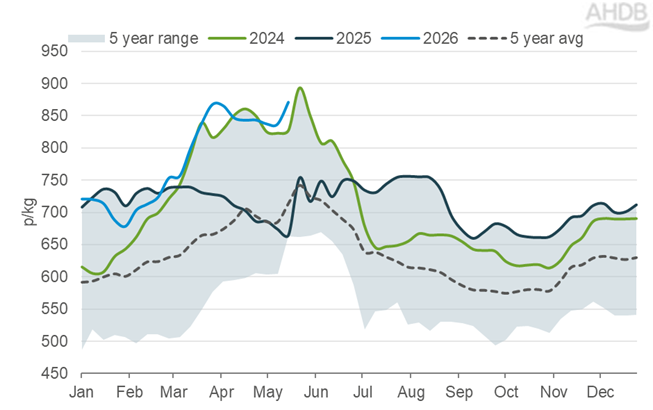
Since then, we have seen a period of strong growth in prices, with the old season lamb (OSL) SQQ rising by over 100p/kg throughout March to peak at 867p/kg in the week ending 28 March, a new record high for that week.

This period of growth followed typical seasonal trends, however, was stronger than we have seen in previous years.

We have since seen prices move back slightly but remain at record high levels, in line with those seen in 2024. Indeed in the latest reporting week (week ending 16 May), the deadweight OSL SQQ sat at 871p/kg, almost 160p above the five-year average.

Figure 1. GB deadweight reporting lamb SQQ

Reporting lamb price graph

Source: AHDB

Old season lambs reported until 3rd Monday in May, new season lambs then reported for the remainder of the year.

Figure 1 shows the GB deadweight lamb SQQ price, with lines for each year from 2024-2026, a dotted line showing the five-year average and the shared area showing the five year range.

AHDB has also begun reporting new season lamb prices, with the SQQ opening at 919p/kg in the week ending 25 April. This sat in line with the record highs seen in 2024. Prices have remained strong over recent weeks, growing to 937p/kg in the week ending 16 May.

Supply

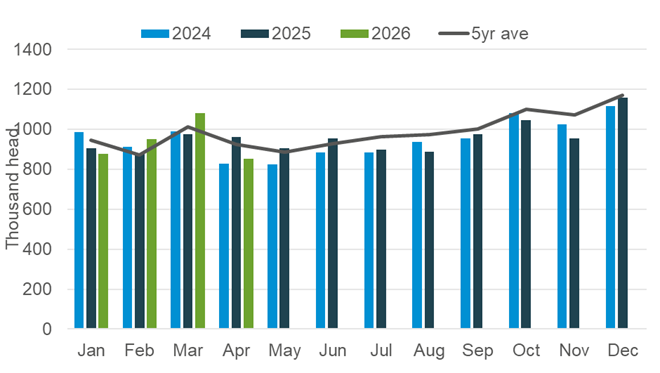
Data from Defra shows that clean sheep slaughter grew 5% year-on-year in the first quarter of 2026. This was broadly in line with our forecast, with an increased number of old season lambs carried over into the new year.

Higher throughputs and increased average weights (+3% YoY) increased sheep meat production in Q1 to 70,400 tonnes, growth of 8% on the year before.

However, April’s clean sheep slaughter eased back with throughputs down nearly 20% on March’s level. This tightening in supply has likely sustained elevated prices, despite passing the usual seasonal demand peak.

Long term declines in the breeding flock combined with weather and disease challenges have reduced domestic sheep numbers, tightening supply and driving prices to new highs across all categories.

Figure 2. UK clean sheep slaughter

clean sheep slaughter graph

Source: Defra

Figure 2 shows clean sheep slaughter by month for the years 2024-2026 using bars. The line represents the five-year average.

Demand

Domestic

British shoppers spent £2.2bn on lamb across retail and foodservice in the year to 22 March 2026, up 3.4%¹. However, this growth was driven entirely by higher prices, not increased demand. Volumes fell by 4.3%² in retail and 3.4%³ in foodservice as shoppers cut back due to rising prices.

Despite this, there are pockets of increased demand, with stewing (+10.4%), marinades (+10.4%), breast (+7.8%), steak (+5.8%) and burgers (+4.8%) all seeing volumes gains in retail over the last 12 weeks⁴.

Shoppers switched into these cuts from not just other lamb cuts, but also other proteins including beef, pig meat and fish⁵, despite several of the lamb cuts being more expensive⁴. This suggests that shoppers were not motivated solely by price but were instead seeking lamb, and lamb cuts that offered versatility across different dishes as well as synergy with the time of year.

Easter also boosted roasting demand, which saw its best performance of the last five years with 6.4m KG sold, up by 8.6% this Easter compared with Easter 2025⁶.

In foodservice, over the most recent 12 weeks, lamb centred meals (including roast dinners) saw growth in takeaways⁷, possibly reflecting consumers replacing home cooked roast occasions with those requiring low effort to prepare and clean up. For those looking to eat lamb out of home, kebabs volumes saw an increase of 2.1% (+7 tonnes)⁷, as consumers opted for them more frequently.

International trade

We have also seen real strength in exports in 2026 so far. Data for Q1 (Jan-Mar) shows total sheep meat export volumes (fresh, frozen, offal and processed) at 26,800 tonnes, up 18% year-on-year.

The value of this trade has also grown significantly, up nearly 25% on the year to total £204 million. Demand remains strong in the EU, the major customer for UK lamb, and flocks are contracting in key regions. This is supporting the trade and delivering value back to the farmgate.

Import volumes meanwhile have been largely steady in Q1 2026 year-on-year, with 19,000 tonnes of product (incl. offal and processed) imported. Gains in Australian volume have just outweighed reductions from New Zealand.

What next?

We have now passed the seasonal peak for lamb demand, yet prices remain exceptionally strong. Looking ahead, we could expect some easing of prices, in line with seasonal trends, however the underlying economic factors suggest that prices will remain supported.

Market reports suggest lambing has been relatively benign this year, but continued contraction the breeding flock will likely limit lamb numbers somewhat. Our forecast suggests the 2026/27 lamb crop will be 2% smaller year-on-year. Weather remains a key watchpoint.

On the demand side, whilst the domestic picture is more muted, the prospects for export, particularly to the continent appear favourable. The European Commission are forecasting a 5% annual growth in sheep meat imports in 2026, with the UK well-placed to meet some of this increasing volume, if supplies allow.

¹  Worldpanel by Numerator UK retail & AHDB estimated volumes based on Worldpanel by Numerator UK OOH data, 52 w/e 22 March 2026

² Worldpanel by Numerator, 52 w/e 22 March 2026

³AHDB estimates based on Worldpanel by Numerator UK OOH, 52 w/e 22 March 2026

⁴ Worldpanel by Numerator, lamb, 12 w/e 22 March 2026

⁵ Worldpanel by Numerator, MFP switching, 12 w/e 22 March 2026

⁶Worldpanel by Numerator, primary lamb, 2 w/e 5 April 2026 vs 2 w/e 20 April 2025

⁷AHDB estimated volumes based on Worldpanel by Numerator UK OOH data, 12 w/e 22 March 2026


Image of staff member Becky Smith

Becky Smith

Senior Analyst (Livestock)

See full bio


Sign up for regular updates

You can subscribe to receive Beef and Lamb market news straight to your inbox. Simply fill in your contact details on our online form.

Visit the Keep in touch page

While AHDB seeks to ensure that the information contained on this webpage is accurate at the time of publication, no warranty is given in respect of the information and data provided. You are responsible for how you use the information. To the maximum extent permitted by law, AHDB accepts no liability for loss, damage or injury howsoever caused or suffered (including that caused by negligence) directly or indirectly in relation to the information or data provided in this publication.

All intellectual property rights in the information and data on this webpage belong to or are licensed by AHDB. You are authorised to use such information for your internal business purposes only and you must not provide this information to any other third parties, including further publication of the information, or for commercial gain in any way whatsoever without the prior written permission of AHDB for each third party disclosure, publication or commercial arrangement. For more information, please see our Terms of Use and Privacy Notice or contact the Director of Corporate Affairs at info@ahdb.org.uk  © Agriculture and Horticulture Development Board. All rights reserved. 

Topics:

Sectors:

Tags:

×