Australia remains a key player on the global beef and lamb markets: Beef and lamb market update

Friday, 19 June 2026

Australian beef production reached record highs, while lamb output fell through the first few months of this year. We explore the latest trends in the market and the impact on the UK.

Key points

  • Australian beef production reached the highest levels on record in the first quarter of 2026, with prices high as global supply remains tight.
  • Lamb production meanwhile is easing from historical highs, reducing export volumes. Despite this, exports to the UK increased 15% year-on-year in Q1.
  • Risk of a ‘super’ El Nino could bring more cattle and sheep forward to slaughter after two years of good rain.

Global beef demand boosts Australian prices and production

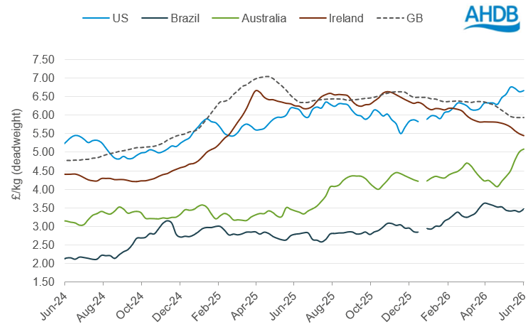
Australian beef prices remain at record highs, driven by a strong export trade. They are forecasted to remain firm into the mid-year, as the average deadweight for the price week ending 12 June 2026 stood at £5.09/kg equivalent, as seen in Figure 1.

Figure 1: Deadweight global cattle prices (£/kg)

Figure 1 shows the deadweight global cattle prices on a line graph.

Figure 1 shows the deadweight global cattle prices on a line graph, with US in light blue, Brazil in dark blue, Australia in green, Ireland in brown and GB in the dotted line.

Australian beef production was up 8% year on year for the Q1 (Jan-Mar) period, totalling just over 730,000 tonnes. This is the highest production of beef for the quarter on record.

Output has been underpinned by growth in slaughter and carcase weights, helped by improved pasture conditions and a high grain-fed turnoff rate.

Meat and Livestock Australia’s (MLA) latest forecasts show beef production peaking at 2.9 million tonnes for the full year of 2026, up 4.1% year-on-year.

As the Australian cattle cycle peaks and the herd enters a retention phase, beef production is forecast to contract in 2027 and 2028 following a period of liquidation. The national female slaughter rate lifted to 53% in the first 3 months of 2026, below recent peaks but still reflecting ongoing herd contraction.

However, output will remain historically high. The development of El Nino weather patterns will be an important watchpoint for slaughter rates given the large herd inventory. Prolonged dry conditions may mean more cattle are marketed.

Beef trade prompted by supply and geopolitics

Australian beef exports grew 16% in Q1 compared to the previous year, bolstered by increased exports to the US, China and South Korea among others.

Exports to China increased by 32% year-on-year, with the Chinese government reporting on 1 June that Australia had used 90% of its 205,000-tonne safeguard quota. Once filled, a 55% tariff applies. Australia is also expected to hit its South Korean beef safeguard quota limit earlier than previous years, after which a 24% tariff applies.

The current quota situation may mean more Australian beef needs a home on the global market later in the year.

MLA forecast a 1.4% rise in beef exports to 1.57 million tonnes by the end of 2026, driven by the high global demand for lean beef - most notably the US lean mince market. US beef imports were up +15% in Q1 2026 of which Australia was the largest contributor.

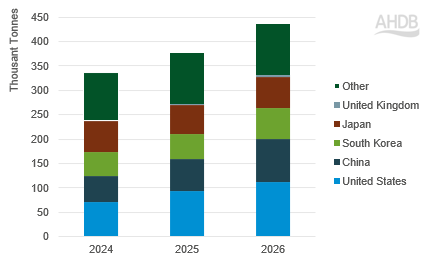
Figure 2: Q1 Australian beef exports by destination

Figure 2 shows the volume of Australian beef exports by destination over Q1 2024-2026.

Source: Australian Bureau of Statistics via Trade Data Monitor LLC

Figure 2 shows the volume of Australian beef exports by destination over Q1 2024-2026. The largest market for Australian beef is the US in light blue, followed by China (dark blue), South Korea (green), Japan (brown), UK (grey) and other in dark green.

In Q1 2026, the UK was the 11th largest market for Australian beef, taking just under 4,500 thousand tonnes of product.

Like other markets, conflict in the Middle East has driven up fuel and fertiliser prices for Australian producers. Notably, live cattle exports have dropped 27% as shipping issues to the region continue.

Sheep meat production down and driving strong prices

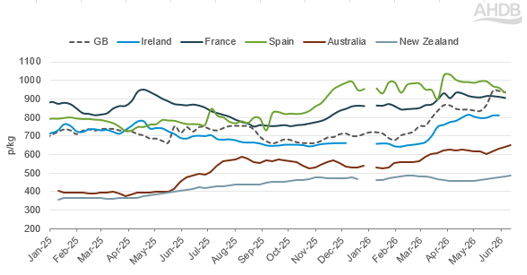
Australian lamb prices remain high as supplies tighten. For the week ending 12 June, the deadweight lamb price stood at £6.51/kg equivalent, up over £2 year-on-year.

Figure 3: Global deadweight farmgate lamb prices

The line chart in Figure 3 shows farmgate lamb prices in key global markets from Jan 2025-June 2026.

Source: AHDB, European Commission, MLA, AgriHQ

The line chart in Figure 3 shows farmgate lamb prices in key global markets from Jan 2025-June 2026. New Zealand is shown in grey, Australia in brown, France in dark blue, Ireland in light blue, Spain in green and GB in the grey dashed line.

High prices come because of lower kills, with rates pulling back through Q1. High ewe turnoff since 2023 and poor seasonal conditions in the south have left depleted lamb numbers, with lamb production forecast by the MLA to fall 10% in 2026 to 538,000 tonnes.

Lamb carcase weights are up (6% year-on-year) due to a shift in breeds away from merinos, more use of grain-fed feedlot systems, genetic gains and producers holding on as processors reward heavier lambs.

Overall, sheep meat (lamb and mutton) production through Q1 fell by 10% year-on-year to 202,000 tonnes. For 2026, total production is forecast to be back 10% at 723,000 tonnes, following 3 exceptionally strong years.

The longer forecast into 2027/28 is recovery with lamb slaughter to increase year-on-year by 1% in 2027 and 5% in 2028.

Sheep meat export volumes back from historical highs

With production back notably, Australia’s sheep meat export volumes have fallen. However, trade to a few markets including the UK bucks the trend.

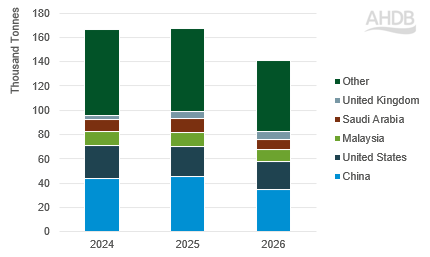
Q1 exports (fresh/frozen sheep meat and offal) dropped 16% year-on-year to 141,000 tonnes, notably to China (-24%), the US (-6%) and the Middle East. Disruptions to air freight due to the US-Iran conflict has made trade limited and expensive to the Middle East & North Africa (MENA) region, with volume exported to the region down 36% year-on-year. The UAE and Saudi Arabia are currently the largest markets in the region for Australia.

Growth areas for Australian sheep meat exports during Q1 included South Korea (+37%), the UK (+15%) and Japan (+41%).

Figure 4: Q1 Australian sheep meat exports by destination

Figure 4 shows a bar chart with the volume of sheep meat exported from Australia over Q1 of 2024-26.

Source: Australia Bureau of Statistics vis TDM

Figure 4 shows a bar chart with the volume of sheep meat exported from Australia over Q1 of 2024-2026. China is shown in the light blue, the US in dark blue, Malaysia in light green, Saudi Arabia in brown, UK in grey and other in dark green.

Australia’s live sheep exports have also been affected by the conflict, driving up costs and forcing re-routing. 

Australia’s new Free Trade Agreement (FTA) with the EU, which once it goes through, could create a growth in exports to the EU. With the negotiations concluded in March 2026, this will be a watchpoint going forward.

So, what does this all mean for the UK?

Beef

While Australian beef prices are supported by a tight global market, exports remain competitive.

The pace at which Australian exporters are filling the Chinese and South Korean safeguard quotas is a watchpoint for global markets (including the UK) in the second half of the year.

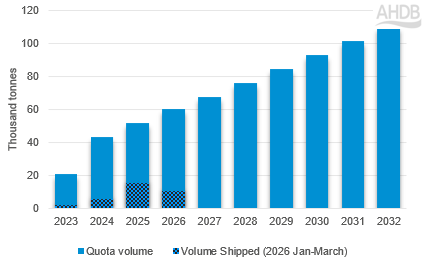
For the UK, Australia is currently not filling its FTA beef quota and volumes are small but rising quickly. Figure 4 illustrates this. By March 2026, 17% of the quota had been filled. Imports of Australian beef into the UK rose by 153% year-on-year for Q1, making it the fifth largest supplier of beef (including offal) to the UK, and the third largest for just fresh and frozen beef.

Figure 5: Australia – UK FTA beef quota utilisation 2023-2026, with available quota to 2032

The bar chart in figure 5 shows the volume of beef Australia can export to the UK under the FTA .

Source: Australian Government, Trade Data Monitor LLC

The bar chart in figure 5 shows the volume of beef Australia can export to the UK under the FTA from 2023 to 2032 in the light blue, with the volume shipped in dark blue checked area. Note: the quota allowance in 2023 was for a part-year, with quota allowance from 2024 onwards for full calendar years.

Although Australia has technical quota room to grow shipments, other trade considerations remain. Firstly, the UK is a relatively small market for Australian beef, making up 1% of exports in Q1 this year, up from 0.5% Q1 2025. While demand persists from more dominant (US) or proximal (China, Asia) global markets, these will likely be prioritised. However, geopolitics and quota limits are of course key watchpoints here.

Lamb

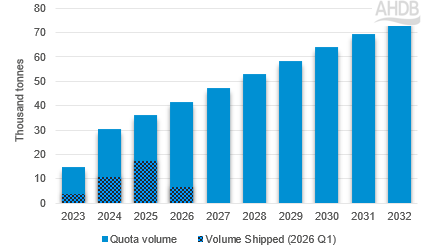
On the lamb side, Australian shipments to the UK have not been filling available quota. However, these volumes are increasing, and as of the end of March 2026, they had exported 6,600t of sheep meat to the UK, 16% of the quota for the year. Q1 volumes were up 15% year-on-year.

Figure 6: Australia - UK FTA sheep meat quota utilisation 2023-2026, with available quota to 2032

The bar chart in Figure 6 shows the volume of lamb Australia can export to the UK under the FTA.

Source: Australian Government, Trade Data Monitor LLC

The bar chart in Figure 6 shows the volume of lamb Australia can export to the UK under the FTA from 2023 to 2032 in light blue, with the volume shipped in the dark blue checked area. Note: the quota allowance in 2023 was for a part-year, with quota allowance from 2024 onwards for full calendar year.

While Australia has valuable markets closer to home, these will likely be the priority, but a combination of factors are likely putting other markets (including the UK) into focus for Australia. These include the UK FTA, high value of UK market currently, lower production and disruption to other markets.

Lower production may limit Australia’s volume, but it will still be strong on the global stage. Risks around weather, the Middle East conflict progression and Chinese demand will be key influencers on Australia’s lamb exports as the year progresses.


Image of staff member Molly Corbett

Molly Corbett

Analyst (Livestock)

See full bio


Sign up for regular updates

You can subscribe to receive Beef and Lamb market news straight to your inbox. Simply fill in your contact details on our online form.

Visit the Keep in touch page

While AHDB seeks to ensure that the information contained on this webpage is accurate at the time of publication, no warranty is given in respect of the information and data provided. You are responsible for how you use the information. To the maximum extent permitted by law, AHDB accepts no liability for loss, damage or injury howsoever caused or suffered (including that caused by negligence) directly or indirectly in relation to the information or data provided in this publication.

All intellectual property rights in the information and data on this webpage belong to or are licensed by AHDB. You are authorised to use such information for your internal business purposes only and you must not provide this information to any other third parties, including further publication of the information, or for commercial gain in any way whatsoever without the prior written permission of AHDB for each third party disclosure, publication or commercial arrangement. For more information, please see our Terms of Use and Privacy Notice or contact the Director of Corporate Affairs at info@ahdb.org.uk  © Agriculture and Horticulture Development Board. All rights reserved. 

×