Australian beef market update: Record production meets growing market access challenges

Thursday, 8 October 2026

Australia's cattle sector is on track for another year of strong production, supported by a productive national herd, record feedlot utilisation and global demand for beef. Diverse export markets are expected to drive exports to a second consecutive record in 2026. We explore what this means for the UK.

Key points

  • Australian beef production is forecast to top 3 million tonnes in 2026, held up by strong carcase weights and slaughter numbers
  • Diverse export markets continue to bolster demand for Australian beef across the globe despite market access challenges
  • Volumes headed to the UK continue to grow under the Free Trade Agreement, but this comes from a very small base

Production gains despite a shrinking herd

The Australian national beef herd is forecast to total 30.8 million head in 2026, a 0.9% year-on-year decline, with further contraction anticipated through 2027 and 2028.

Cattle slaughter is forecast to increase by 3.4% to 9.6 million head in 2026, the highest level in almost five decades. This reflects strong global demand for cattle and increased cattle availability.

However, beef production for 2026 is expected to reach a record 3 million tonnes carcase wight (cwt), up 5% from the previous year. Production is forecast to ease slightly through 2027 into 2028, yet remain historically high, driven by increases in carcase weights.

Average carcase weights are forecast to increase by 1% year-on-year in 2026 to reach 313 kg/head. They are projected to continue rising in the following years, forecast to reach 319 kg/head by 2028.

Higher carcase weights and cattle availability reflect several changes in Australian beef production:

  • Genetic gains, improving growth rates, fertility, herd survival rates and strong cow prices, are incentivising producers to replace older, less productive animals with younger breeding females
  • A younger breeding herd across Queensland and the Northern Territory is supporting long-term productivity. Good rainfall and pasture conditions have increased turn-off rates and feedlot entry weights
  • Increased feedlot capacity, shorter production cycles and improved finishing systems are enabling producers to market cattle more quickly, supporting throughput despite a gradually declining herd
  • Feedlot utilisation has exceeded 90%, with approximately 1.6 million cattle on feed

Export growth continues amid market access concerns

Australia's beef exports reached a record 2.3 million tonnes carcasses weight equivalent (cwe) in 2025, up 15% year-on-year. Export volumes are forecast to increase further to 2.4 million tonnes in 2026, representing growth of 5.8%.

Strong domestic supply and resilient international demand continue to underpin export performance. However, market access conditions are becoming more restrictive.

China’s safeguard measures introduced in January meant the allocated 205,000 tonnes of Australian beef was frontloaded into China, reaching the quota by June. A tariff of 55% thereafter was imposed. Exporters are expected to start ramping up volumes in the last few months of 2026 to reach China in the first quarter 2027.

South Korea, Australia’s second-largest export market year to date 2026, has quota arrangements which have resulted in tariffs of approximately 24% being applied after quota volumes were exhausted in July.

Diversification remains Australia's key advantage

The key message from MLA’s outlook is that Australia's diversified export portfolio remains a major competitive strength. Australia supplies grain-fed and grass-fed beef to a wide range of premium markets.

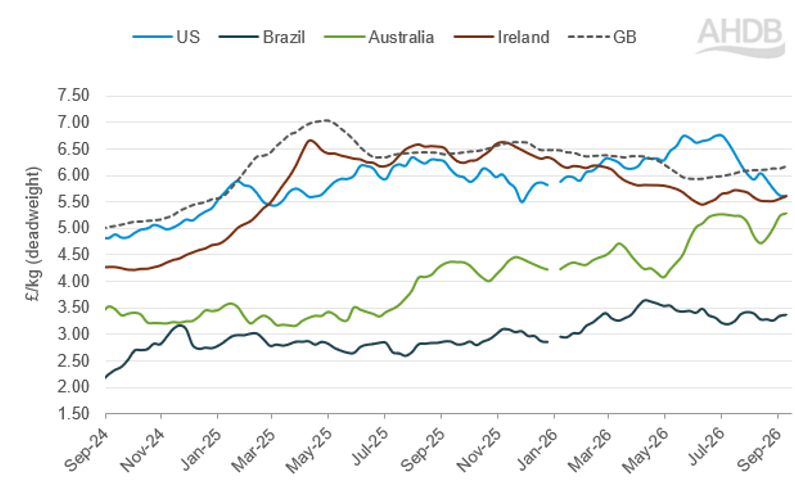
Australian cattle prices remain within the top 10% of historical levels, while producers continue to face volatility in input markets, with fertiliser and fuel prices increasing significantly throughout the year following the outbreak of conflict in the Middle East.

Figure 1. Deadweight global cattle prices £/kg September 2024–September 2026

Source: AHDB, European Commission, INAC, MLA, Consorcio de Exportadores de Carnes Argentinas, Informe Ganadero Argentina 

Brazil's cost advantage continues to support export growth and increased market share, particularly in South East Asia. The key watchpoints for Australian exporters are whether Brazil enters a herd rebuilding phase and how US herd rebuilding and trade policy changes affect future import demand.

Live cattle exports are forecast at 640,000 head in 2026, with a modest recovery anticipated in the following year.

Outlook

The Australian beef outlook for 2026 is characterised by record production, historically high slaughter rates and increasingly efficient production systems. While the national herd is expected to decline gradually, productivity gains are allowing output to continue growing.

The greatest challenge for the sector is likely to come from changing market access conditions and increasing competition from major exporters. Nevertheless, Australia's diversified customer base, premium product reputation and strong production fundamentals position the industry well to navigate an increasingly complex global trading environment.

So, what does this mean for the UK?

Concern over China’s safeguarding measures resulting in more Australian and Brazilian beef coming to the UK have been growing.

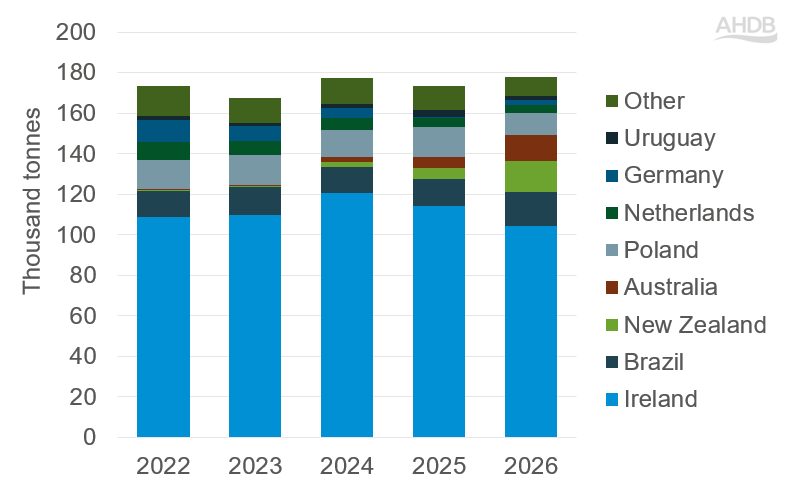
Exports of Australian beef to the UK have increased by 126% in the first seven months of the year, as they continue to diversify export markets and make more use of their growing Free Trade Agreement (FTA) into the UK. However, Figure 2 shows that these volumes come from a very small starting point, totalling 12,900 tonnes in the first seven months of 2026. The vast majority of the product (91%) of this beef was frozen.

Figure 2. Imports of beef into the UK year to date (Jan–Jul) 2022–2026, thousand tonnes

Source: HMRC via TDM LLC

The UK has taken just 1.26% of the 2026 year-to-date volume of Australia’s exported beef.

The price of Australian beef is also increasing, which is tightening the gap compared to the GB and Irish price (as shown in Figure 1), reducing its competitiveness against Irish imports. This may reduce incentives for importing Australian beef into the UK.

With increasing access for Australian beef to come into the UK under the FTA, volume increases will certainly continue to be a watch point going forward. Volumes, however, remain small in terms of imports into the UK and very small in terms of volumes exported by Australia.

Image of staff member Molly Corbett

Molly Corbett

Analyst (Livestock)

See full bio


Sign up for regular updates

You can subscribe to receive Beef and Lamb market news straight to your inbox. Simply fill in your contact details on our online form.

Visit the Keep in touch page

While AHDB seeks to ensure that the information contained on this webpage is accurate at the time of publication, no warranty is given in respect of the information and data provided. You are responsible for how you use the information. To the maximum extent permitted by law, AHDB accepts no liability for loss, damage or injury howsoever caused or suffered (including that caused by negligence) directly or indirectly in relation to the information or data provided in this publication.

All intellectual property rights in the information and data on this webpage belong to or are licensed by AHDB. You are authorised to use such information for your internal business purposes only and you must not provide this information to any other third parties, including further publication of the information, or for commercial gain in any way whatsoever without the prior written permission of AHDB for each third party disclosure, publication or commercial arrangement. For more information, please see our Terms of Use and Privacy Notice or contact the Director of Corporate Affairs at info@ahdb.org.uk  © Agriculture and Horticulture Development Board. All rights reserved. 

×