Brazil’s cattle herd contraction not slowing export volumes: Beef market update

Friday, 21 August 2026

Brazil, the world's largest beef exporter, is heading into 2026 with a shrinking herd, rising prices and the EU market closing on 3rd September. We examine what this means for the global beef market and the UK.

Key points

  • Brazil's cattle herd is forecast at 225 million head in 2026, a third consecutive annual fall as the cycle turns contractionary.
  • Tighter supply lifted calf prices by 27% and fed cattle prices by 19% in 2025. As of 14 August, AHDB’s global cattle prices put Brazil’s deadweight steer price at £3.28/kg, more than £2/kg lower than the EU.
  • Exports hit 1.7 million tonnes in the first half of 2026, up 15% year-on-year. With the EU's suspension of Brazilian animal products from 3 September 2026, redirected volume is a key watchpoint for the UK.

Production

The US Department of Agriculture (USDA) continues to attribute Brazil as the second largest beef producer in the world, with their beginning cattle stock forecast at 178.2 million head in 2026, down from 186.9 million head as the top of their cattle cycle in 2025. This is in line with Brazil’s forecast annual total cattle supply of 225 million head in 2026, down from 234 million head in 2025. The 4% fall in numbers is the largest reduction in recent history.  

The calf crop is forecast at 47.2 million head in 2026, unchanged in 2025. The USDA expects the Brazilian industry to remain in the contractionary phase of the cycle through 2026.

Figure 1: Annual total Brazilian cattle herd

   Bar chart showing Brazil's cattle population from 2011 to 2025

Source: USDA

Figure 1 shows the USDA official estimates for Brazilian cattle numbers for 2010-2025, and their revised 2026 forecast. The graph shows a cyclical trend, where the cattle herd increases and then contracts, with the 2026 forecast falling to the lowest levels in the observed period.

The USDA suggests that producers signal the inversion of the cattle cycle by retaining inventories. They note economic factors, such as high interest rates, tariffs, taxes and a weak currency, are weighing on producers’ capacity for production.

Price

Calf prices are forecast to rise again throughout 2026, with heavy slaughter in earlier years having reduced calf availability. Both calf and fed cattle prices are expected to sit above recent-year levels. As of 14 August, Brazil’s deadweight steer price sat at £3.28/kg, up 16% on the same week of last year.

Extreme weather affects the cattle industry widely. With the potential of a strong El Nino, it is likely that high levels of rainfall will hit the Southern Americas, potentially influencing the supply of Brazilian beef on the market, thus putting pressure on prices.

Trade

Brazil was the world's largest beef exporter in 2025 and is forecast to extend its ten-year run in 2026. However, the USDA does forecast a contraction in exports in 2026, in line with the expected pull-back in production.

Looking at the latest available data, Brazil's exports for the first half (H1) of 2026 were up by 213,000 tonnes compared with 2025, reaching 1.7 million tonnes. These exports are higher than the previous seven years.

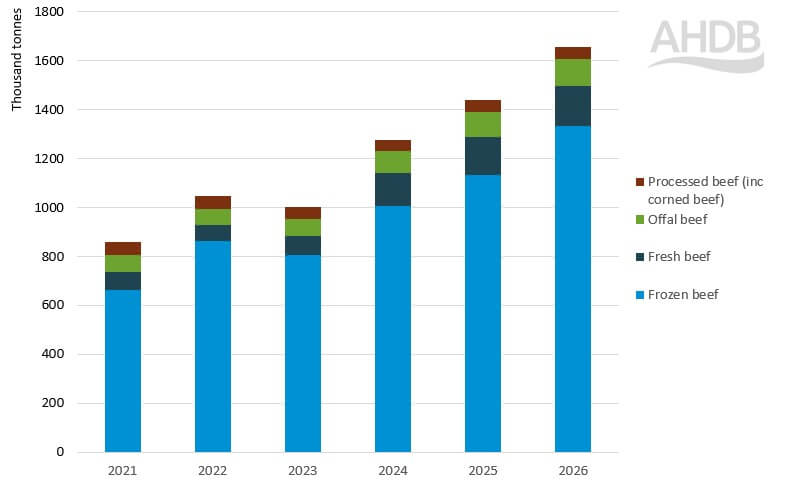
Figure 2: H1 (Jan-Jun) Brazilian beef exports by product

Brazilian beef exports to the world by product.

Source: Brazil Ministry of Development, Industry and Trade via TDM LLC

Figure 2 shows Brazilian fresh, frozen, offal and processed (including corned) beef export volumes to the rest of the world, in tonnes, 2020 to 2026 H1 (January to June).

Frozen product dominates at 81% of total exports in the first half of 2026, reflecting the long logistical chain to many destination markets. Volumes rose 18% in 2026 to 1.3 million tonnes (Figure 2).

Fresh beef and offal exports grew at a similar pace in the first half of 2026, up 5% and 8% respectively, while processed beef shrank by 7%. These volumes are small next to frozen but rising offal exports help carcase balance and rising fresh beef exports suggest demand in closer markets remains firm.

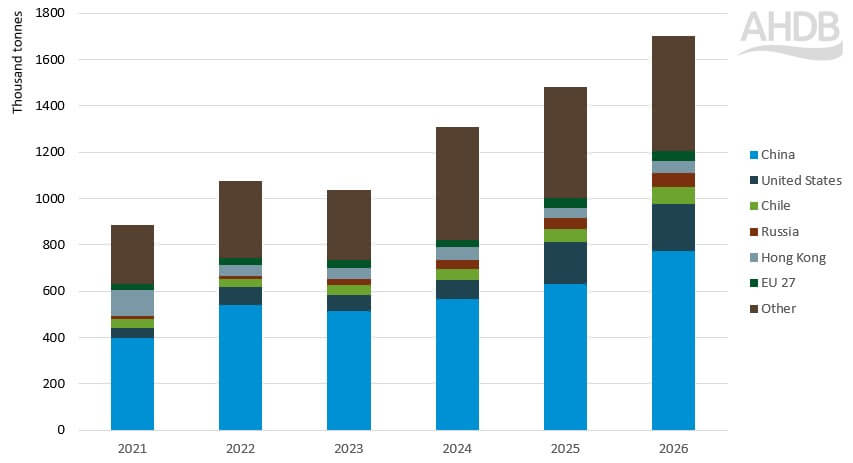
Figure 3: H1 (Jan-Jun) Brazilian beef exports by country

   Brazilian beef exports to the world by country.

Source: Brazil Ministry of Development, Industry and Trade via TDM LLC

Figure 3 shows Brazilian fresh, frozen, offal and processed (including corned) beef export volumes to the rest of the world, in tonnes, 2021 to 2026 H1 (January to June) by country.

China dominates Brazilian beef exports, taking 48% of Brazil’s export volume in the full year 2025 and 47% in the first half of 2026. This grew 23% year-on-year in H1 2026, to 774,000 tonnes.

Brazilian beef exports to China now near 90% of the 1,106,000 tonne 2026 Quota as of August 10th, according to the Chinese Ministry of Commerce. This will have no direct effect on the UK market; however, the UK could feel the knock-on impact of a shifting global beef trade.

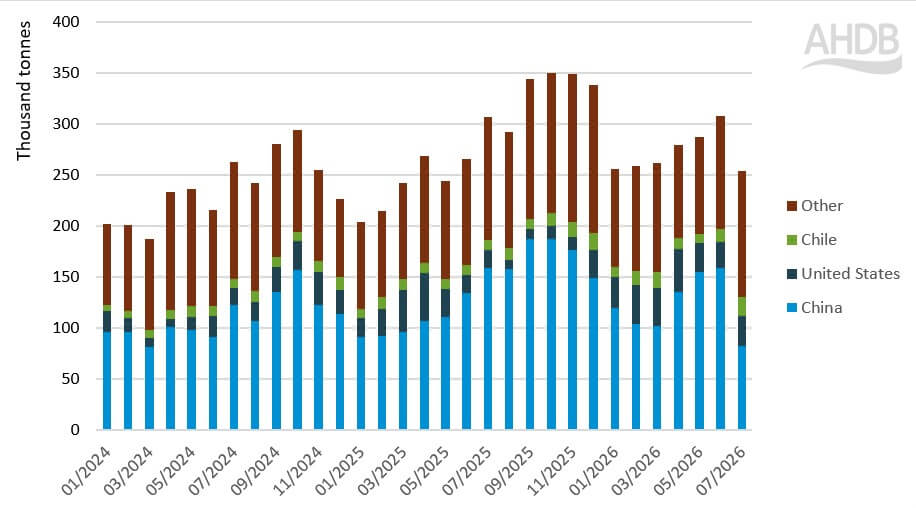
Figure 4: Monthly Brazilian beef exports by country

This graph shows Brazil monthly beef exports to the world by top 3 countries and other.

Source: TDM LLC

Figure 4 shows monthly Brazilian fresh, frozen, offal and processed (including corned) beef export volumes to the rest of the world, in tonnes, from January 2024 to July 2026 by top 3 and other countries.

With Chinese safeguards being reached in July, it is clear to see the impact on Brazil’s beef exports to China in Figure 4, dropping 48% on the month. As China provides the largest base to Brazil’s beef exports, this has dropped their total exports down by 17% month-on-month, however some of this volume has been diverted to other key importers, where volumes increased by 13% for all other countries.  

The US is Brazil’s second largest beef esport destination, accounting for 12% of Brazilian beef exports in H1 2026. Total H1 volumes hit 203,000 tonnes, 13% year-on-year growth.

This can be attributed to sustained US demand alongside a contracting domestic herd. Brazil is benefiting from the growing US import requirement but must compete with other competitive exporters, such as Australia. Consequentially, Brazil has lost market share, making up 20% of US import volumes in H1 2026, down from 23% in H1 2025.

Trade into the EU

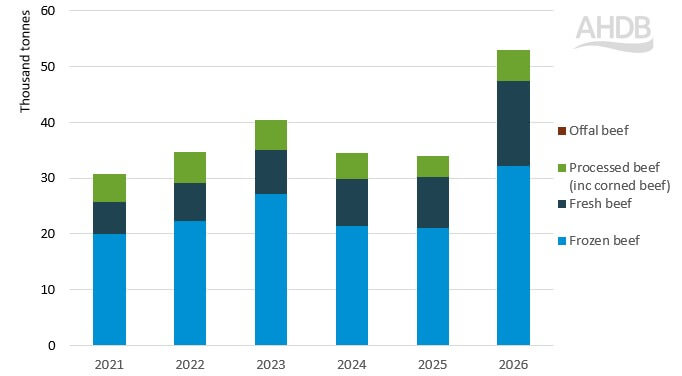
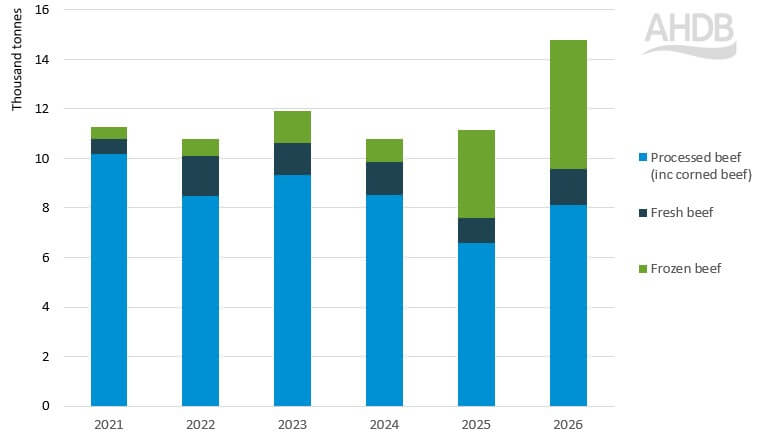
Looking more closely at the European Union’s beef imports from Brazil, H1 volumes had remained relatively consistent in recent years until a surge in 2026.

In the first half of 2026, imports rose by 56% (19,000 tonnes) to reach 53,000 tonnes. This increase can likely be attributed to buyers front-loading purchases ahead of the EU's ban on Brazilian beef imports, which takes effect from the 3rd of September 2026 over concerns around antimicrobial use.

The strong growth in both fresh (+66%) and frozen (+53%) beef volumes suggests EU importers were securing supply whilst able, even as the wider trading relationship faced disruption.

The value of this trade increased by 60%, relatively in line with volume growth and yearly inflation.

Figure 5: H1 Brazilian beef imports to the EU by product

Brazilian beef exports to the EU 27 by product.

Source: EuroStat via TDM LLC

Figure 5 shows Brazilian fresh, frozen, offal and processed (including corned) beef export volumes to the European Union 27, in tonnes, 2021 to 2026 January to June.

UK relevance

Looking into 2026, UK beef imports from Brazil in the first half of the year grew by 33% to 15,000 tonnes. Fresh and frozen beef grew more than proportionally, rising 43% to 1,500 tonnes and 47% to 5,000 tonnes respectively.

Processed volumes grew by 23% to 8,000 tonnes, slightly reducing its share of total imports but still accounting for 55% of all products.

Figure 6: UK import volume of Brazilian beef

   Brazilian beef exports to the  by product.

Source: UK HMRC via TDM LLC

Figure 6 shows annual UK import volumes of Brazilian beef in the first half of the year (January to June), in tonnes, 2021 to 2026, split by processed, offal, fresh and frozen.

The total value of Brazilian imports rose by 42%, outstripping volume growth and potential inflation, pointing to a stronger inflow of higher-value product. Notably, while fresh beef recorded a smaller volume growth, it saw the largest increase in total value, up 64%. With growth concentrated in higher-value cuts, there are some concerns these imports could displace both domestic product and higher-value imports, particularly in foodservice channels, and weigh on domestic carcase values.

From 3 September 2026, Brazil will no longer be authorised to export products of animal origin to the EU, having been left off the EU's updated list of approved third countries over guarantees on antimicrobial use. Concerns have been raised that displaced volume could seek alternative markets, including the UK.

The Animal and Plant Health Agency (APHA) have stated that GB will not introduce import restrictions on Brazilian product on 3 September and will undertake its own technical assessment of Brazil’s antimicrobial assurance arrangements. This is expected to take around six months to complete, and imports from Brazil may continue during this time.

These changes, combined with the continued shift towards higher-value cuts, mean that UK import flows from Brazil remain an important watchpoint for the remainder of the year.

Image of staff member Sebastian Abbott

Sebastian Abbott

Trainee Analyst

See full bio


Sign up for regular updates

You can subscribe to receive Beef and Lamb market news straight to your inbox. Simply fill in your contact details on our online form.

Visit the Keep in touch page

While AHDB seeks to ensure that the information contained on this webpage is accurate at the time of publication, no warranty is given in respect of the information and data provided. You are responsible for how you use the information. To the maximum extent permitted by law, AHDB accepts no liability for loss, damage or injury howsoever caused or suffered (including that caused by negligence) directly or indirectly in relation to the information or data provided in this publication.

All intellectual property rights in the information and data on this webpage belong to or are licensed by AHDB. You are authorised to use such information for your internal business purposes only and you must not provide this information to any other third parties, including further publication of the information, or for commercial gain in any way whatsoever without the prior written permission of AHDB for each third party disclosure, publication or commercial arrangement. For more information, please see our Terms of Use and Privacy Notice or contact the Director of Corporate Affairs at info@ahdb.org.uk  © Agriculture and Horticulture Development Board. All rights reserved. 

×