EU price momentum slows and disease still remains a risk: EU pork market update

Wednesday, 23 September 2026

EU pig prices eased in the week ending 13 September, ending a run of seven weekly increases, with national markets diverging sharply and supply pressure expected to persist into 2027.

Key points

  • The EU Grade S reference pig price declined slightly to 148.13p/kg equivalent in the week ending 13 September, narrowing the gap to UK prices to 38p
  • EU pig meat production reached 11.1 million tonnes in the first half of 2026, up 1.8% year-on-year
  • EU export volumes fell by 1.3% year-on-year during the first half of 2026
  • Spanish pork export value totalled £3.06 billion in the first half of 2026, down 17% year on year

Grade S reference prices strengthen

European finished pig prices have generally strengthened in recent weeks, although the pace of the recovery appears to have slowed. The EU Grade S reference price stood at 148.13p/kg equivalent in the week ending 13 September, down 0.24p/kg on the previous week. This was the first decline in seven weeks.

Prices have gained just over 6p across the past four weeks but remain 27.5p/kg below year-earlier levels. The recovery has narrowed the gap between EU and UK prices to just under 38p, its smallest since early September 2025.

Tighter short-term supply following the summer heatwaves appears to have supported the recovery, as high temperatures reduce feed intake and growth rates. This has been most apparent in Germany and Spain. The return to normal trade after the holiday period has reportedly also supported demand.

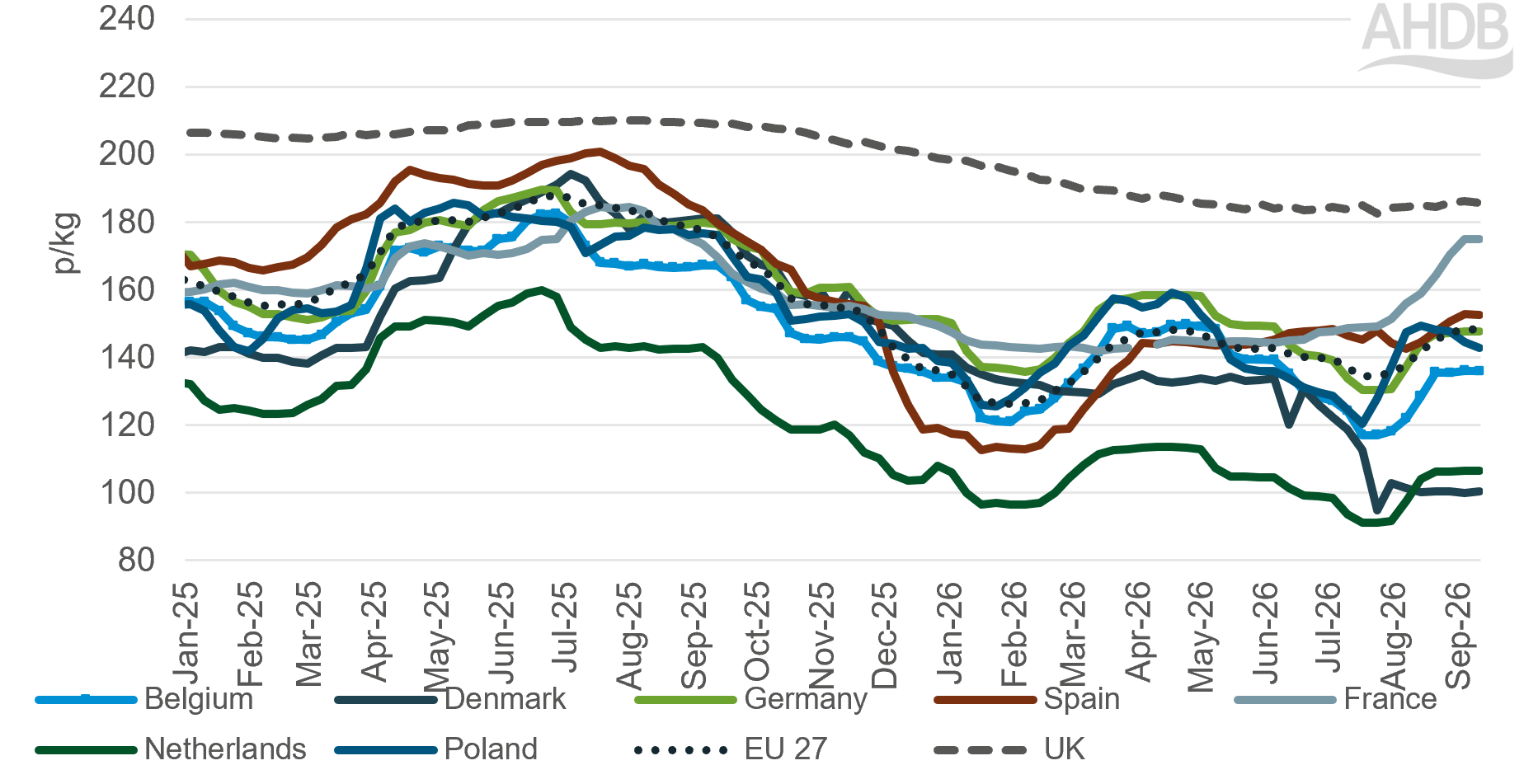
There has been considerable variation between member states. Prices in most major producing countries have increased over the past month, although they remain below year-earlier levels in all but France. The French price averaged 175.14p/kg in the week ending 13 September, its highest level since August 2025. Price strength reportedly reflects tighter domestic supply, potentially linked to heat-related production constraints.

Belgian and Spanish prices have recorded particularly strong gains over the past month, reaching 135.94p/kg and 152.51p/kg respectively. Dutch prices increased more modestly to 106.62p/kg, while Danish values were broadly unchanged. Poland was the exception, with prices easing over the period to 142.84p/kg.

The divergence is particularly marked in Denmark. At 100.39p/kg, the Danish price is around 80p/kg below its year-earlier level, the largest decline among the major producing countries. A year ago, Danish prices were around 11p/kg above French prices; they are now approximately 75p/kg below them.

Underlying conditions nonetheless remain challenging. Greater pork availability continues to weigh on prices, with improved productivity contributing to higher supply, while African swine fever-related export restrictions continue to affect the balance between production and demand across the region.

Figure 1. Trends in selected European grade S reference pig prices (p/kg) January 2025 – September 2026

Source: Eurostat

The line chart in Figure 1 shows the progression of European finished pig prices back to the start of 2025. Growth can be seen in prices reported over the past few weeks in most member states.

Piglet prices under pressure

Piglet prices have fallen further than finished pig prices, averaging just over £38 per head equivalent in the week ending 13 September. This was 28% below the year-earlier level.

Lower piglet prices provide some support to finishing margins and may encourage producers to place pigs and carry them to heavier weights, adding to future supply. The pressure is greater for breeding units, where prolonged poor returns could eventually encourage herd contraction. However, any reduction in breeding numbers would take time to feed through to finished pig supply.

Production slightly increased

EU27 pig meat production totalled 11.1 million tonnes in the first half of 2026, an increase of 1.8% (199,600 tonnes) YoY.

Spain drove much of the growth, with output up 3% (84,900 tonnes) YoY. Denmark recorded a 9% (61,700 tonne) rise and Poland a 3% (33,100 tonne) increase. Meanwhile, production was steadier in Germany, Belgium and France. The Netherlands saw the largest reduction among the major producers, with output down 7% (50,700 tonnes) YoY.

Higher production across the bloc reflected gains in both throughput and carcase weights, with EU clean pig slaughter up 2% YoY to 113.9 million head and average carcase weights up 0.3% (0.28kg) to 97.5kg.

Figure 2. Pig meat production of select EU27 countries 2024–2026, year-to-date (Jan-Jun)

Source: Eurostat

The bar chart in Figure 2 shows the pig meat production in various member states from 2026 to 2024. A clear increase in pig meat production can be seen in Spain.

Exports dip slightly

EU pig meat exports fell by 1.2% year on year during the first half of 2026, totalling 1.98 million tonnes of fresh, frozen and processed products, including offal.

Spanish exports fell 3.5% YoY to 1.3 million tonnes, the lowest half-year volume since 2020, following the country's ASF outbreak and resulting market closures.

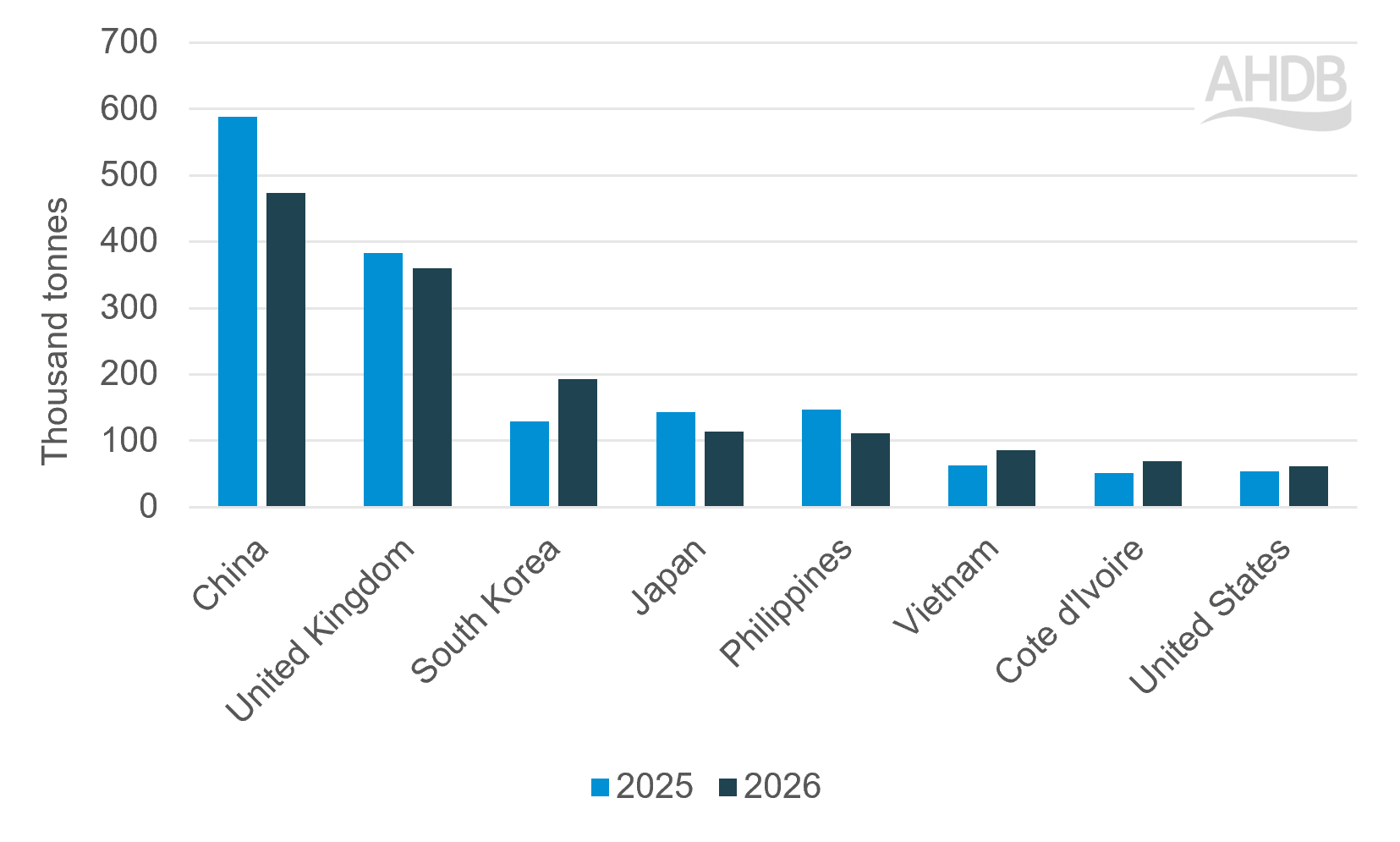
China remained the largest destination overall, though shipments declined 19.5% YoY, reflecting anti-dumping measures, domestic oversupply, weaker consumer demand and a continued push towards self-sufficiency.

The UK was the second-largest destination, with volumes down 6% (22,900 tonnes) YoY. The significant price differential earlier in the year did not translate into higher imports, signalling continued domestic support for British product.

Elsewhere in Asia, growth was strong. Shipments to South Korea rose 50% to 193,300 tonnes and those to Vietnam 35% to 85,400 tonnes. The pattern underlines the value of a diversified export base as Chinese demand softens.

Figure 3. Exports of pig meat (including offal) from the EU27 to non-EU countries between January to June 2025 and 2026

Source: Eurostat compiled by Trade Data Monitor LLC

The bar chart in Figure 3 shows exports of pig meat from the EU to various countries from 2025 to 2026. A substantial decline in exports can be seen in China.

The cost of closed markets

Spanish pork export value totalled £3.06 billion in the first half of 2026, down 17% (£623.1 million) YoY and the lowest since 2020.

With shipments eased just 3.5% to 1.3 million tonnes in volume terms, the significant drop in value shows Spain exported almost as much pork as a year earlier but earned substantially less for it. Products displaced from closed markets have had to be redirected to lower value destinations.

Imports edge higher

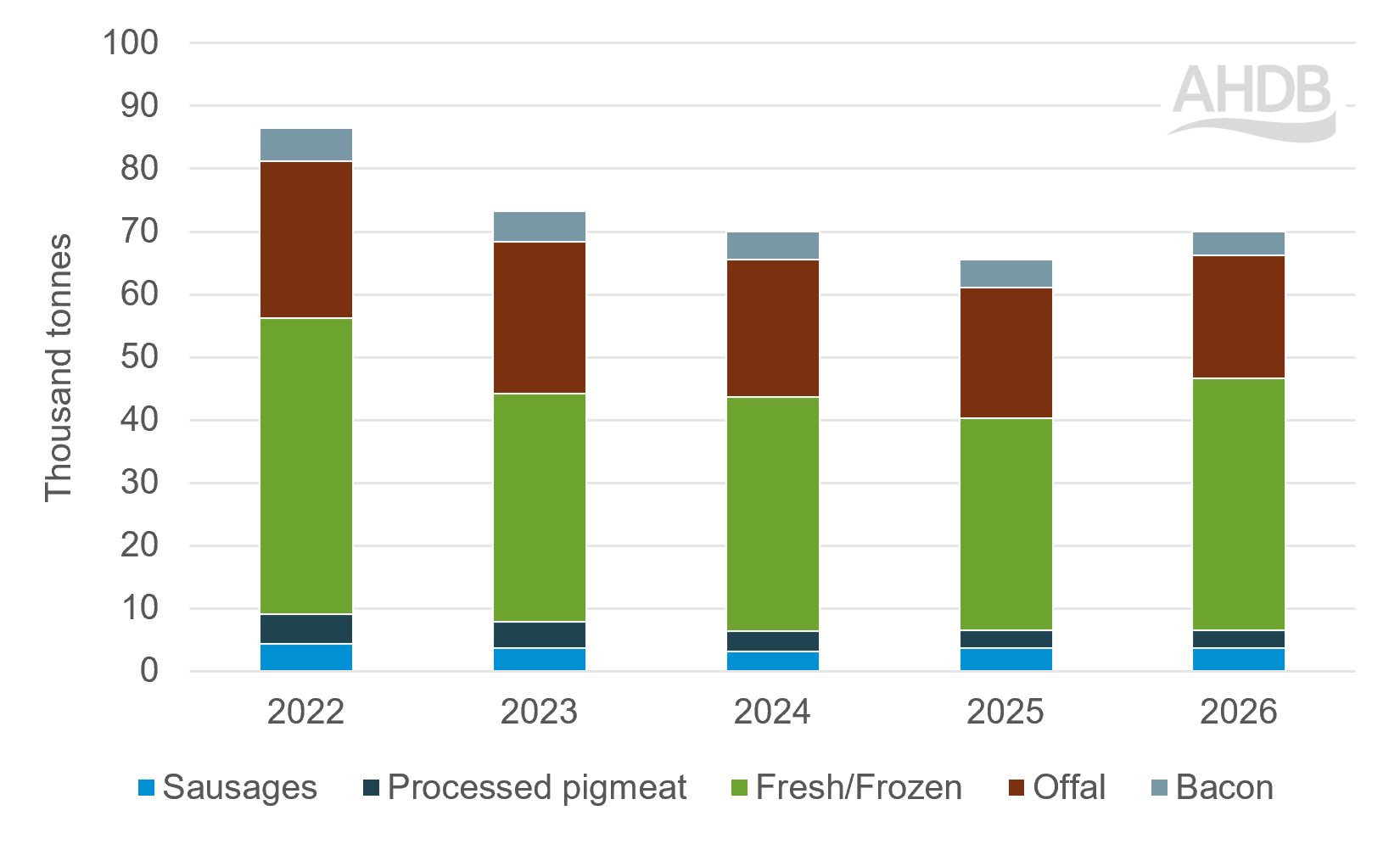
EU pig meat imports stood at 70,300 tonnes in the first half of 2026, up 7% YoY, according to Eurostat.

The UK remained the largest individual supplier at 52,300 tonnes, up 2% (1,000 tonnes) YoY.

By product, fresh and frozen pork recorded the strongest growth at 19%, and sausages rose 3%, while offal, bacon and processed pig meat declined 5%, 14% and 3% respectively.

Figure 4 Imports of pig meat (including offal) by the EU27 between January to June 2022 and 2026

Source: Eurostat compiled by Trade Data Monitor LLC

The column chart in Figure 4 shows imports of pig meat into the EU from 2022 to 2026. Fresh and Frozen pork category recorded the strongest growth in 2026.

Looking ahead

African swine fever (ASF) remains a significant risk to production and trade. Cases in domestic pigs in Hungary have continued to spread geographically, with recent outbreaks reported in areas further from previous affected regions. The ongoing risk of further outbreaks across Europe could place additional pressure on production and exports.

EU exporters also continue to face challenges in the Chinese market following the anti-dumping duties. This could make it more difficult for European pork to compete in China, particularly against lower cost suppliers such as Brazil. The loss of access to China for some volumes could also increase competition between EU producers in other export markets.

Strong supplies, subdued demand and low prices are likely to continue weighing on the market. Any significant reduction in production is unlikely to feed through quickly, meaning market conditions could remain challenging into 2027.

Image of staff member Adam Chowdry

Adam Chowdry

Analyst (Livestock)

See full bio

Sign up for regular updates

Subscribe to receive pork market news straight to your inbox. Simply complete our online form.

Visit the Keep in touch page

While AHDB seeks to ensure that the information contained on this webpage is accurate at the time of publication, no warranty is given in respect of the information and data provided. You are responsible for how you use the information. To the maximum extent permitted by law, AHDB accepts no liability for loss, damage or injury howsoever caused or suffered (including that caused by negligence) directly or indirectly in relation to the information or data provided in this publication.

All intellectual property rights in the information and data on this webpage belong to or are licensed by AHDB. You are authorised to use such information for your internal business purposes only and you must not provide this information to any other third parties, including further publication of the information, or for commercial gain in any way whatsoever without the prior written permission of AHDB for each third party disclosure, publication or commercial arrangement. For more information, please see our Terms of Use and Privacy Notice or contact the Director of Corporate Affairs at info@ahdb.org.uk  © Agriculture and Horticulture Development Board. All rights reserved. 

×