 

GB pig prices stay close to 2026 lows as EU prices fall further: Pork market update

Wednesday, 18 November 2026

Key points

  • The GB standard pig price (SPP) fell by 2.43p to 176.12p/kg in the week ending 14 November, a new low for 2026 and 24.18p lower than a year ago
  • The EU grade S reference price has fallen by 23.79p in eight weeks to 125.06p/kg, widening the gap with UK prices
  • Average carcase weights have risen by almost 4kg since mid-July, to 93.38kg
  • The pig industry is going through challenging times, with prices at their lowest point this year and around 15,000 pigs a week coming out of contract from November
Image of staff member Adam Chowdry
Adam Chowdry

Analyst (Livestock)

See full bio of Adam Chowdry

GB prices stay close to 2026 lows

GB pig prices have stayed close to their lowest point of 2026 throughout the autumn.

The EU-spec SPP reached 180.84p/kg in the week ending 19 September. It then fell slowly through October, reaching 176.38p/kg in the week ending 24 October. Across October as a whole, the SPP averaged 177.86p/kg. This was 2.56p lower than September and 26.22p lower than October 2025.

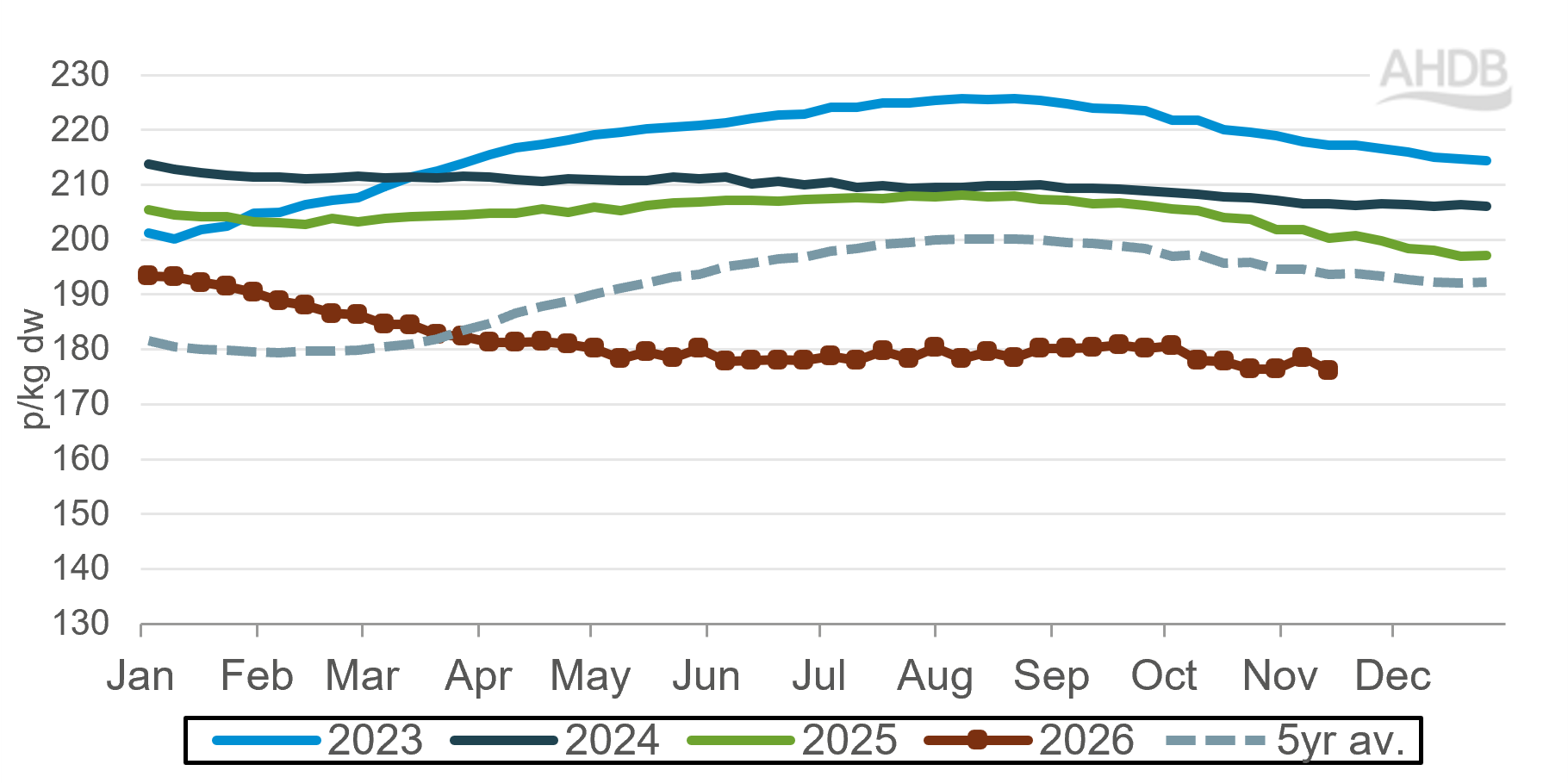
Figure 1. GB standard pig price (SPP – EU spec), p/kg (2023 to 2026)

Source: AHDB

Figure 1 shows the weekly GB standard pig price (SPP – EU spec) from 2023 to 2026. The SPP peaked at around 226p/kg in August 2023 and stayed above 200p/kg through 2024 and most of 2025. It has fallen steadily since late 2025, from 193p/kg at the start of 2026 to a low for the year of 176.12p/kg in the week ending 14 November.

Prices picked up briefly in the week ending 7 November. The SPP rose by 2.10p to 178.54p/kg, its largest weekly rise since early 2023. Prices went up in every weight band from 60kg to 105kg.

The rise did not last. In the week ending 14 November, the SPP fell by 2.43p to 176.12p/kg, its lowest level this year. It is now 24.18p lower than the same week last year, and 31.77p below its three-year average.

The SPP is an average, so it can mask the wide spread of prices currently being paid for pigs.

EU prices fall further

EU pig prices have fallen much faster than UK prices this autumn.

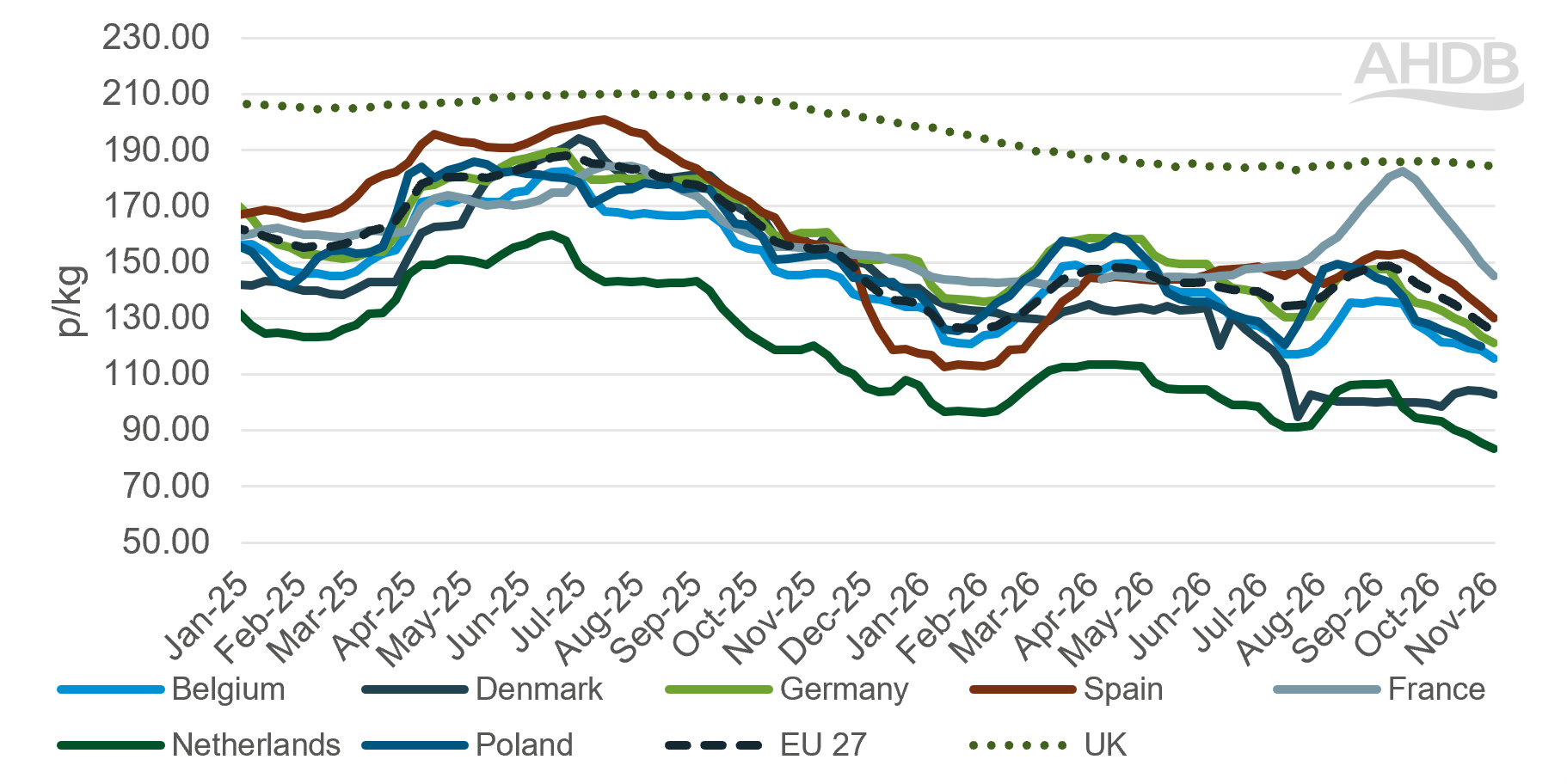
The EU grade S reference price fell by a further 3.12p to 125.06p/kg in the week ending 8 November. This is 23.79p lower than in mid-September, and 29.53p lower than a year ago.

As a result, the gap between UK and EU prices has grown. The UK grade S reference price was 184.14p/kg for the week ending 8 November, this puts it 59p/kg above the EU price. In mid-September, the gap was around 37p/kg.

Figure 2. Trends in selected European grade S reference pig prices (p/kg)

Source: Eurostat

Figure 2 is a line chart which compares the weekly UK grade S reference price with the EU grade S reference price of selected EU countries. The EU price has fallen from 148.85p/kg in mid-September to 125.06p/kg in the week ending 8 November, widening the gap between the EU and UK.

There are more pigs in Europe than the market currently needs. In Germany, the recommended price paid to farmers was cut to €1.32/kg on 28 October, well below their cost of production. Prices have also kept falling in Spain and France. Since African swine fever (ASF) was detected in Spain in November 2025, Some Spanish pork previously destined for non-EU markets has been redirected to the EU, increasing the volume of pork available on the EU market.

A wider price gap makes EU pork cheaper than British pork. This could potentially limit how far UK pork prices can rise.

Slaughter

Fewer pigs have been slaughtered than last year since the start of September.

In the week ending 7 November, estimated slaughter was 163,200 head. This was 7,100 fewer than the week before and 8,200 fewer than a year ago.

Lower slaughter does not mean there are fewer pigs on farms. The National Pig Association (NPA) reports that processors are already working at full capacity, and some are short of staff. This leaves little room to take extra pigs.

More sows are also being sent for slaughter. Our estimates show 38,100 sows and boars were slaughtered in September and October, 15% more than a year earlier. Sow and boar slaughter was also 15.4% higher in Q3. This suggests some producers are reducing their herds. This suggests some producers are reducing their herds, possibly due to the current challenging market conditions.

Carcase weights

Carcase weights have been trending upwards recently. The average SPP carcase weight was 93.38kg in the week ending 14 November. This was 0.22kg lighter than the week before and 0.2kg heavier than a year ago. It is also almost 4kg heavier than the summer low of 89.62kg in mid-July.

A larger share of pigs in the SPP sample are now heavy pigs. 24.8% weighed 100kg or more in the week ending 14 November, up from 14.3% in early August.

Some of this rise is normal for the time of year, as pigs grow faster in cooler weather.  However, there are reports of pigs without a home for slaughter being kept on farm and growing overweight. Weights are still below early 2026, when pigs backed up on farms and averaged over 95kg.

Looking ahead

The biggest short-term risk to prices is the number of pigs coming off contract. Earlier this year, processors gave some producers six months' notice to end their contracts. As these notice periods end, the NPA estimates around 15,000 pigs a week could be without a buyer from November. That is about 9% of current weekly GB slaughter.

This could affect the market in multiple ways such as:

  • Prices: pigs without a contract are likely to sell at a discount, which could pull prices down more widely
  • Weights: pigs kept on farm for longer will get heavier, and producers may face penalties for overweight pigs
  • Christmas: processors are busy in the run-up to Christmas, and there are fewer slaughter days over the holiday. Pigs not slaughtered before the break may be held into January

The farming minister has announced an emergency pig industry summit, but no date has been set. In September, the NPA asked the Government for support, including a Slaughter Incentive Scheme and Private Storage Aid.

Sign up for regular updates

Subscribe to receive pork market news straight to your inbox. Simply complete our online form.

Visit the Keep in touch page

While AHDB seeks to ensure that the information contained on this webpage is accurate at the time of publication, no warranty is given in respect of the information and data provided. You are responsible for how you use the information. To the maximum extent permitted by law, AHDB accepts no liability for loss, damage or injury howsoever caused or suffered (including that caused by negligence) directly or indirectly in relation to the information or data provided in this publication.

All intellectual property rights in the information and data on this webpage belong to or are licensed by AHDB. You are authorised to use such information for your internal business purposes only and you must not provide this information to any other third parties, including further publication of the information, or for commercial gain in any way whatsoever without the prior written permission of AHDB for each third party disclosure, publication or commercial arrangement. For more information, please see our Terms of Use and Privacy Notice or contact the Director of Corporate Affairs at info@ahdb.org.uk  © Agriculture and Horticulture Development Board. All rights reserved. 

×