Irish cattle prices ease despite continued supply constraints: Beef market update

Thursday, 7 May 2026

Irish prime cattle prices have come under pressure in the early part of this year, despite supplies remaining well below year-ago levels. We examine the drivers and impacts of these market movements.

Key points

  • Prime cattle prices in Ireland fell for seven consecutive weeks through February and March, widening the price differential to GB.
  • Supplies remain tight, with prime cattle slaughter in the year to date back 13% on last year’s levels. Forecasts indicate that this is likely to continue through the remainder of the year.
  • Lower supplies and falling prices have impacted trade volumes, with Irish exports constrained and imports higher in the first two months of 2026.

Prime cattle prices

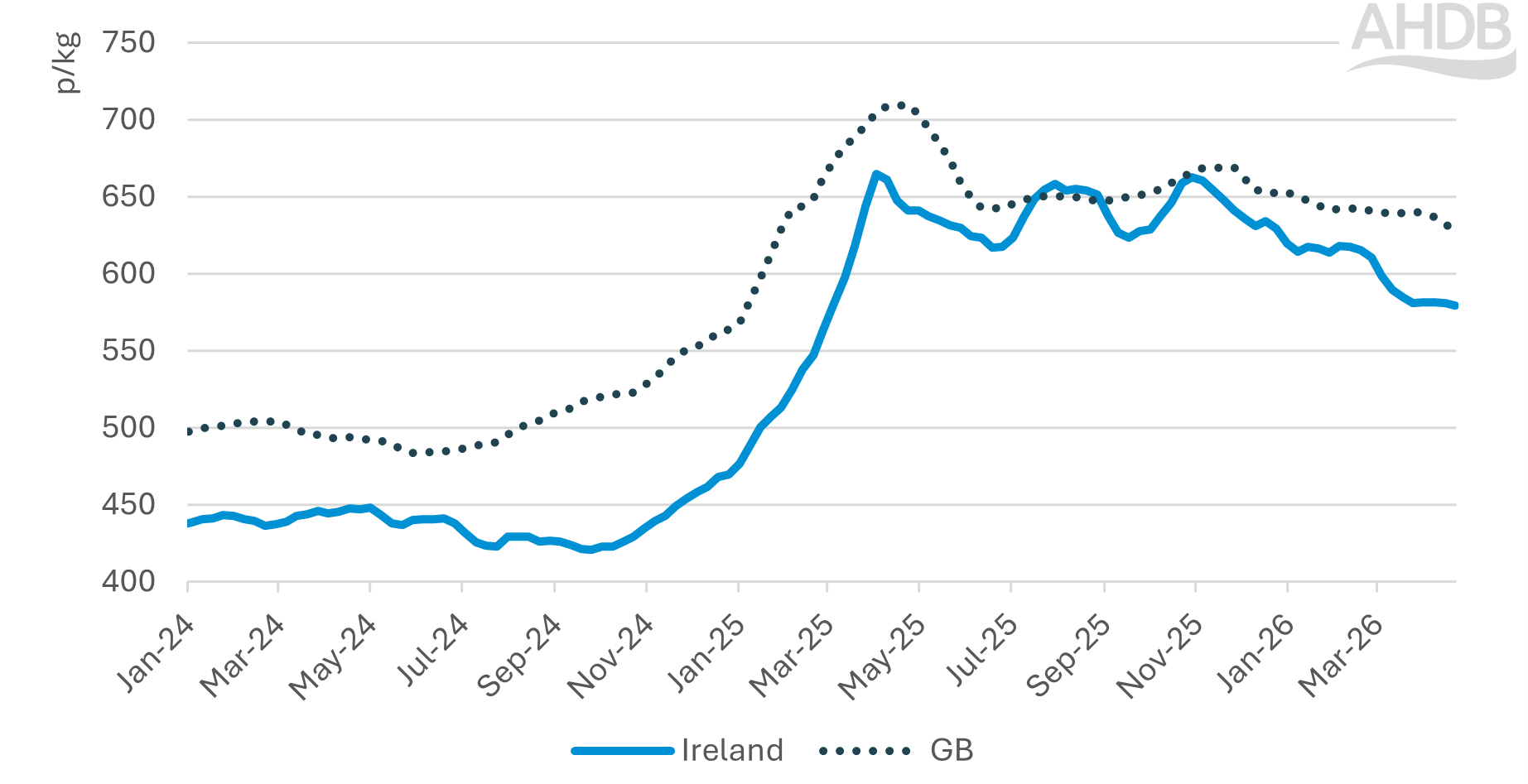
Irish prime cattle prices have steadied in recent weeks, following a period of declines in the spring. Steers averaged 581p/kg in the week beginning 20 April.

Values fell for seven consecutive weeks through February and March, as reports suggested demand for cattle wavered and stocks backed up on farm.

However, prices appear to have stabilised in recent weeks, with buying demand for cattle lifting. Commentary suggests that improved weather has boosted demand somewhat, particularly for steaking cuts.

With Irish prices falling at a steeper rate than those in GB, we have seen the differential widen, to 47p/kg in the latest week’s data (week beginning 27 April). This wider price differential is likely impacting trade volumes across the Irish sea.

Figure 1. Weekly Irish and GB steer prices (R3 carcase classification)

Chart showing weekly GB and Irish R3-grade deadweight steer prices 2024-2026

Sources: European Commission, AHDB

Figure 1 shows weekly R3 deadweight steer prices for GB (dark blue dotted line) and Ireland (light blue solid line) in sterling terms. GB prices generally track above Irish.

Cow prices

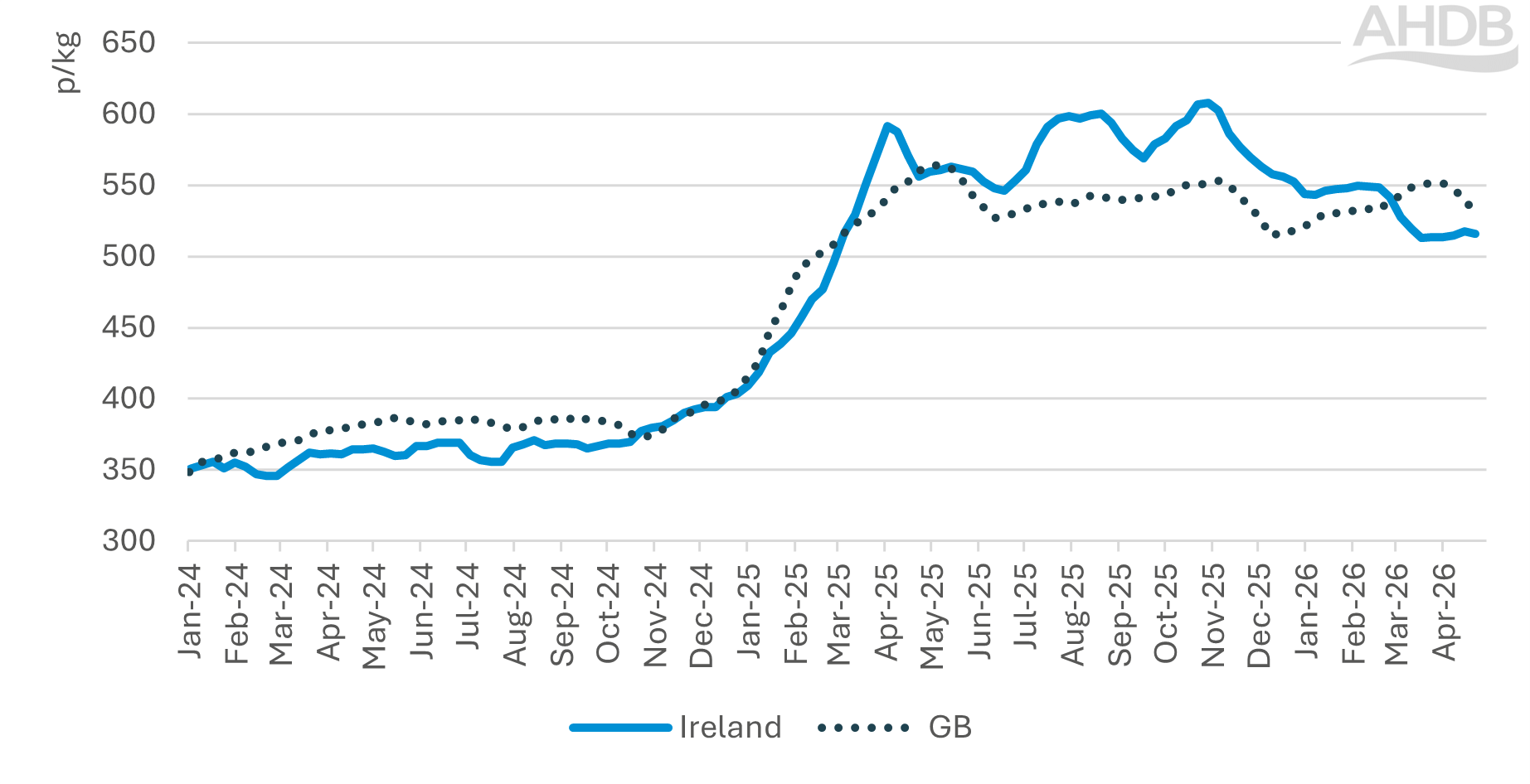
Cow prices track more closely across the two markets generally but have shown more volatility in recent months. Irish prices moved significantly above the GB market through 2025 on the back of significantly reduced kills but have recently moved closer to a more typical price position in relation to GB levels.

Irish cows were at a near 13p/kg equivalent discount to GB in the week beginning 27 April (average across O3 cow carcases).

Irish cow slaughter so far in 2026 has been lower year-on-year (-19% for 18 weeks to 27 April), and weekly throughputs have been in a similar range to those recorded in the second half of 2025.

Figure 2. Weekly Irish and GB cow price (O3 carcase classification)

Chart showing weekly GB and Irish O3-grade deadweight cow prices 2024-2026

Sources: European Commission, AHDB

Figure 2 shows weekly O3 deadweight cow prices for GB (dark blue dotted line) and Ireland (light blue solid line). The prices historically track closely together, however have experienced more volatility in recent months.

Supply

In the year to date, Irish cattle kill (excl. calves) has totalled 552,300 head (18 weeks to 27 April), back 13% on the same period of 2025.

Fewer numbers were seen across all categories, with the largest fall seen in cow numbers.

Tightness in supply has characterised the European beef market over the last eighteen months and Ireland is no exception to this trend. Forecasts for 2026 suggest that this is likely to continue, with the European Commission expecting a 2.6% annual decline in beef production in 2026.

Trade

Imports

In the first two months of the year, imports of fresh & frozen beef into Ireland totalled 6,800 tonnes, growth of nearly 70% versus the same period a year ago. Monthly volumes were at a similar level to those recorded at the end of 2025, following growth through the year. The UK is the majority supplier into the Irish market at over 90% market share and has driven this increase. This likely reflects the closeness in price between the two markets during the period, incentivising greater movement of beef across the Irish Sea.

With the price differential widening in recent weeks, the effect on trade volumes will be a key watchpoint as the year progresses.

Exports

Export volumes have also been impacted by both the price differential and supply dynamics outlined above. In the period Jan-Feb 2026, fresh & frozen beef exports from Ireland totalled 54,600 tonnes, a fall of 13% compared to 2025. Volumes declined to almost all key markets, including the UK, France and the Netherlands. Indeed, subdued demand (hampered by beef price inflation) in the UK and EU markets will be having an impact.

Live exports also form a key part of Irish beef trade, particularly into the EU. Supply constraints are evident in performance so far this year, with Bord Bia reporting that total live exports are down 18% year-on-year (year to 25 April). Reductions were seen in all categories, with steepest falls across finished (-35%), stores (-26%) and weanlings (-30%). Calves make up the largest proportion of live exports, with numbers down by 14% year-on-year.

Conclusion

Irish beef prices appear to have steadied in recent weeks, with reports suggesting increased buying activity as we move towards a key beef demand period in May and June.
Supplies are forecast to remain tight, which would point to an underlying level of support for farmgate prices generally moving forwards.

Export prospects may improve as the year progresses, as Irish prices now sit more competitively compared to both GB and others on the continent. This improved positioning may help to stimulate demand further along the supply chain.

However, longer-term impacts of price inflation across critical UK and EU markets remain a key risk for consumer purchasing and overall beef demand. Indeed, competition from other suppliers into the EU and UK markets remain a watchpoint for Irish trade, especially with constrained Irish production prospects.


Sign up for regular updates

You can subscribe to receive Beef and Lamb market news straight to your inbox. Simply fill in your contact details on our online form.

Visit the Keep in touch page

While AHDB seeks to ensure that the information contained on this webpage is accurate at the time of publication, no warranty is given in respect of the information and data provided. You are responsible for how you use the information. To the maximum extent permitted by law, AHDB accepts no liability for loss, damage or injury howsoever caused or suffered (including that caused by negligence) directly or indirectly in relation to the information or data provided in this publication.

All intellectual property rights in the information and data on this webpage belong to or are licensed by AHDB. You are authorised to use such information for your internal business purposes only and you must not provide this information to any other third parties, including further publication of the information, or for commercial gain in any way whatsoever without the prior written permission of AHDB for each third party disclosure, publication or commercial arrangement. For more information, please see our Terms of Use and Privacy Notice or contact the Director of Corporate Affairs at info@ahdb.org.uk  © Agriculture and Horticulture Development Board. All rights reserved. 

×