Q1 exports at four-year high while imports decline: Pork market update

Friday, 22 May 2026

Key points

  • Q1 exports totalled 87,100 tonnes increasing by 12% (9,200 tonnes) year on year
  • Q1 imports totalled 173,300 tonnes down 4% (7,500 tonnes) year on year
  • Fresh and frozen pork exports recorded the strongest growth, particularly to the China and Japan
  • Growing Brazilian production and increased competition in the Philippines may create additional export pressure later in 2026

Exports

UK pig meat exports (including offal) fell to 29,700 tonnes in March, down 2% from the previous month.

Across Q1 2026 as a whole, exports increased by 10% (7,800 tonnes) compared with Q4, largely driven by stronger shipments to the EU (5,800 tonnes) and the Philippines (1,500 tonnes). This likely reflects continued African Swine Fever (ASF) related supply pressures within both regions. The European Commission has reported 4,756 ASF cases across wild boar and domestic pigs within the EU.

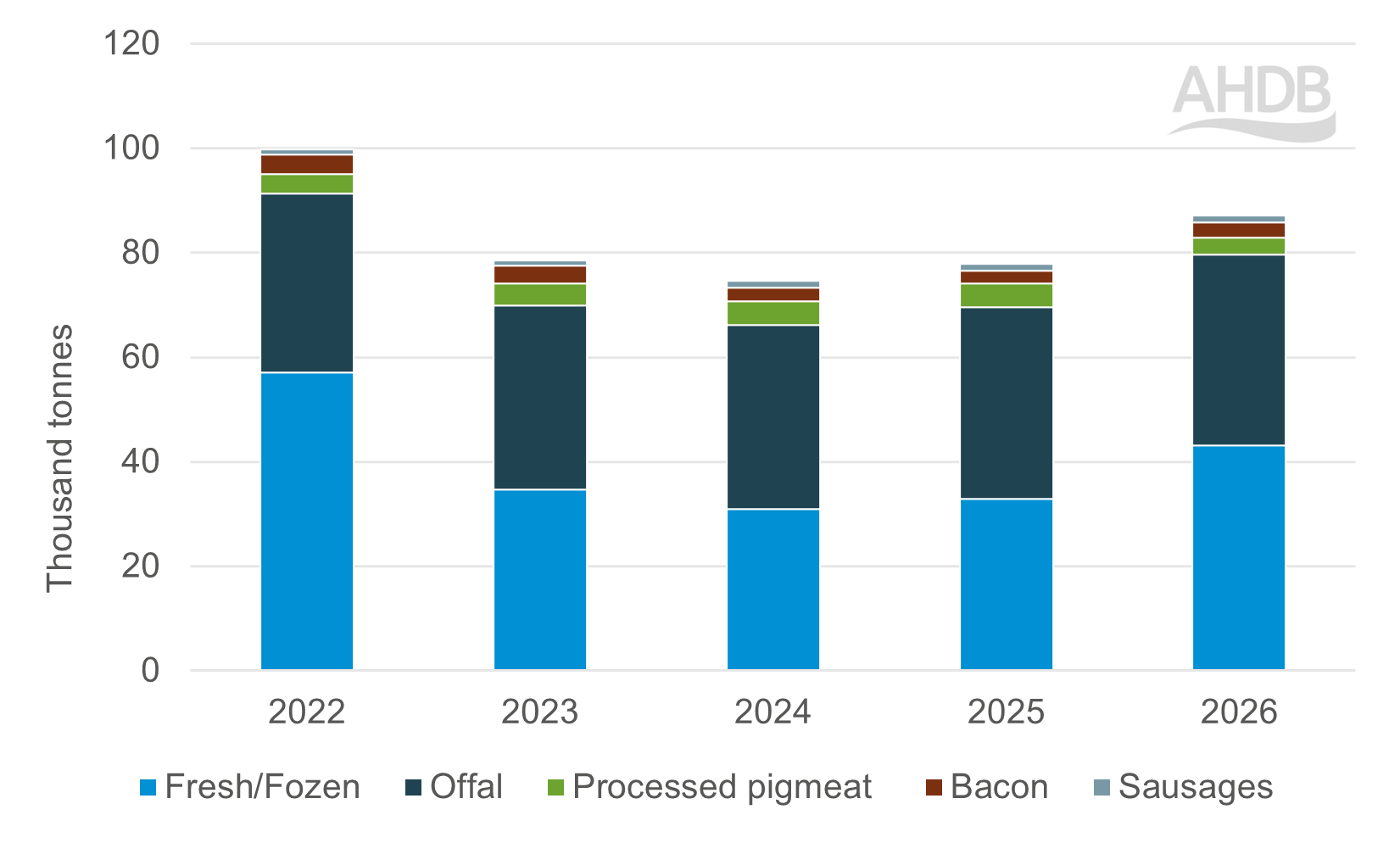
Q1 exports increased by 12% (9,200 tonnes), to 87,100 tonnes year on year (YoY) marking the highest Q1 export volume since 2022. This highlights the continued strength of UK exports compared with 2025 levels.

Growth was primarily driven by higher shipments to the EU (+5,600 tonnes), Japan (+1,300 tonnes) and South Africa (+766 tonnes). Increased demand from these markets may partly reflect ongoing ASF-related challenges impacting domestic supply.

Within the EU, Denmark and Germany imports increased by 1,300 tonnes and 1,000 tonnes respectively. This was partially offset by lower shipments to the Netherlands (-588 tonnes) and France (-254 tonnes).

Product trends

Fresh and frozen pork exports recorded the strongest growth during Q1, increasing by 31% (10,200 tonnes) YoY. Growth was supported by stronger demand from China and Japan. Shipments to China increased by 15% (1,700 tonnes), while exports to Japan rose by more than 300% (1,200 tonnes) YoY. Exports to the EU also strengthened, increasing by 42% (6,500 tonnes).

Meanwhile, processed pigmeat exports declined by 26% (1,100 tonnes) YoY, mainly due to reduced shipments to the EU.  

UK offal exports totalled 36,500 tonnes during Q1 2026. China remained the leading destination; however, these shipments fell by 8% (1,900 tonnes) YoY, likely caused by China’s ongoing focus on self-sufficiency.

Offal exports to the Philippines increased by 33% YoY. Additionally, exports to South Africa rose sharply by 385% (700 tonnes), supported by ASF related domestic supply pressures.

Bacon exports increased by 15% (385 tonnes) YoY to stand at 2,900 tonnes in the first quarter. While sausage exports declined by 5% (68 tonnes) YoY totalling 1,200 tonnes.

Figure 1. UK pig meat exports by product ('000 tonnes) January to March

Source: HMRC, compiled by Trade Monitor LLC

Figure 1 shows UK pig meat exports by product from 2022 to 2026, expressed in thousand tonnes. The categories include fresh and frozen pork, bacon, sausages, processed pig meat, and offal.

Imports

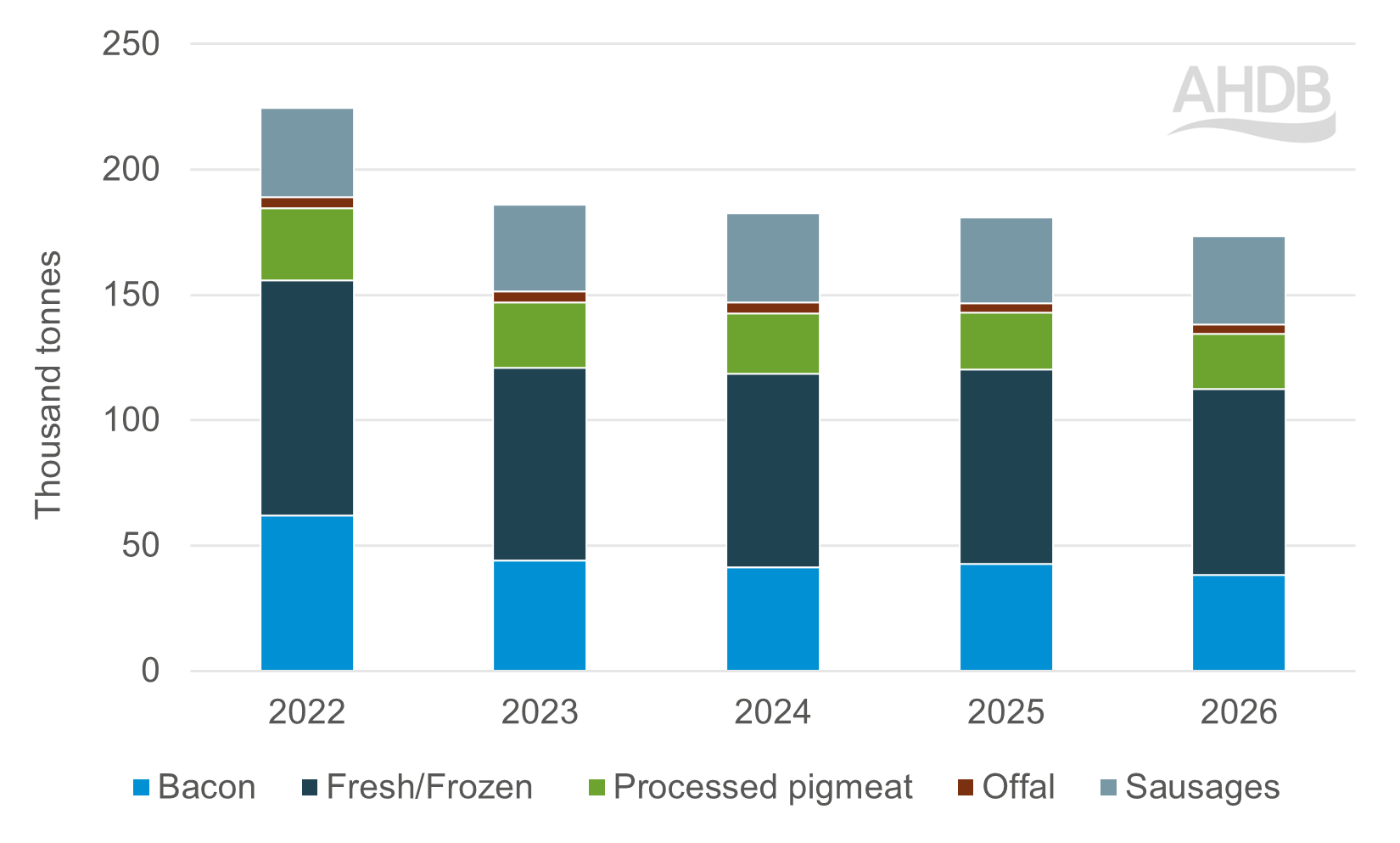
UK pig meat imports, including offal, remained lower YoY throughout Q1. Total import volumes reached 173,300 tonnes, down 4% (7,500 tonnes) compared with the same period last year.

Imports from Germany increased sharply by 114% (15,700 tonnes) YoY to 29,500 tonnes. This substantial increase largely reflects a recovery effect, as German volumes during 2025 were reduced by trade restrictions introduced following a foot-and-mouth disease outbreak.

The recovery in German imports was partially offset by lower volumes from the Netherlands (-6,400 tonnes) and Denmark (-7,500 tonnes).

Product trends

The largest product-level declines were seen in bacon and fresh and frozen pork imports, which fell by 10% (4,100 tonnes) and 5% (3,900 tonnes) respectively.

Within the fresh and frozen category, imports from Germany surged by 460% (11,800 tonnes). However, this was offset by lower volumes from Denmark (-5,600 tonnes), the Netherlands (-2,253 tonnes) and Spain (-2,200 tonnes).

The bacon category showed a similar trend. Imports from the Netherlands declined by 15% (3,800 tonnes), while Danish volumes also fell by 15% (1,800 tonnes). Although German bacon imports increased by 241% (939 tonnes), this only partially offset declines elsewhere.

Processed pig meat imports edged down by 3% (634 tonnes) YoY to 22,100 tonnes.

Sausages were the only category to record growth during the quarter, increasing by 3% (1,100 tonnes) YoY to 35,161 tonnes. Germany accounted for the majority of this increase, with volumes rising by 25% (1,900 tonnes).

Figure 2. UK pig meat imports by product ('000 tonnes) January to March

Source: HMRC, compiled by Trade Monitor LLC

Figure 2 shows UK pig meat imports by product from 2022 to 2026, expressed in thousand tonnes. The categories include fresh and frozen pork, bacon, sausages, processed pig meat, and offal. Although total import volumes fell over the period, the proportion contributed by each product type remained largely unchanged.

Looking ahead

Brazil continues to expand pig meat production and remains highly competitive due to its lower production costs. This is likely to increase competitive pressure for UK exporters within Asian markets.

At the same time, China’s continued focus on self-sufficiency is expected to weigh on long-term UK export opportunities. Ongoing efforts to reduce breeding sow numbers while increasing domestic productivity suggest China will remain focused on strengthening domestic supply.

China’s anti-dumping measures on EU pork may provide some short-term opportunities for UK exporters to partially fill supply gaps. However, the scale of this opportunity is likely to remain limited given broader structural changes within Chinese domestic production.

In the Philippines, new regionalisation agreements are expected to increase competition for UK pig meat exports. Spain has resumed access to the market following an ASF regionalisation review, while Germany has also secured a long-awaited regionalisation agreement, lifting its previous import ban. Both developments are likely to intensify competition within the market during the remainder of 2026.

Sign up for regular updates

Subscribe to receive pork market news straight to your inbox. Simply complete our online form.

Visit the Keep in touch page

While AHDB seeks to ensure that the information contained on this webpage is accurate at the time of publication, no warranty is given in respect of the information and data provided. You are responsible for how you use the information. To the maximum extent permitted by law, AHDB accepts no liability for loss, damage or injury howsoever caused or suffered (including that caused by negligence) directly or indirectly in relation to the information or data provided in this publication.

All intellectual property rights in the information and data on this webpage belong to or are licensed by AHDB. You are authorised to use such information for your internal business purposes only and you must not provide this information to any other third parties, including further publication of the information, or for commercial gain in any way whatsoever without the prior written permission of AHDB for each third party disclosure, publication or commercial arrangement. For more information, please see our Terms of Use and Privacy Notice or contact the Director of Corporate Affairs at info@ahdb.org.uk  © Agriculture and Horticulture Development Board. All rights reserved. 

×