What’s happening in New Zealand’s B&L markets and how is it influencing UK imports? Beef and lamb market update

Wednesday, 10 June 2026

Strong farmgate prices have been seen across both beef and lamb in NZ in recent months. We take a look at what this means for production and trade in the region, and the implications for the UK market.

Key points

  • Strong farmgate prices have supported increased beef production in NZ with a growing proportion of exports coming to the UK
  • Lamb production has declined in the region with less product being exported to the UK as they diversify export markets
  • With an expanding quota under the UK-NZ Free Trade Agreement (FTA) NZ beef exports could increase beyond their current levels as the year progresses

Outlook

New Zealand’s beef and lamb producers are generally positive, with strong farmgate prices driving higher revenue. Summer and autumn provided a good grass growing season, allowing farmers to hold onto stock, maximising weights and returns.

However, input costs have risen, with fuel and fertiliser prices up as conflict in the Middle East continues. While effects have been limited so far, prolonged disruption is expected to place greater pressure on producers.

Beef

NZ beef prices have started to soften in recent weeks as more cattle begin to come through to slaughter. However, they remain historically strong, supported by good export demand and tight global supply. Farmgate steer prices in the week ending 29 May averaged 408p/kg carcase weight equivalent (CWE).

Cows have been held on farm longer due to good feed availability and strong prices. Strong dairy payouts and new herds being formed have also encouraged retention. More cows are now coming forward, but the number of cows going to slaughter was still down 14% year on year as of 2 May, the lowest levels since 2012.

Looking ahead, cattle numbers are expected to grow, with herds rebuilding after losses due to forestry conversions in previous years. The forecast from B&L NZ indicates that cattle processed in 2025-26 season will be up 1.1% on the year prior.

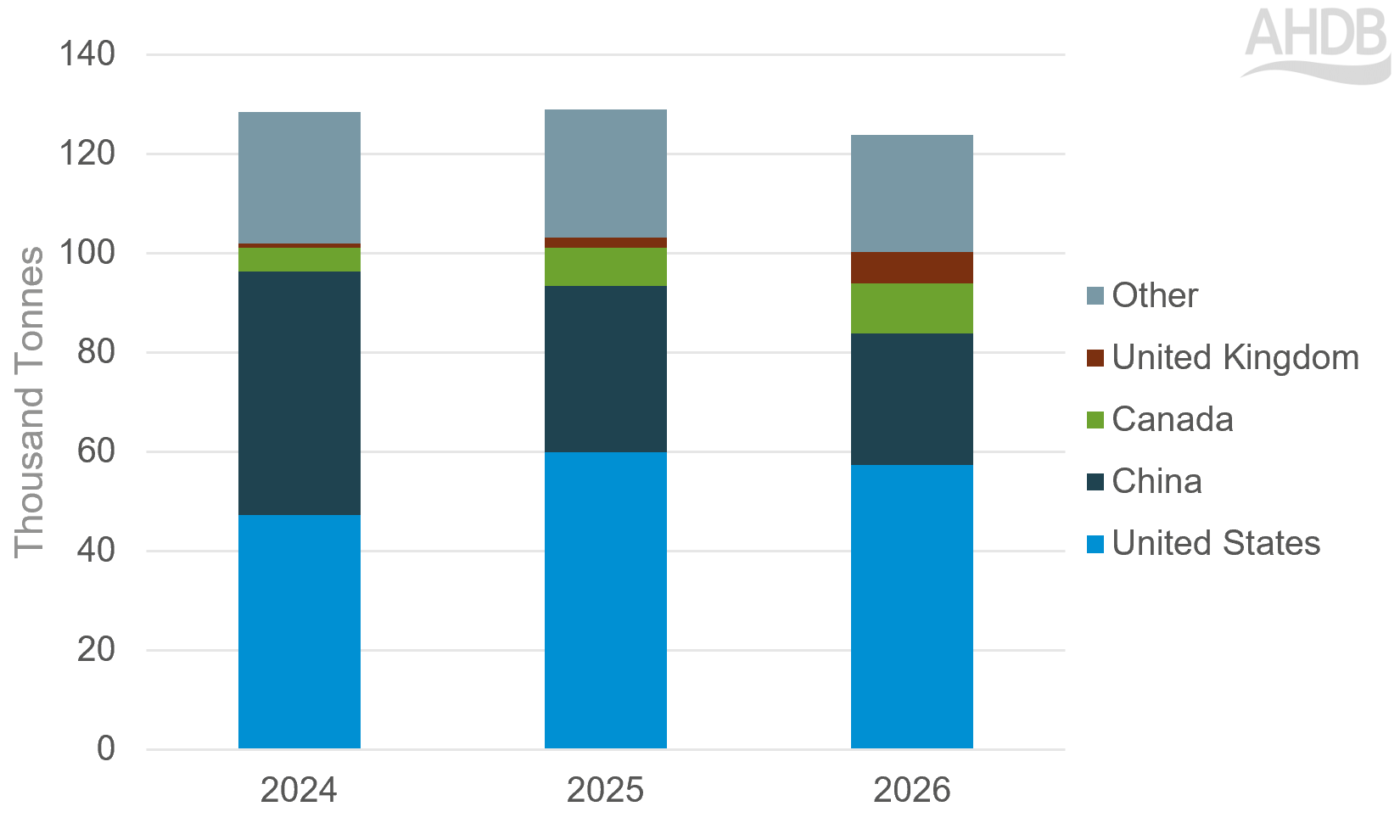
Beef exports from NZ in Q1 of 2026 totalled 137,000 tonnes, back 4% on the same period of the year prior.

Figure 1. NZ beef exports in Q1 of 2026, by destination

Graph sowing NX beef exports

Source: TDM

NZ beef export markets have diversified as seen in Figure 1. The bar displays the volumes of beef being exported by NZ in Q1 by the destination. The US (light blue) shows the largest volume, followed by China (dark blue), Canada (green) UK (brown), and other countries in grey.

Exports have been supported by reduced tariffs into the US, China’s safeguarding measures keeping export volumes stable, and potential opportunities with an FTA with India.

Product sent to the UK has increased substantially year on year, now accounting for around 5% of NZ beef exports.

Lamb

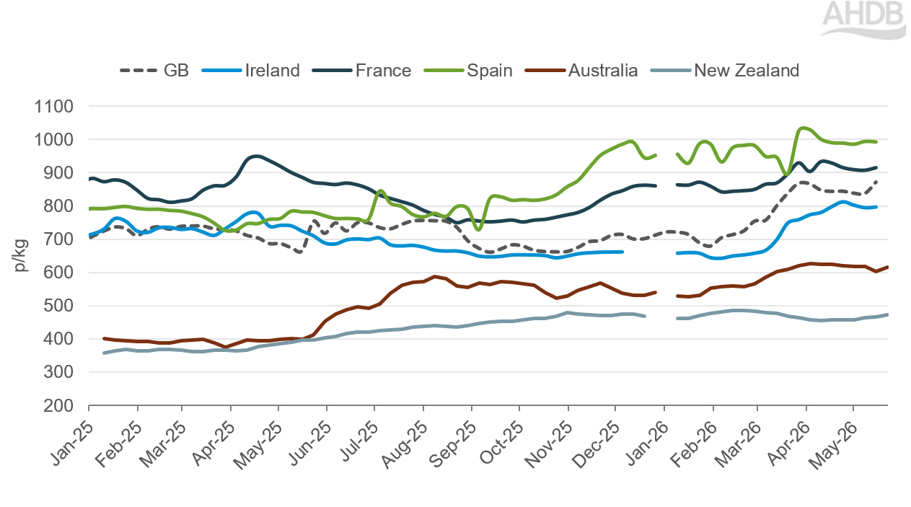
Lamb farmgate prices in NZ have started to soften, but from historical highs. In the week ending 22 May the average price sat at 472.5p/kg cwe, up 17p year on year.

A slaughter peak coinciding with the shorter Easter kill weeks, led to lesser demand for sheep and the farmgate prices softened. As the kill weeks head back to normality, and the stock numbers fall seasonally, this price has started to rise.

Figure 2. Global deadweight farmgate lamb prices

Graph showing global lamb prices

Source: AHDB, European Commission, MLA, AgriHQ

The line chart in Figure 2 shows the farmgate lamb prices from Jan 2025-May 2026, with NZ in grey, Australia in brown, France in Black, Ireland in Blue, Spain in green and GB in dashed line.

A better-than-expected lambing has increased expected supply, and a good growing season has allowed producers holding on to stock, increasing weights. These factors have made the actual supply situation slightly more positive than the forecasted, but YoY kill is still down 5% for the first 27 weeks of the year.

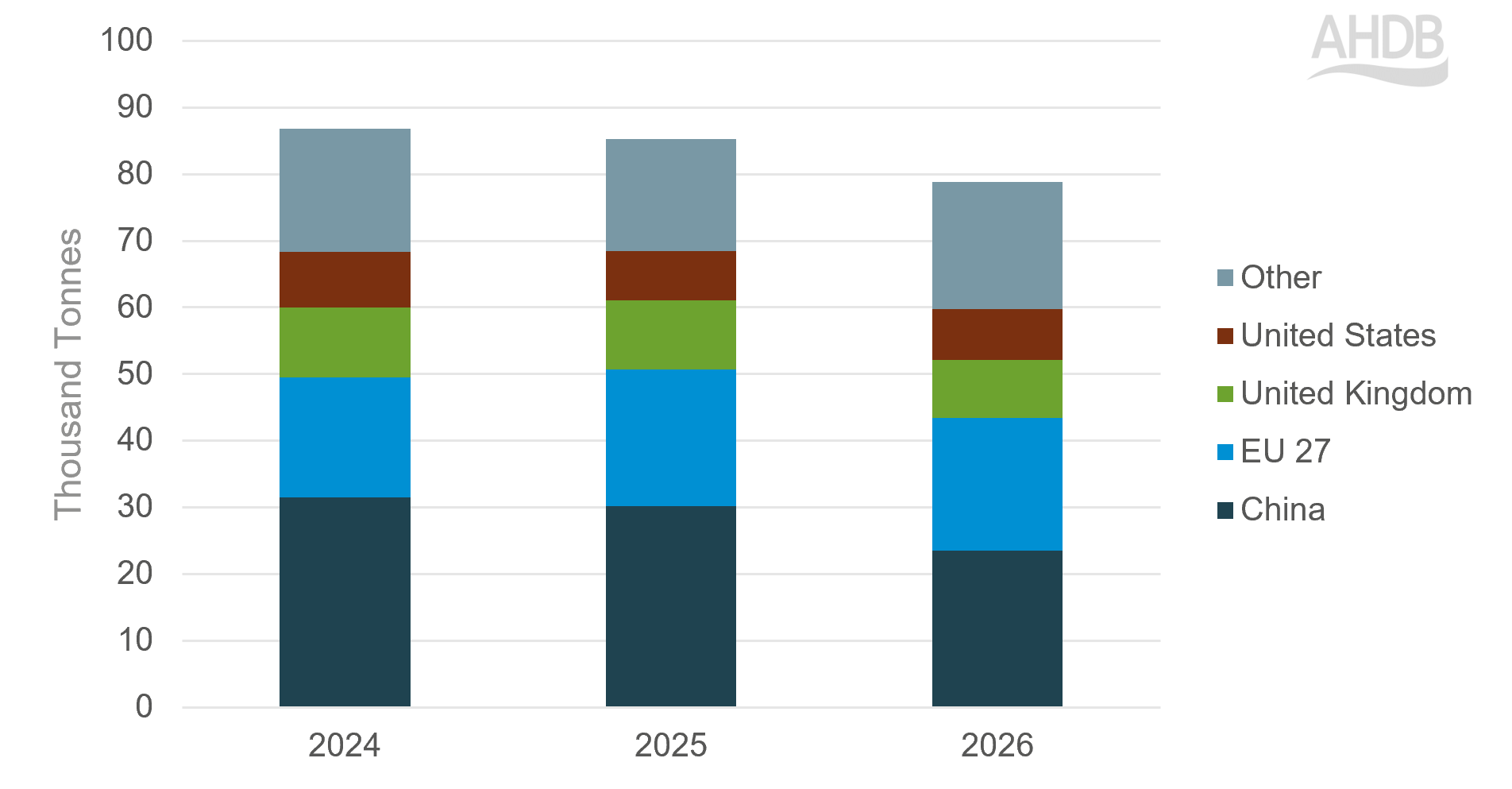
NZ are continuing to diversify their lamb exports, with Q1 export destinations shown in Figure 3.

Overall NZ lamb exports were down for Q1, with volumes to the UK down 16% year on year. Exports into the US grew by 4% on the year, as tariffs dropped from 15% to 10%, with an additional 1% MFN rate.

Figure 3. NZ lamb exports in Q1 of 2026, by destination

Graph showing NZ lamb exports

Source: TDM

The bar chart in figure 3 shows the lamb exports from NZ in Q1 2024-2026, with China in the dark blue, EU 27 in the light blue, UK in green, US in brown and other countries in grey.

So where does this leave the UK?

Beef

NZ have long benefited from tariff-free market access to the UK for lamb, but the new FTA has given them new access to a tariff-free quota for beef which steadily rises through to 2032. As at the end of May, almost 70% of the 2026 quota had been issued under export certificates, according to the NZ Meat Board.

As a high value market for beef, the UK is an attractive export customer for NZ. The UK and Irish beef herds have seen several years of structural decline which has tightened domestic supply, creating room for imported product in the market.

Furthermore, trust and understanding of NZ lamb exports to the UK are providing good opportunities for NZ beef to increase access to the UK. We can expect them to make the most of the FTA, likely filling the quota towards the end of the year. The impact of this additional NZ beef in the market will be a key watchpoint.

However, ongoing cost-of-living pressures mean consumers remain price sensitive, and sustained inflationary pressures for beef is weighing on demand.

With this lowering demand, and new export customers for NZ such as India combined with increased demand from the US and EU, the quantity exported to the UK has the potential to ease as the year progresses.

Lamb

The UK took 11% of NZ’s lamb exports in Q1 2026 and NZ remain the largest contributor to the UK lamb market. With New Zealand’s national herd continuing to decline and their exports continuing to diversify, it would stand to reason that lamb exports to the UK may decline.

However, as a high value market with strong demand, as well as room in the WTO quota for growth, the UK will likely remain a strong market, with long term ties and relationships.

Image of staff member Molly Corbett

Molly Corbett

Analyst (Livestock)

See full bio


Sign up for regular updates

You can subscribe to receive Beef and Lamb market news straight to your inbox. Simply fill in your contact details on our online form.

Visit the Keep in touch page

While AHDB seeks to ensure that the information contained on this webpage is accurate at the time of publication, no warranty is given in respect of the information and data provided. You are responsible for how you use the information. To the maximum extent permitted by law, AHDB accepts no liability for loss, damage or injury howsoever caused or suffered (including that caused by negligence) directly or indirectly in relation to the information or data provided in this publication.

All intellectual property rights in the information and data on this webpage belong to or are licensed by AHDB. You are authorised to use such information for your internal business purposes only and you must not provide this information to any other third parties, including further publication of the information, or for commercial gain in any way whatsoever without the prior written permission of AHDB for each third party disclosure, publication or commercial arrangement. For more information, please see our Terms of Use and Privacy Notice or contact the Director of Corporate Affairs at info@ahdb.org.uk  © Agriculture and Horticulture Development Board. All rights reserved. 

×