- Home
- News
- What’s the outlook for Australia and New Zealand’s beef and lamb sectors and what does this mean for the UK?
What’s the outlook for Australia and New Zealand’s beef and lamb sectors and what does this mean for the UK?
Wednesday, 4 March 2026
Global demand for beef and sheep meat is strong, with Australia and New Zealand key suppliers in both sectors. This article summarises expectations for production and trade for the year ahead and explores implications for the UK market.
Key points
- Beef production in New Zealand is likely to grow in 2026, with strong prices supporting farmer confidence. Lamb numbers are likely to remain tighter, with strong export demand for available product
- In Australia, beef production growth is forecast to slow following record highs in 2025. Smaller lamb numbers have supported price growth in recent months and the size of the remainder of the lamb crop will be a key influence on supplies
- We have seen increased beef imports from both regions into the UK, with quota volumes set to increase out to 2032. Sheep imports have been more mixed, with New Zealand volumes limited by their domestic supply but growth in imports from Australia
New Zealand
Beef
Rabobank expect continued firm farmgate pricing for New Zealand beef throughout 2026, as local supplies remain tight and strong export demand persists. This is anticipated to support farmer confidence. Slaughter numbers for 2026 are forecast to increase by 3% year-on-year, from a low 2025, with a great number of dairy-beef calves in the system bolstering supply.
New Zealand saw strong exports through 2025, with values hitting record highs. Key markets included the US, accounting for almost 40% of volume, and China at 25%. It is expected that the US will continue to drive export demand into 2026 as their domestic supply remains constrained and strong import demand persists.
Furthermore, New Zealand could be set to benefit from a more generous quota into China in 2026. This is not the case for other major suppliers Australia and Brazil, which have quotas smaller than 2025 volumes, meaning that if China maintains or increases demand for imported beef in the coming year, New Zealand may be well placed to fulfil it.
Lamb
The outlook for lamb production indicates supply will remain similarly tight as last year. Lower ewe numbers are likely to be particularly offset by a better lambing season, leading to a slightly increased lamb crop.
Farmgate lamb prices have remained strong in the region, underpinned by export demand. Whilst Rabobank expect some easing of prices as they move into the bulk of supply over the coming weeks, the long-term picture is to remain supported.
New Zealand’s lamb export portfolio diversified in 2025, reducing their reliance on China as increased product was shipped to the EU, USA and Middle East. This trend is expected to continue through this year, with good demand from these markets benefitting New Zealand product.
Australia
Beef
Australia’s beef production hit record highs in 2025, driven by the combination of greater cattle numbers and higher carcase weights. Strong demand for export supported prices, with strong price growth seen in the second half of the year.
Forecasts for 2026 indicate that this production growth is likely to slow, with production levels likely to be in line with or slightly below 2025 levels. Export demand from the US is expected to remain strong, supporting prices, however quota constraints from China may provide some downside pressure on prices in the second half of the year.
Lamb
Sheep supply began to tighten in the second half of 2025, with analysts attributing this to a poorer lambing and weather challenges that limited numbers forward. This supported prices as demand began to outpace supplies. Looking into 2026, forecasts suggest that Australian lamb numbers are likely to remain tight, which will continue to support prices.
Exports remain extremely important to Australian lamb markets, with Rabobank estimating that 70% of lamb produced is now exported. The US and China remain the largest export markets, by volume, with growth seen in shipments to the Middle East in recent years.
How does this impact the UK?
Beef
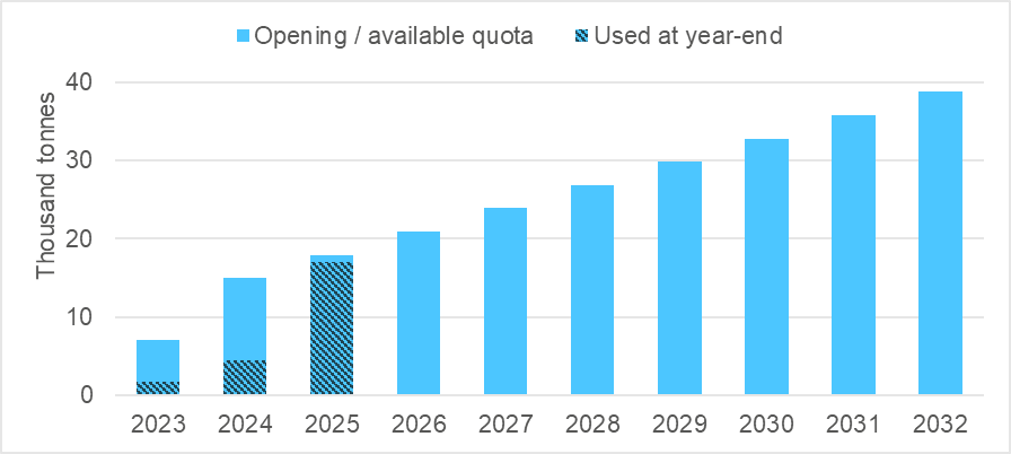
In 2025, we saw New Zealand use 95% of its FTA beef quota which equates to just over 17,000 tonnes. Whilst this represents significant year on year growth in volumes, New Zealand still only accounted for 5% of total beef (fresh, frozen, offal and processed) imports into the UK in the year.
This quota continues to grow to 2032, and we can expect that New Zealand would look to maximise its beef export potential to the UK’s high value market. With a total quota volume of 38,800 tonnes available in 2032, the impact of increasing presence of NZ product will be an important watchpoint for the domestic market over the coming years.
Figure 1: Usage of NZ-UK FTA beef quota

Source: New Zealand MFAT
Figure 1 shows a bar chart the quota volume for New Zealand beef into the UK. The light blue bars show the available volume and the dark blue hashed bars show how much product was sent in the year to date. The available quota bars grow steadily from 2023 to 2032.
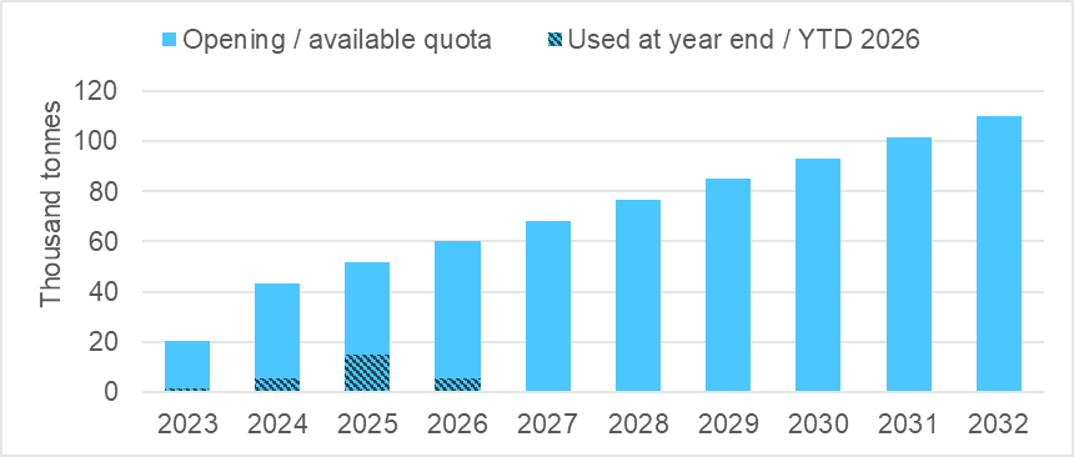
Australia shipped a similar volume of beef to the UK in 2025 at just over 15,000 tonnes, however this represented only 29% of their available quota. Demand in other key global markets, such as the US, likely had a stronger draw on Australian beef, somewhat limiting product destined for the UK.
Data for the first 8 weeks of 2026 (up to 23 February) records 5,200 tonnes of beef shipped under the 2026 FTA, equivalent to 8% of the total available. This would suggest that we may see greater imports of Australian beef into the UK as the year progresses, under this trade agreement.
If Australian product is unable to flow into China once the FTA volume is reached, we may see more in the global market that could move into the UK. However, global beef supplies remain tight and historically the UK is a relatively low volume market for Australia, with markets such as the US have a strong pull on available product.
Figure 2: Usage of Australia-UK FTA beef quota

Source: Australia DAFF
Figure 2 shows a bar chart the quota volume for Australian beef into the UK. The light blue bars show the available volume and the dark blue hashed bars show how much product was sent in the year to date. The available quota bars grow steadily from 2023 to 2032.
Lamb
UK sheep meat imports from New Zealand fell slightly year on year in 2025, back by 6%, however they retained the largest market share with a total of 42,800 tonnes.
Looking into 2026, imports from New Zealand are likely to stay relatively stable, with potential for slight growth. There is significant headroom for growth in the WTO quota and the UK remains a consistent and high value market for New Zealand sheep meat. However, their domestic production is likely to limit export potential, alongside strong draw for product from the EU at high prices.
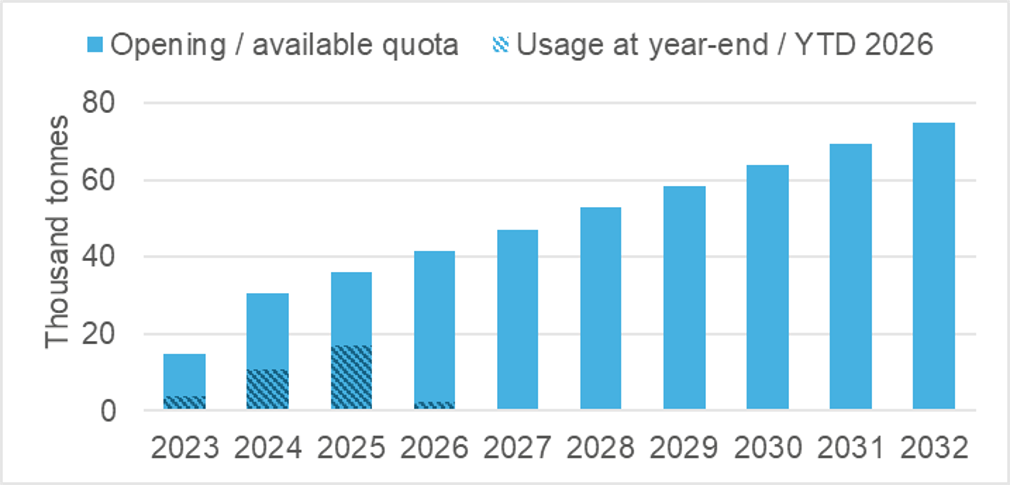
In contrast, we saw sheep meat imports from Australia lift by 35% on the year, totalling 25,800 tonnes for the full year of 2025. The Australian sheep meat quota continues to grow into 2026, with some expectations that this will facilitate greater imports into the UK. So far in 2026 (to 23 February) 2,600 tonnes of product has been shipped, equating to only 6% of the available quota for the year.
Figure 3: Usage of Australia-UK FTA sheep meat quota

Source: Australia DAFF
Figure 3 shows a bar chart the quota volume for Australian sheep meat into the UK. The light blue bars show the available volume and the dark blue hashed bars show how much product was sent in the year to date. The available quota bars grow steadily from 2023 to 2032.
Sign up for regular updates
You can subscribe to receive Beef and Lamb market news straight to your inbox. Simply fill in your contact details on our online form.
While AHDB seeks to ensure that the information contained on this webpage is accurate at the time of publication, no warranty is given in respect of the information and data provided. You are responsible for how you use the information. To the maximum extent permitted by law, AHDB accepts no liability for loss, damage or injury howsoever caused or suffered (including that caused by negligence) directly or indirectly in relation to the information or data provided in this publication.
All intellectual property rights in the information and data on this webpage belong to or are licensed by AHDB. You are authorised to use such information for your internal business purposes only and you must not provide this information to any other third parties, including further publication of the information, or for commercial gain in any way whatsoever without the prior written permission of AHDB for each third party disclosure, publication or commercial arrangement. For more information, please see our Terms of Use and Privacy Notice or contact the Director of Corporate Affairs at info@ahdb.org.uk © Agriculture and Horticulture Development Board. All rights reserved.