Agricultural price index: How the conflict in the Middle East has affected input prices on farms in the UK

Wednesday, 17 June 2026

The Agricultural Price Index (API) reflects the price that farmers pay for farm inputs and the price they get paid for outputs, relative to the base year of 2020. With conflict in the Middle East escalating towards the end of February, we look at how these global shocks have filtered through into changing costs on farms.

Key points

  • API data for March shows total agricultural input price inflation rose by 3.7% year-on-year and was up 1.1% month-on-month, primarily driven by fertiliser, soil enhancers, fuels and lubricants.
  • Inflation in output prices for commodities such as milk and pork eased, meaning that input costs grew faster than the output. However, this is not directly linked to the conflict in the Middle East, with other key driving market factors across supply and demand.
  • Suggestions to negate the impact of price rises include monitoring input prices such as fertiliser using the AHDB GB fertiliser prices and making the most of alternatives such as FYM or digestate. However, it remains difficult for farmers to negate the impacts of these input price rises, as divergence between input and output prices continue to increase.

Inputs

March 2026 data recorded that agricultural input inflation rose by 3.7% year-on-year and 1.1% month-on-month, continuing an upward trend. The key contributors to this increase were fertilisers and soil improvers (index values +19.7% year-on-year, +2.7% month on month) and plant protection products (index +33.1% year-on-year). This aligns closely with the timing of the Iran conflict, which directly disrupted global energy and fertiliser markets.

The conflict affected the Strait of Hormuz, through which around one-fifth of oil and a large share of fertiliser trade passes. Disruption and perceived risk in this region led to sharp increases in oil and gas prices. In March, crude oil prices climbed to around $110 per barrel, while gas prices rose significantly due to strikes and supply uncertainty. Because natural gas accounts for roughly 60% of fertiliser production costs, this directly led higher fertiliser prices. Diesel and oil costs also rose as a result of the geopolitical risk, with the API reporting the energy and lubricants index value up 10.9% month-on-month.

Figure 1. UK Agricultural Price Index for Inputs

Line graph showing input prices from January 2020 to April 2026.

Source: Defra

Figure 1 shows a line chart, demonstrating the changes in API over all agricultural products (light blue dash), energy and lubricants (dark blue), fertilisers and soil improvers (light green), plant protection products (brown), and animal feedstuffs (dark green). This is over the period of January 2020 – March 2026.

Outputs

In contrast to rising input costs, agricultural outputs were weaker overall, with the index value falling by 5.3% year-on-year in March 2026, although it did rise 1.1% month-on-month. This highlights a key issue for farm profitability: costs increased faster than farm-gate returns.

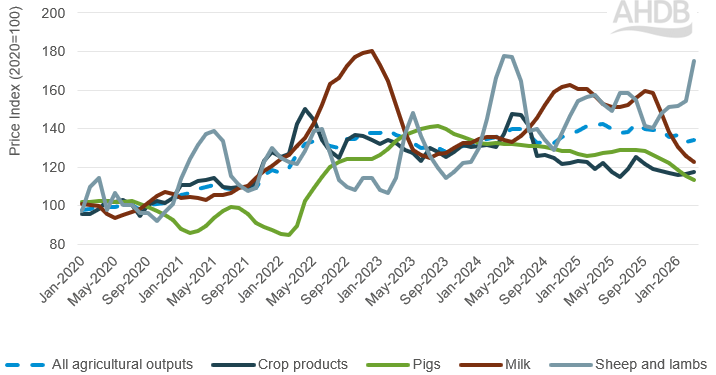
The decline in output prices was driven primarily by sectors such as milk and pigs. While some sectors like sheep and lamb provided positive contributions, these were not sufficient to offset broader downward pressure.

It is hard to quantify how much of the drop in output prices can be attributed to the conflict in the Middle East, as other attributing factors such as a global over supply of milk and oversupply of UK pork are key factors in these price drops.

Figure 2. UK Agricultural Price Index for Outputs

  Line graph showing output prices from January 2020 to April 2026.

Source: Defra

Figure 2 shows the line chart, demonstrating the changes in API over all agricultural outputs (light blue dash), crop products (dark blue), pigs (light green), milk (brown), and sheep and lambs (dark green). This is over a time period of January 2020 – March 2026.

Result on the market

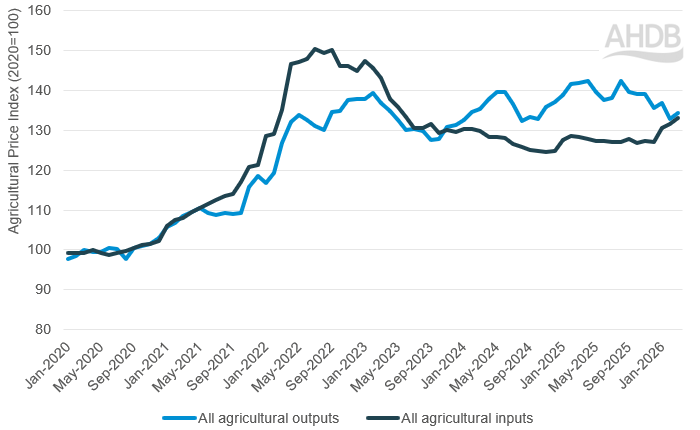
The March API data confirms that, despite a slight monthly recovery in output prices, the annual trend remained negative, while input costs continued to climb.

Figure 3. API Input and Output Price Indexes

Line graph showing input and output prices from January 2020 to April 2026.

Source: Defra

The line chart in figure 3 shows the divergence in API input price inflation (dark blue) vs output (light blue).

On farm, the effects of this inflation in input prices include:

  • Increased uncertainty around fertiliser purchasing decisions
  • Higher fuel prices increasing costs in every sector
  • Short-term profitability challenges across most sectors
  • Higher working capital requirements

The Iran conflict in March 2026 primarily impacted UK agriculture through input-side inflation, especially in fertiliser and energy. While output prices showed some monthly recovery, they remained weak overall, resulting in a widening gap between costs and returns. The API data reflects this imbalance clearly, highlighting how geopolitical shocks can quickly erode farm margins before output markets fully adjust.

What can farmers do to mitigate the impact of rising input costs?

  • Monitor prices using the GB fertiliser prices, get multiple quotes, bulk buy, or join purchasing groups.
  • Fix or manage fuel price risk (short term) - consider fixing fuel prices or negotiating supply deals where possible.
  • In the longer term, cut fuel use by reducing machinery passes and adopt low-disturbance systems like direct drilling and adopt on-farm energy such as solar or wind.
  • Use soil testing, nutrient plans, and variable rate application to reduce input needs. These can be included in SFI schemes also.
  • Make the most of farm yard manure (FYM) using the RB209 management guide and AHDB slurry wizard tool.
  • Look at alternatives such as buying in FYM/slurry, or the use of other products such as digestate or chicken litter.
  • Use approaches like rotational/mob grazing or winter grazing of wheat to reduce inputs.
  • Consider contracts or added-value outputs where appropriate.

However, some of these may not always be possible in practical terms. Using output-side measures like contracts are not always suitable and can be difficult to implement or not be suitable to a business. They may also limit upside potential if prices rise and farmers are locked into lower returns.

Similarly, investing in equipment such as min-till drills or variable-rate technology is challenging when profits are tight, as both affordability and confidence to invest is low.

Conclusion

In conclusion, the March 2026 API data underlines how quickly geopolitical tensions can feed through into UK farm economics, primarily via higher input costs.

The Middle East conflict has amplified existing pressures on fertiliser and energy markets, widening the gap between costs and farm-gate prices and tightening margins across most sectors.

While a range of mitigation strategies exist, their practicality is often constrained by cashflow and confidence, particularly in a low-margin environment.

As a result, the current situation reinforces the importance of careful cost control, flexible decision-making, and resilience planning, as farms continue to navigate volatile global markets.


Image of staff member Molly Corbett

Molly Corbett

Analyst (Livestock)

See full bio


Sign up for regular updates

You can subscribe to receive Beef and Lamb market news straight to your inbox. Simply fill in your contact details on our online form.

Visit the Keep in touch page

While AHDB seeks to ensure that the information contained on this webpage is accurate at the time of publication, no warranty is given in respect of the information and data provided. You are responsible for how you use the information. To the maximum extent permitted by law, AHDB accepts no liability for loss, damage or injury howsoever caused or suffered (including that caused by negligence) directly or indirectly in relation to the information or data provided in this publication.

All intellectual property rights in the information and data on this webpage belong to or are licensed by AHDB. You are authorised to use such information for your internal business purposes only and you must not provide this information to any other third parties, including further publication of the information, or for commercial gain in any way whatsoever without the prior written permission of AHDB for each third party disclosure, publication or commercial arrangement. For more information, please see our Terms of Use and Privacy Notice or contact the Director of Corporate Affairs at info@ahdb.org.uk  © Agriculture and Horticulture Development Board. All rights reserved. 

×