Promotions and price sensitivity steer Easter purchasing patterns in 2026

Tuesday, 2 June 2026

Total grocery sales over the two weeks to Easter reached £6.43bn, up 3.7% from Easter 2025. But while shoppers still wanted a special Easter meal, affordability played a much bigger role in what went into baskets this year.1

Primary red meat volumes grew 8.4%, helped by heavy promotions and shoppers stocking up early.

The biggest winner was pork roasting, with volumes rising almost 30% as shoppers looked for cheaper alternatives to beef. This suggests value and affordability are likely to remain key drivers of Easter shopping in 2027. (2)

Key takeaways

  • Some shoppers looked for cheaper alternatives to traditional Easter proteins, helping pork become the standout performer of 2026
  • Lamb remained central to Easter celebrations, despite continued pressure on household budgets
  • Rising beef prices pushed more shoppers towards lower-cost roasting options
  • Promotions drove much of the category growth
  • Shoppers bought earlier and seemingly stocked freezers ahead of Easter

Table 1: Roast joint market performance across proteins for Easter 2026

Measure

Primary red meat

Beef

Lamb

Pork

Whole chicken

Volume growth

+12.5%

+8.5%

+8.6%

+29.9%

-3.0%

Price change

+13.7%

+40.5%

+6.3%

-5.8%

-4.2%

Volume on promotion share %

51.4%

33.2%

64.2%

47.2%

46.4%

Source: Worldpanel by Numerator, 2 w/e 5 April 2026 vs 2 w/e 20 April 2025

Easter 2026 showed that shoppers still want to celebrate the occasion, but value played a much bigger role in what they bought this year.

With Easter falling earlier and a colder start to spring, shoppers returned to roasting joints for their celebrations.

Pork grew as shoppers looked for better deals, but lamb remained important for traditional Easter meals.

Pork became the value choice for Easter

Primary pork roasting volumes this Easter rose 29.9% compared to last year, reaching their highest level in five years.

As beef roasting joint prices rose (exceeding £13/kg to become the most expensive protein centrepiece) shoppers increasingly pivoted to pork as a value-driven alternative that was over two and a half times cheaper.

This shift was not just about trading down from beef, it also saw consumers trading up from whole chicken to pork roasting to secure a more celebratory red meat treat for the holiday. Driven by this competitive pricing, pork roasting gained an additional 407 tonnes in volume, winning shares from beef, lamb and chicken.

Promotions drove earlier shopping and stock-ups

Promotions also helped boost sales, with pork seeing the biggest growth in promotional sales across red meat.

Gammon also saw success this Easter:

  • Volumes up 12.2% Easter 2026 vs Easter 2025
  • Volume share on promotion rose by 14 percentage points

Retailers ran promotions earlier than last year, with deals significantly increasing two weeks before Easter 2026 compared to Easter 2025.

This encouraged shoppers to buy earlier and stock up their fridges during promotional windows.

Pricing also played a major role, with pork roasting and whole chicken being the only proteins to record average price decline. At the same time, beef prices continued to rise.

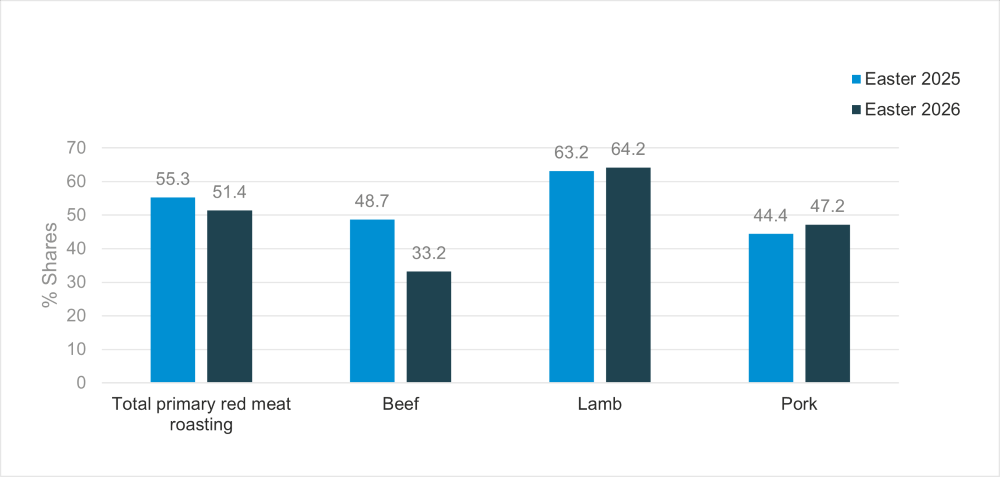
Figure 1: Primary red meat roasting joints, volume on promotion share Easter 2026 vs Easter 2025

Bar chart showing volumes of red meat sold of promotion Easter 2026

Source: Worldpanel by Numerator, 2 w/e 05 Apr 2026 vs 2 w/e 20 Apr 2025

Figure 1 compares the volume share of primary red meat roasting joints on promotion during Easter 2025 and Easter 2026. Lamb remains the highest at 64.2 in 2026 versus 63.2 in 2025. Beef has the most drastic decrease, from 48.7 in 2025, to 33.2 in 2026, whereas pork had the largest increase, from 44.4 in 2025, to 47.2 in 2026.

Strong premium pork (+11.2%) and lamb (+15.5%) volume growth signals a clear move toward ‘affordable luxury’ as shoppers prioritise high-quality centrepieces for at-home celebrations. Retailers can tap into this by providing budget-friendly roast ideas alongside premium treats.

If beef prices remain high into 2027, pork could continue gaining share as shoppers look for more affordable roasting options.

If shopper remained focused on deals, there may be an opportunity for retailers to continue pushing Easter promotions even earlier, with celebrations starting at the end of March in 2027.

Lamb holds firm through seasonal strength

Despite continued pressure on household budgets, lamb volumes increased 8.6% from last year, holding its spot as an Easter classic.

Growth was driven by:

  • Number of households buying lamb increasing 2.7%
  • Volumes per shopping trip increasing 2.6%

Lamb leg joints were some of the best-selling Easter products this year, accounting for four of the top five primary red meat roasting joints.

Promotions remained critical to performance, with 64.2% of lamb volume sold on promotion. This was focused around the Easter period. (1)

The results reinforce lamb’s continued importance during major seasonal occasions but also highlight its growing reliance on events such as Easter, Christmas and Ramadan. This means seasonal events such as Easter will remain especially important for lamb performance going into 2027.

Versatile cuts supported value-led shopping

Roasting joints weren’t the only thing shoppers were buying this Easter, with many choosing cheaper cuts that could be used across several meals.

Mince performed well across beef, lamb and pork as shoppers looked for lower-cost ways to keep red meat on the menu.

Pork mince saw the biggest growth, with volumes up 41.8% from last Easter. Pork mince continues to gain from beef due to competitive prices, but beef mince remains the household staple. (1)

This trend shows shoppers were trying to make their Easter food budget go further across the long weekend and school holidays. With 53% of households saying the cost of living is still affecting spending (2), affordable and flexible cuts became more important this Easter, and will likely remain important in following years as shoppers continue to look for ways to stretch food budgets. (1)

Butchers benefited from affordable indulgence

Butchers saw a good recovery in Easter 2026 following years of volume declines due to a significant price gap versus supermarkets.

Primary red meat volumes through the channel increased:

  • 2.5% overall
  • 6.7% for roasting joints (1)

This was largely driven by loyal shoppers buying more premium cuts. Although fewer people shopped at butchers overall, those who did made larger purchases, with volume per trip increasing from 0.90 kg to 1.13 kg and total volume per shopper rising from 1.3 kg to 1.7 kg. It seems that loyal shoppers are buying more on their trips and this is helping the recovery.

This creates an opportunity for both supermarkets and butchers to build on demand for premium at-home dining. Premium meal deals, upgraded own-label ranges and restaurant-inspired products could help shoppers recreate the eating-out experience at home, while promotions on vegetables and side dishes may encourage consumers to spend more on higher-quality meat cuts.

Outlook for Easter 2027

Easter will fall earlier in 2027, landing on 28 March. This could create further pressure on shoppers already managing a post-Christmas budget.

Many of the trends seen during Easter 2026 are likely to continue into next year, including:

  • Value-led meals
  • Strong early promotions
  • Versatile cuts for multiple meals
  • Premium-at-home celebrations
  • Clear positioning between value and premium proteins

Note – Easters are compared to equivalent Easter periods in previous years due to the event moving on an annual basis. Easter 2026 refers to the 2 w/e 5 April 2026, and Easter 2025 refers to the 2 w/e 20 April 2025.

(1) Worldpanel by Numerator, Easter 2026, 2 w/e 5 April 2026

(2) NielsenIQ, Easter 2026, 4 w/e 4 April 2026

Image of staff member Lucy Rabjohn

Lucy Rabjohn

Retail and Consumer Insight Analyst

See full bio


Sign up to receive the latest information from AHDB.


While AHDB seeks to ensure that the information contained on this webpage is accurate at the time of publication, no warranty is given in respect of the information and data provided. You are responsible for how you use the information. To the maximum extent permitted by law, AHDB accepts no liability for loss, damage or injury howsoever caused or suffered (including that caused by negligence) directly or indirectly in relation to the information or data provided in this publication.

All intellectual property rights in the information and data on this webpage belong to or are licensed by AHDB. You are authorised to use such information for your internal business purposes only and you must not provide this information to any other third parties, including further publication of the information, or for commercial gain in any way whatsoever without the prior written permission of AHDB for each third party disclosure, publication or commercial arrangement. For more information, please see our Terms of Use and Privacy Notice or contact the Director of Corporate Affairs at info@ahdb.org.uk  © Agriculture and Horticulture Development Board. All rights reserved. 

×